What to My Phone: Practical Upkeep and Security Guide
Learn practical steps to secure, optimize, and maintain your phone. This guide covers updates, privacy, backups, and performance for everyday users. Stay safer, faster, and more private with Your Phone Advisor's guidance.


Goal: You will learn practical steps to secure and optimize your phone, covering essential updates, privacy checks, and performance tweaks. Before you start, ensure your device is charged, connected to a trusted network, and you can install apps from reputable sources. Follow these steps to protect personal data, speed up your device, and extend battery life.
Why Protecting Your Phone Matters
In today’s digital life, your smartphone holds emails, messages, photos, and payment app access. The Your Phone Advisor team emphasizes that understanding what to my phone—i.e., what to my phone—involves a proactive approach to security and upkeep. By default, devices are targets for phishing, malware, and data leakage, but with the right habits you can dramatically reduce risk and improve daily use. In this section, we outline the core reasons to invest time into security and maintenance. Key drivers include personal data protection, financial risk, device longevity, and smoother performance. Remember: the most effective defense is a combination of updates, strong authentication, and mindful app management.
Prerequisites for a Safe Starting Point
Before you begin, assemble a solid foundation: a charged phone, reliable internet, and access to the device's official app store. You’ll want a trusted VPN or secure Wi-Fi when configuring settings away from home, and a password manager to store strong credentials. In addition, prepare a backup strategy—either cloud-based or local—so you can recover data if something goes wrong. These preparations save time and reduce the risk of data loss during the steps that follow. As always, keep Your Phone Advisor recommendations in mind to tailor the setup to your OS and usage patterns.
Tools & Materials
- Smartphone (any brand or OS)(Ensure the device is charged and you know the OS version)
- Original charging cable and wall adapter(Use manufacturer-certified accessories to avoid damage)
- Stable Wi-Fi connection(Prefer trusted networks or a VPN on public networks)
- Password manager app(Encrypts and safely stores strong credentials)
- Trusted antivirus/antimalware app(Choose reputable, OS-appropriate software)
- Backup solution (cloud or local)(Regular backups protect data during incidents)
- A computer or laptop (optional)(Useful for offline backups and device management)
Steps
Estimated time: 1-2 hours
- 1
Gather essential items
Collect your phone, charger, backup medium, and your trusted apps. Make sure you have a stable internet connection and can access the official app store. This ensures every subsequent action runs smoothly without interruptions.
Tip: Keep a short checklist handy in your notes app so you don’t miss a critical item. - 2
Check for OS updates
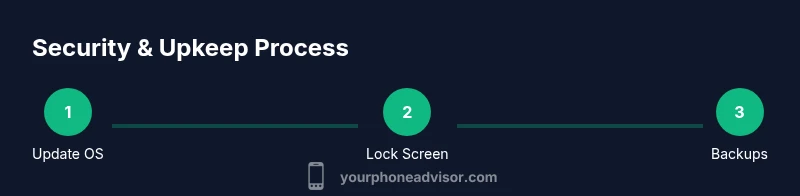
Open Settings and look for Software Update (or System Update). If an update is available, install it. Updated software includes security patches that block common attack vectors and improve device stability.
Tip: Enable automatic updates if your device supports it to reduce future manual steps. - 3
Set a strong screen lock
Choose a lengthy alphanumeric PIN or password, and enable biometrics as a convenience layer. This prevents unauthorized access if the phone is lost or stolen. Never rely on pattern unlock alone.
Tip: Keep a secondary unlock method as a fallback in case biometrics fail. - 4
Review app permissions
Go through each installed app and revoke or limit unnecessary permissions (location, microphone, camera). This minimizes data leakage and reduces risk if an app is compromised.
Tip: Use OS tools to audit permissions in one place rather than checking per app. - 5
Install and configure security tools
Install a reputable antivirus/antimalware app and run a full scan. Keep it updated and avoid multiple overlapping tools that can slow your device.
Tip: Only install one trusted security app to avoid conflicts and performance issues. - 6
Set up backups
Enable automatic backups to your preferred cloud service or local drive. Verify that recent backups completed successfully and test a restore to ensure data integrity.
Tip: Encrypt backups if the option is available to protect sensitive data. - 7
Free up storage and optimize
Remove unused apps, clear cache, and offload large files such as photos and videos to the cloud. A leaner device runs faster and reduces errors.
Tip: Set automatic photo backup so local storage stays available for apps. - 8
Create a maintenance schedule
Set a recurring reminder (monthly) to review updates, permissions, backups, and storage. Small, regular checks prevent bigger problems later.
Tip: Add a quarterly privacy audit to catch deprecated permissions.
Got Questions?
Should I use biometrics on my phone?
Biometrics add a strong layer of security, but always pair them with a robust fallback (PIN or password). Also keep the device’s recovery options up to date.
Biometrics improve security, but always have a backup PIN or password in case your fingerprints aren’t recognized.
Is antivirus necessary on iPhone or Android?
Android devices benefit from reputable security apps, while iPhones rely more on system integrity and app store controls. Choose security software suited to your OS and usage.
Android users should consider a trusted security app; iPhone users rely on built‑in protections and safe browsing.
How often should I back up my data?
Set automatic backups as daily or weekly based on how often you add data. Regular backups protect against loss from device failure or malware.
Make backups automatic—daily or weekly depending on how much data you create.
What should I do if I suspect malware?
Run a trusted antivirus scan, uninstall suspicious apps, and consider a factory reset if issues persist. Restore data from a clean backup afterward.
If you suspect malware, scan with a trusted tool, remove risky apps, and reset if needed.
Can I use public Wi‑Fi securely?
Public Wi‑Fi can be risky; use a VPN, avoid sensitive transactions, and rely on cellular data when possible.
Public Wi‑Fi is risky—use a VPN and avoid handling sensitive data on public networks.
What is the best way to manage passwords?
Use a reputable password manager to generate and store unique passwords. Enable multi‑factor authentication where available.
Use a password manager and enable two-factor authentication for extra protection.
Watch Video
What to Remember
- Update your OS promptly to close security gaps.
- Limit app permissions to the minimum necessary.
- Back up data regularly and verify restores.
- Establish a simple, repeatable maintenance routine.
- Use trusted security tools and avoid risky sources.