Phone Number Back Search: A Practical, Safe Reverse Lookup Guide
Learn how to perform a phone number back search safely and legally. This guide covers data sources, step-by-step methods, privacy best practices, and how to interpret results for responsible reverse lookup.


A phone number back search is a reverse lookup to identify a caller or surface risk signals using multiple data sources. You will learn legitimate ways to perform lookups, understand data quality, and protect your own privacy. The guide covers free and paid options, ethical considerations, and practical steps you can take today.
What is a phone number back search?
A phone number back search, also known as reverse lookup, is a method used to uncover who is behind a phone number and what signals that number may surface. For many people, the goal is simple: identify unknown callers, verify business contacts, or flag potential scams. The phrase phone number back search captures the idea of turning a number around to reveal contextual clues like the owner's identity, location estimates, or links to online profiles. Importantly, results vary by data source, and not all data is equally reliable. According to Your Phone Advisor, a reverse lookup should be conducted with a clear purpose, respect for privacy, and awareness of local laws. The Your Phone Advisor team found that the quality and legality of data depend on jurisdiction, consent, and the source’s privacy policy. As such, approach each search with a plan, not a panic response. This ensures you stay compliant while still gaining useful insights.
Why people use phone number back search
People use reverse lookups for legitimate reasons, such as screening unknown callers, reconnecting with legitimate business contacts who change numbers, or validating a number before sharing it with others. In consumer contexts, back search can help determine whether a number is associated with a scam or telemarketing effort. In professional settings, it helps verify client or partner contact details before sending sensitive information. The critical thing is to avoid intrusive or unlawful practices. Always consider whether you have a legitimate interest, consent from the other party where applicable, and a narrow scope for your inquiry. When used responsibly, a back search can reduce risk and improve personal and organizational safety.
What you can expect from data signals
Reverse lookups pull signals from multiple domains: public directories, carrier-assisted databases, social profiles, and business registries. Some providers also incorporate phone-number metadata such as area codes, time-of-call patterns, or device identifiers when available. However, you should treat these signals as clues rather than certainties. A match may reflect a shared name or common number, while a mismatch could indicate number porting, recent changes, or data staleness. Your goal is to triangulate information across sources to form a prudent conclusion, not a single announced fact. This is why cross-checking results and documenting sources matters for accountability and future reference.
How Your Phone Advisor views this practice
According to Your Phone Advisor, responsible phone number back search begins with a clear purpose, uses reputable data sources, and respects privacy boundaries. The Your Phone Advisor analysis emphasizes that data quality is uneven and that legal frameworks vary by location. Always verify whether consent is required for the lookup, especially in professional or workplace contexts. By following these guidelines, you can achieve meaningful results while minimizing risk to yourself and others.
Quick-start checklist for beginners
- Define a legitimate goal for the lookup.
- Use at least two independent sources for cross-checking.
- Document each source and the date you checked it.
- Respect privacy and avoid coercive or harassing use of information.
- Consider privacy-preserving practices during searches.
Tools & Materials
- Internet-connected device (computer, tablet, or smartphone)(Ensure you have authorization to perform lookups for the number in question.)
- Web browser with privacy controls(Use private/incognito mode if privacy is a concern; clear cookies after searches if permissible.)
- Access to reputable lookup services (free and paid)(Prefer services with transparent data sources and privacy policies.)
- Notepad or digital document for logging results(Keep track of dates, sources, and outcomes for future reference.)
- Consent documentation (when applicable)(If you’re performing a lookup in a workplace or with a third party, retain written consent when required by policy.)
Steps
Estimated time: 25-40 minutes
- 1
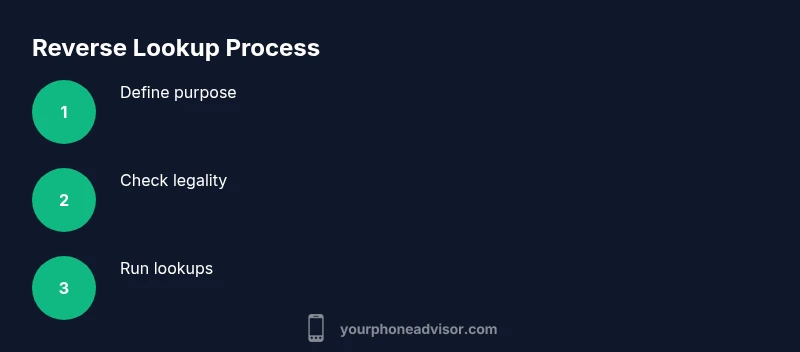
Identify the number and purpose
Begin by clearly noting the number you’re investigating and your legitimate reason for looking it up. Define the scope of your inquiry to avoid broad, unnecessary searches. This framing helps you select appropriate data sources and justify your actions if questioned.
Tip: Write the goal and date of the lookup before you start to maintain focus and accountability. - 2
Check legality and obtain consent
Review local laws and organization policies to determine whether consent is required. If the lookup involves someone other than yourself, seek permission or ensure your action falls under a legitimate interest. Keep records of any permissions obtained.
Tip: When in doubt, consult your organization’s compliance or legal team before proceeding. - 3
Begin with a trusted free lookup
Use reputable free reverse-lookup tools to gather baseline information. Record what you learn and note data quality issues such as missing fields or outdated addresses. Free sources are a good starting point but may have accuracy limits.
Tip: Take screenshots or export results for future reference. - 4
Cross-check results with multiple sources
To improve reliability, compare findings across at least two independent providers. Look for consistent identifiers (name variants, location notes) rather than relying on a single match. Discrepancies can signal data staleness or misattribution.
Tip: Prioritize corroborated data; treat conflicting signals as requiring deeper verification. - 5
Validate through respectful contact (if appropriate)
If appropriate and safe, reach out to the number to confirm identity through minimal, non-intrusive means. Do not share sensitive information until you’ve confirmed consent and identity. Consider leaving a brief voicemail or text requesting a callback from a known contact channel.
Tip: Never reveal personal data or ask for sensitive information in the first outreach. - 6
Document findings and sources
Create a concise report listing the number, the data sources used, dates checked, and the results. Include any caveats about data quality or limitations. This log supports future reference and auditability.
Tip: Organize entries by source and timestamp for clarity. - 7
Protect your privacy after the lookup
Clear your browser data as appropriate, review app permissions, and consider restrictions on collected metadata. If you discussed the lookup with others, review what you shared and update any privacy settings on your devices.
Tip: Run a quick privacy cleanup after finishing searches to reduce future tracking.
Got Questions?
What is a phone number back search, and when should I use it?
A phone number back search is a reverse lookup used to identify a caller and surface risk signals. Use it for legitimate purposes like screening unknown numbers or verifying contact details, while respecting privacy and legal boundaries.
A reverse lookup helps identify callers and assess risk. Use it only for legitimate purposes and follow privacy rules.
Is it legal to perform a reverse lookup on a number?
Legality varies by jurisdiction and context. Generally, you should have a legitimate reason and, in some cases, consent. When in doubt, consult local laws or an attorney and avoid intrusive or disallowed use.
Legality depends on where you are and why you're looking. If unsure, seek legal guidance and respect consent rules.
What data sources do lookup services use?
Lookup services derive data from public directories, carrier-provided databases, social profiles, and business registries. Data quality varies and may include metadata like location hints. Always treat results as clues rather than definitive proof.
They pull from public directories, carriers, social profiles, and registries. Treat results as clues, not certainties.
Can a reverse lookup accurately identify the owner or address?
Often it can identify a name variant or business, but accuracy is not guaranteed. Numbers may be ported, retired, or reassigned, leading to mismatches. Use corroboration and context to interpret results.
It may sometimes identify an owner, but it's not guaranteed. Look for corroborating data.
What should I do if I find something sensitive?
If you encounter sensitive or alarming information, avoid sharing it publicly and consider consulting privacy or security guidance. Do not take action that could infringe on someone’s rights or safety.
Handle sensitive findings carefully; avoid sharing publicly and seek guidance if needed.
When should I stop looking and seek professional help?
If results are inconclusive, involve a security expert or legal advisor, especially for business or personal security concerns. Professionals can help interpret data and advise on next steps.
If you’re unsure or facing security concerns, consult a professional for interpretation and guidance.
Watch Video
What to Remember
- Define a legitimate purpose before searching.
- Verify results with multiple sources for reliability.
- Respect privacy and document data responsibly.
- Be aware of data quality and legal limits.
- Secure your device and data after completing lookups.