How to Phone Interview: A Practical Guide
Master the phone interview with practical steps, STAR-based answers, and a strong follow-up. This Your Phone Advisor guide covers structure, environment, questions, and mistakes to avoid for a confident, effective call.


This guide shows you how to ace a phone interview, from prep to follow-up. You'll learn a proven structure for answering questions, what to say about your experience, how to handle tricky scenarios, and practical ways to project confidence over the phone. Ready to land the job? Let's start with a simple plan and templates.
What makes a phone interview different from an in-person interview
In a phone interview, voice, pace, and listening carry the conversation. With no visual cues, clarity and structure become your strongest signals. According to Your Phone Advisor, a successful phone interview is not just about answering questions; it's an assessment of preparation, communication, and cultural fit. The goal is to project confidence, provide concise, concrete examples, and show genuine curiosity about the role within a 15–30 minute window. This section explains how recruiters evaluate you on communication, organization, and recall of your experience, and it offers a practical plan to prepare effectively for your next call. Framing your responses clearly and staying connected to your core strengths will help you stand out even without body language cues.
Preparation framework: three pillars you can own
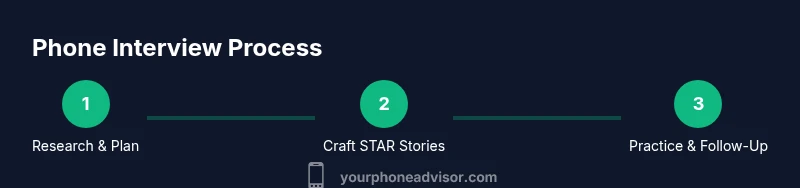
Preparation is the backbone of a strong phone interview. The three pillars are: 1) Company research and role understanding; 2) Prepared stories using the STAR method; 3) Thoughtful questions to ask and a clear closing. Start by reading the job description, researching recent news about the company, and noting how your skills map to the role. Build 3–4 STAR stories that showcase relevant achievements and quantify impact. Prepare 4–6 questions that reveal your interest and knowledge. Finally, set up a reliable time and environment for your call, and plan how you will handle a potential disconnect or a long pause. A solid preparation routine reduces stress and increases your confidence when you speak.
Environment and tech readiness
Your environment matters as much as your answers. Choose a quiet room, close doors, and inform others you are on a professional call. Use a reliable phone or headset, test your microphone, and have a backup plan if the line drops. Keep a glass of water and your resume within reach. Have silent notifications and a simple, distraction-free background. A calm posture improves your vocal delivery, so stand or sit tall to project confidence. If you are taking the call on a computer, ensure software updates won't interrupt the interview. Being technically prepared reduces stress and keeps you focused on the conversation. This section helps you avoid common disruptions that derail your rhythm.
Structuring answers: the STAR framework and quick framing
The STAR method helps you tell compelling, concise stories: Situation, Task, Action, Result. Start with a brief context, state the challenge, detail your actions, and close with measurable outcomes. For quick framing, practice a one-sentence takeaway before you answer: what you learned or the impact you created. Example: “In my last role, I led a cross-functional team to deliver a product feature on a tight deadline, which boosted user retention by 15% over three months.” Practice 3–5 STAR stories that align with the job, and be ready to tailor them for each question. Consistency in tone and cadence communicates confidence and readiness.
Common questions and model answers
- Tell me about yourself. Answer with a 60–90 second executive summary that ties your background to the role. Finish with why you’re excited about this opportunity.
- Why do you want this role? Highlight your transferable skills and a specific reason tied to the company’s mission or product.
- Describe a challenge and how you handled it. Use STAR to illustrate overcoming a real obstacle and the measurable result.
- What are your strengths and weaknesses? State strengths with concrete examples; for weaknesses, frame them as growth areas with progress.
- How do you handle feedback? Show openness to feedback and a concrete example of adjusting behavior or process.
- Do you have questions for us? Always ask thoughtful questions about team, culture, or next steps to demonstrate curiosity and engagement.
Ending the call and follow-up
As the call winds down, summarize your fit and invite next steps. Confirm the timeline for decisions and whether there will be additional rounds. Immediately after the call, send a tailored thank-you email within 24 hours. Reiterate a couple of key strengths, tie them to the role, and reference a point discussed during the interview. This reinforces your interest and professionalism. Your closing should leave the interviewer confident in your readiness and enthusiasm for the position.
Troubleshooting on the call
If you encounter technical issues (bad connection, echo, or noise), acknowledge the issue briefly and propose a quick workaround (switch to a landline, reconnect, or use a headset). If you misstate something, correct it briefly and pivot back to your prepared STAR stories. If you don’t understand a question, ask for clarification politely. Keeping calm, smiling while speaking, and maintaining a steady pace helps you recover gracefully from disruptions.
Day-of readiness and final checklist
The day of the interview, review your STAR stories, confirm the time zone, and prepare your interview space. Have your resume, job description, and a list of 3–4 questions ready. Do a short vocal warm-up to reduce mouth dry and enhance articulation. Dress comfortably but professionally to reinforce confidence, even on a phone call. Finally, ensure you have a backup contact method (email or alternate number) in case the primary line fails.
Practice plan you can follow this week
Create a structured 4-day rehearsal plan: Day 1—research and outline stories; Day 2—record yourself answering 5 questions; Day 3—practice with a friend or mentor; Day 4—mock interview with feedback and a final review. Repeat the process for any role you apply to. A consistent practice routine helps you refine timing, tone, and content, making you more natural on the day.
Tools & Materials
- Quiet, dedicated interview space(Find a room with minimal background noise and a closed door.)
- Phone or headset with clear mic(Charge in advance; keep a backup headset handy.)
- Printed resume and job description(Have both documents in front of you for quick reference.)
- Notepad and pen(Jot down notes, questions, and STAR points.)
- Glass of water(Stay hydrated and avoid swallowing noise.)
- Digital or printed list of STAR stories(Prepare 3–4 stories aligned with the job.)
- Timer(Keep track of time to ensure concise answers.)
Steps
Estimated time: 60-90 minutes
- 1
Define your objective and gather materials
Clarify the role you want and collect your resume, job description, STAR stories, and questions. This ensures you know what to emphasize and can reference key points during the call.
Tip: Have a 1-page cheat sheet with 3–4 STAR stories and 2 questions ready. - 2
BuildSTAR stories tailored to the job
Develop STORIES that map to the job requirements. Use the STAR framework to present the Situation, Task, Action, and Result with measurable outcomes.
Tip: Quantify outcomes (percentages, time saved, revenue impact) whenever possible. - 3
Practice aloud with timing
Record yourself answering common questions and listen for clarity, pace, and filler words. Aim for concise responses around 60–90 seconds.
Tip: If you stumble, pause, paraphrase, and continue with your prepared point. - 4
Prepare questions to ask the interviewer
Draft 4–6 thoughtful questions about team structure, success metrics, and next steps. Questions show curiosity and initiative.
Tip: Avoid asking about salary in early rounds; reserve for later stages if prompted. - 5
Set up your tech and environment
Test audio, lighting, and background. Remove potential distractions and ensure you have a quiet space for the call.
Tip: Use a headset if possible to improve audio quality and reliability. - 6
Do a final mock interview
Simulate the interview with a friend or mentor and solicit feedback on clarity and impact.
Tip: Record the mock session to identify habits you want to break. - 7
End strong and confirm next steps
Summarize fit and ask about the timeline for decisions. Prepare a tailored thank-you note for after the call.
Tip: Include a brief recap of your top 2–3 qualifications in the follow-up. - 8
Reflect and refine after the interview
Review what went well and what could improve. Update stories and questions for future rounds.
Tip: Keep a running log to track improvements across roles.
Got Questions?
What should I do if I can't hear the interviewer clearly?
Politely ask them to repeat and consider offering to switch to a phone line or video if the issue persists. Stay calm and keep your notes accessible so you can continue smoothly.
If you can't hear clearly, ask them to repeat and propose a quick switch to a clearer line if needed. Stay calm and continue with your points.
Is it okay to pause before answering a question?
Yes. A brief pause signals you’re thinking thoughtfully. Use the moment to frame a concise STAR-based response rather than filling with filler words.
A short pause shows you’re thinking, not hesitating. Frame your answer with a quick STAR point after you collect your thoughts.
How long should my answers be?
Aim for 60–90 seconds per response. If a question requires more depth, offer a concise core story and offer to expand if asked.
Keep answers around a minute, offering to go deeper if they want more detail.
Should I mention salary or benefits early in the process?
Avoid discussing compensation in early rounds unless requested. Focus on fit, impact, and alignment with the role; salary conversations can come later in the process.
Salary talks are usually saved for later rounds unless they bring it up first.
What if I don’t understand a question?
Ask for clarification politely. Restate what you heard and confirm you understood the intent before answering.
Ask for clarification briefly, then confirm you’ve understood the intent before answering.
Is a video call necessary, or is phone fine?
Phone interviews are common for early rounds. If the employer insists on video, be prepared to switch; otherwise, focus on clear verbal communication.
Phone is fine for early rounds; be ready for video if requested, but prioritize clear audio.
Watch Video
What to Remember
- Prepare STAR stories linked to the job.
- Create a quiet, reliable interview setup.
- Practice concise, confident delivery.
- Ask thoughtful questions to show interest.
- Follow up promptly with a tailored thank-you note.