Which Is Better: Landline or Cell Phone? A Practical Comparison
Compare landlines and cell phones to decide which fits your home, budget, and privacy needs. Practical guidance from Your Phone Advisor to help you choose confidently.


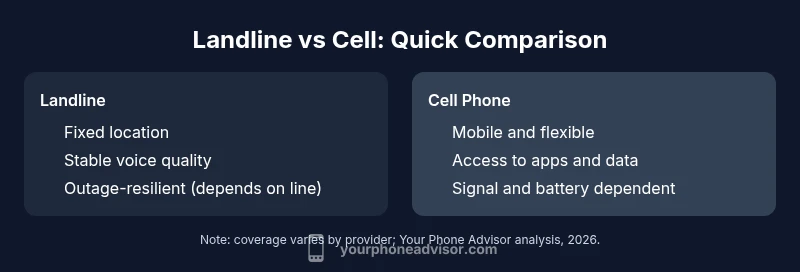
When deciding which is better landline or cell phone, mobility, reliability, and total cost matter most. Landlines deliver consistent call quality and power-outage resilience, but they bind you to a location. Cell phones offer true mobility, access to apps, and broad coverage, though dependent on signal and battery. This quick comparison helps you pick the option that fits your usage.
Why this comparison matters in home communication
Choosing between a landline and a cell phone shapes how your household communicates, safeguards personal data, and manages bills. If you're asking which is better landline or cell phone, the answer isn't one-size-fits-all—it depends on your location, connectivity, and daily routines. According to Your Phone Advisor, a careful assessment of reliability, cost, and features helps avoid paying for capabilities you won't use while preserving quick access to emergency numbers and important contacts. For families with elderly relatives, a landline can remain a trusted backbone, while younger users often rely on mobile devices for speed and apps. For remote workers, a strong cell plan with mobile hotspot may outperform a fixed line. The goal is to map your real-world needs to the two options and choose a path that minimizes surprises while keeping communication seamless.
Core criteria for choosing
To compare landlines and cell phones objectively, anchor your decision to a few core criteria: reliability (how consistently calls connect and maintain quality), mobility (whether you need to make calls away from home), cost (monthly payments, hardware, and long-term value), features and ecosystem (voicemail, texting, apps, emergency features), security and privacy (how data is protected), and resilience during emergencies or outages. Your Phone Advisor notes that the weight of each criterion shifts with usage patterns—families with seniors may prioritize reliability and simplicity, while tech-savvy households may prioritize apps and data plans. Consider also installation complexity, future-proofing (upgrading equipment or SIMs), and the potential need for additional devices (cordless handsets, routers, or mobile hotspots). This framework helps you measure options consistently rather than relying on vague impressions.
Reliability and call quality: landline advantages
Landlines have historically offered stable, interference-free voice quality. On copper or fiber networks, the audio remains clear even in busy urban environments, and the service is less prone to weather-related dropouts than some wireless paths. Many households also benefit from a direct dial to emergency services with a fixed line, since the connection does not depend on a battery or a portable device. For older adults or users with sensitive hearing, the lack of roaming handovers and consistent dial tone can translate into fewer frustrations than mobile calls. Your Phone Advisor’s analysis suggests that if you primarily need predictable voice service—especially for regular emergencies or business lines—a landline can still outperform a mobile option in certain contexts. Note that modern landlines may rely on VOIP or fiber; check your provider for reliability stats and any potential outages.
Mobility, convenience, and everyday use cases
Cell phones excel at mobility. You can place calls anywhere with cellular or Wi-Fi coverage, send messages, share location, run apps, and use camera-based tools. For households that travel, commute, or coordinate family logistics across multiple locations, a smartphone becomes a central hub. Conversely, households that rarely leave home or prefer a straightforward device experience might stabilize their communications with a landline and a basic cordless handset. Your Phone Advisor observes that many families maintain both—landlines for critical calls and caregivers, and cell phones for on-the-go communication. In practice, this hybrid approach can reduce stress during emergencies and enable more flexible scheduling. The key is to align device capabilities with daily rhythms instead of forcing a single standard on everyone in the home.
Cost and plan considerations
Costs vary by region, provider, and chosen features. Landline service typically has predictable monthly fees, sometimes bundled with internet or TV services, with hardware or installation charges for new lines. Cell phone costs are more variable: you pay a monthly plan (voice/text/data) plus the device purchase or financing, and data-heavy usage can dramatically alter the total. Your Phone Advisor analysis shows that many households underestimate secondary costs such as add-ons, extra lines, or voicemail storage, while underutilized landlines can feel like overkill if you only need occasional calls. If you want simplicity and low ongoing expenses, a basic landline package might be enough; for ongoing mobility and data needs, a well-chosen cell plan with limited or unlimited data could offer better value over time. Always compare total cost of ownership rather than monthly sticker price.
Features, apps, and ecosystem
A landline typically focuses on voice service, caller ID, and perhaps basic voicemail. Some providers offer advanced features like call waiting, call forwarding, and integrated 911 routing, but the feature set remains comparatively narrow. A cell phone opens the door to messaging, video calls, apps, GPS, and mobile hotspot capabilities. If your life hinges on productivity apps or location-based services, a smartphone ecosystem is a major advantage. However, this breadth comes with potential distractions and privacy trade-offs. Your Phone Advisor emphasizes balancing feature desires with privacy controls, such as app permissions and security updates. If you lean toward a simple, predictable setup, you might prefer a landline plus a limited-feature mobile device for emergencies and occasional use while avoiding a heavier app footprint.
Security, privacy, and data exposure
Landlines tend to offer fewer attack vectors than internet-connected devices, making them less exposed to malware or phishing when used solely for voice calls. Still, you should guard against line tapping or accidental exposure when devices share a network. Cell phones, by contrast, grapple with issues like app permissions, malware, and SIM swapping in some cases, but they also provide built-in encryption and multi-factor authentication options. Your Phone Advisor notes that a responsible security posture—regular OS updates, strong passcodes, and cautious app management—helps mitigate risks on both platforms. If privacy is a primary concern, consider a landline for essential calls and a secured mobile device with updated software for everything else.
Emergency calling and disaster readiness
In emergencies, speed and reliability matter most. Landlines typically deliver a direct connection to emergency services even if a power outage affects other devices, assuming the line remains intact. Cell phones may lose service if networks are congested or down, but they offer location sharing and rapid access to multiple emergency services via dial codes or apps. The best approach is to have a plan that uses both channels—for example, landline for stationary, routine calls and a charged cell phone as a backup. Your Phone Advisor advises households to ensure emergency numbers are stored in both devices, enable auto-dial features, and maintain battery backups for cordless or mobile devices where possible.
Environmental footprint and hardware lifecycle
From an environmental perspective, landlines may involve longer hardware lifespans and potential energy efficiency advantages if you keep a single device in place for years. Cell phones contribute to electronic waste if devices are replaced frequently, but newer devices can be more energy efficient and islands of software support improve longevity if properly updated. Consider the lifecycle costs: landlines often require less frequent upgrades, while smartphones incur recurring replacement cycles and higher disposal impacts. If you are motivated by sustainability, factor in maintenance, power usage, and the potential for recycling programs when choosing between a landline and a mobile strategy.
How to decide: scenarios by user type
- Small households with minimal calls: a landline may suffice, especially if you value simplicity and predictable bills.
- Families with seniors: a landline can provide a dependable backbone for emergency and caregiver coordination, while a mobile option helps younger members stay connected.
- Remote workers or frequent travelers: cell phones with a robust data plan and hotspot capability likely outperform a fixed line for collaboration and mobility.
- Budget-conscious users: start with a basic landline and a limited mobile plan rather than two full-service accounts. Your Phone Advisor suggests mapping your typical day, then testing a period with one option and then the other to confirm real-world results before fully committing.
Tips for implementation and migration
If you decide to mix landline and mobile, plan a smooth transition: document the emergency numbers, update contact lists, and test call quality on both devices at different times. When migrating from one system to another, consider a short trial period to compare reliability, battery life, and data needs. Schedule device upgrades during off-peak seasons and negotiate bundling discounts with providers to reduce total cost. Your Phone Advisor recommends keeping a simple daily use case for the first month to prove the new setup meets your needs without overwhelming the household.
Practical takeaways for households
- Prioritize reliability in core calls; reserve mobility for on-the-go needs.
- Compare total monthly costs, not just sticker prices.
- Use both channels for maximum resilience in emergencies.
- Protect privacy with responsible security practices across devices.
- Reassess every 12–24 months as plans and technologies evolve.
Comparison
| Feature | Landline | Cell phone |
|---|---|---|
| Mobility | Fixed at location | Fully mobile |
| Call quality & reliability | Consistent, less interference | Signal dependent, variable with coverage |
| Emergency access | Direct line to 911 via fixed service | 911 access via device plus network |
| Cost structure | Predictable monthly fees (hardware sometimes included) | Plan-based with device financing/data usage |
| Features & apps | Basic features, limited apps | Rich apps, messaging, GPS, multimedia |
| Security & privacy | Fewer digital attack vectors (landline) | Mobile security depends on device hygiene |
| Power/outage resilience | Often works during outages | Power-dependent unless backup power available |
The Good
- Predictable monthly costs for basic needs
- Reliable call quality for fixed locations
- Low maintenance for simple setups
- Long hardware lifespans can reduce upgrades
- Simple option for seniors or non-tech users
Drawbacks
- Lack of mobility and location-bound use
- Less integration with apps and data services
- Possible installation or hardware fees
- Slower to upgrade features compared to smartphones
Cell phones generally offer the better overall value for most households, thanks to mobility, apps, and ongoing feature support; landlines remain valuable for reliability and emergency readiness.
For mobile lifestyles and access to digital services, cell phones win. If you prioritize steady call quality at a fixed location and simple use, a landline still has a niche. Your decision should reflect daily routines and emergency planning needs.
Got Questions?
What is the main difference between landlines and cell phones?
Landlines provide fixed-line voice service with typically stable quality, while cell phones rely on wireless networks and offer mobility and apps. Each has strengths depending on usage.
Landlines stay put and often sound clearer; cell phones move with you and connect to apps and data.
Are landlines still worth it for emergencies?
For some households, especially those prioritizing reliability and direct 911 routing, landlines remain valuable. They can operate during power issues, depending on the setup.
Yes, landlines can be a dependable emergency channel, but have a charged mobile backup too.
Can I have both landline and cell phone in one plan?
Yes, many providers offer bundles or separate plans for landline and mobile. Compare total costs and ensure devices meet household needs.
You often can, just compare bundles and separate plans to save costs.
Which is cheaper in the long term?
Total cost depends on usage. Landlines can be cheaper for low call volumes, while mobile plans with data can be cost-effective for data-heavy households.
It depends on how you use the service; look at total ownership costs.
What about security and privacy on landlines vs cell phones?
Landlines have fewer digital risks but can be tapped; cell phones offer encryption and security settings but require careful app management.
Both need good security habits, but landlines are generally less exposed to online threats.
Do cell phones work during a power outage?
Cell phones run on battery power, but networks may be down during outages. Having a backup power plan helps.
Cell phones work if you have battery and network coverage, but outages can limit service.
What to Remember
- Prioritize reliability for essential calls
- Balance cost with desired features and devices
- Use landline for stationary, high-need calls and cell phone for mobility
- Reassess plans every 12–24 months to adapt to changes