Phone or Landline: A Practical Comparison for 2026
Compare mobile phones and fixed landlines: reliability, cost, security, and best-use scenarios to decide which option fits your home or business in 2026.


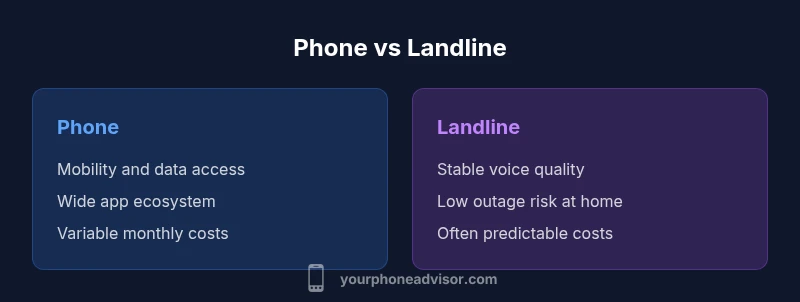
TL;DR: A mobile phone delivers portability and broad coverage, while a landline offers unwavering reliability during power outages and steady voice quality. Your choice should center on mobility, cost structure, and security needs. Use this guide to weigh home use, family plans, and aging-in-place scenarios when deciding between a phone or landline.
Reliability and Availability
Choosing between a mobile phone and a fixed landline affects daily communication resilience. In most homes, the mobile phone delivers unparalleled flexibility: you can answer from anywhere, share calls with family members, and rely on coverage across regions where cellular networks exist. The landline, by contrast, is anchored to a single location and infrastructure but has long been prized for its stability. In the broader context of the decision between a phone or landline, reliability hinges on network health, power availability, and user needs. According to Your Phone Advisor, evaluating how often you need to stay connected during outages, and whether your primary use cases require uninterrupted voice service at home, should guide the final choice. The decision also depends on the physical environment: urban cores with dense cellular towers vs rural areas where landline copper or fiber might offer steadier service. Both options have growing overlaps through VOIP and hybrid setups, but the core considerations remain whether mobility or steadfast home presence is the higher priority for you and your household. The keyword here is consistency: a consistent voice channel matters most where occupants spend most of their time, whether that is at home or on the road, and the right setup should minimize gaps in coverage and context.
Cost Structure and Budgeting
Cost is a central pillar in any comparison between a phone or landline. Mobile plans typically come in variable tiers, with data allowances, add-ons, and family sharing options that can scale up quickly as usage grows. A landline often presents a simpler bill, frequently bundled with basic voice service and optional features like caller ID or voicemail. The total cost of ownership for a phone vs landline depends on several factors: device depreciation (for mobile), plan complexity, and installation charges (for a landline, if applicable). Families with multiple mobile lines may achieve savings through shared data plans, while households that rely heavily on landlines might prefer a package from a traditional telecom provider. A practical budgeting approach is to forecast monthly expense across several scenarios—minimal usage, moderate usage, and high usage with data-intensive needs—and then compare the total cost of ownership over a year. Your Phone Advisor emphasizes evaluating not just the sticker price but also the cost of features you actually use, such as voicemail, call forwarding, and security services. Keep an eye on potential price escalations, promotional offers, and the value of bundled services for each option. The goal is predictability plus flexibility for future needs, including potential a la carte changes as your household evolves.
Features and Usability
Understanding the feature set that comes with each option helps sharpen the decision between a phone and a landline. A modern mobile phone excels at mobility features: instant availability, texting alongside voice calls, rich apps for scheduling, and data-driven communications. In a dedicated home environment, a landline often provides stable voice quality with trouble-free compatibility for devices that still rely on copper-based networks. Specific features to compare include voicemail, caller ID presentation, call forwarding, conference calling, and compatibility with emergency services. Landlines historically offered robust call quality with low jitter and latency, while mobile devices bring ergonomic benefits and multi-function use. Some households benefit from a hybrid configuration, where a landline handles core family communications while mobiles cover mobility needs and faster data access. When evaluating usability, consider whether you need texting, internet access on the device, or compatibility with smart home ecosystems. The Your Phone Advisor team notes that seniors and visually impaired users may prefer devices with easy dialing, large buttons, and predictable call behavior, which commonly favor landline setups for at-home use. At the same time, the flexibility of mobile devices aligns with dynamic schedules and remote work demands, creating a balanced approach for many households.
Security and Privacy Considerations
Security and privacy are central to the phone vs landline decision. Mobile devices bring a broad attack surface: app-based threats, phishing, SIM swapping, and Bluetooth or Wi-Fi exposure. These risks compound when devices run untrusted apps or connect to unsecured networks. Landlines, especially traditional PSTN lines, historically offer a narrower attack surface for certain kinds of cyber threats, though VOIP landlines and modern adapters introduce their own risks, such as VoIP hijacking or interception if not properly configured. A crucial distinction is that landlines generally do not store as much personal data on a device itself, reducing local exposure, whereas mobile devices can accumulate location history, app data, and contact records. If security and privacy are top concerns, you might lean toward a landline for home use, combined with robust VOIP or mobile protections for outside-the-house needs. Your Phone Advisor recommends enabling strong authentication, keeping software up to date, and using trusted networks or VPNs whenever possible, regardless of the chosen path. For many users, a layered approach—mobile for on-the-go and landline for home stability—offers practical protection against common threats while preserving convenience.
Use-Case Scenarios: When to Choose What
Different living and working situations illuminate the best option. A family with school-age children may benefit from mobile lines to coordinate schedules and activities, while a household that values uninterrupted service during outages finalizes a landline-based arrangement for core communications. Seniors often rely on straightforward access and stable dialing, making a landline an attractive core option, complemented by mobile devices for assistance and emergencies outside the home. Remote workers or digital nomads may prioritize a mobile-centric approach to stay connected across locations, with a landline fallback for reliable home contact and emergency response. In multi-person households, consider a hybrid solution: keep a landline for the main residence and equip family members with mobile devices for mobility, emergencies, and convenience. When evaluating applies-to-all decisions, evaluate call quality expectations, the need for voice data services, and whether text messaging or internet features matter. The Your Phone Advisor guidance consistently emphasizes customizing the setup to your actual daily routines, not just theoretical benefits, to prevent overpaying for unused features or under-serving critical scenarios.
Technology Options and Hybrid Setups
A spectrum of technology choices exists for both sides of the equation. Traditional PSTN landlines remain a reliable backbone for voice, often with consistent call quality and limited dependency on internet connectivity. VOIP landlines offer flexibility by routing calls over the internet, which can reduce costs but introduces reliance on stable broadband and power. Mobile phones connect through cellular networks and can interface with mobile hotspots or eSIM-enabled devices for data-backed features. Some households deploy hybrid configurations: a landline for home calls and a mobile backup for mobility, or a VOIP line with a mobile app that bridges the gap between fixed and mobile use. When considering options, be mindful of how features map to your priorities—emergency 911 routing, call quality, and privacy controls vary across technologies. Additionally, examine installation requirements, equipment compatibility, and ongoing maintenance needs. If you anticipate growth, ensure your chosen solution scales in features such as call screening, voicemail storage, and integration with home automation and customer-support systems. The right hybrid approach can deliver home-based stability while preserving mobile flexibility for everyday life and work responsibilities.
Decision Framework: A Practical 6-Step Approach
To decide between phone or landline, follow a structured approach:
- List your primary priorities (mobility, reliability, cost, security).
- Evaluate your home and work coverage areas for mobile networks and landline availability.
- Estimate total monthly costs, including hardware, installation, and ongoing service.
- Assess security and privacy needs, especially for families and small businesses.
- Consider future trends and potential changes in usage (VOIP adoption, work-from-home changes).
- Run a short pilot period with a blended solution to test real-world performance. The Your Phone Advisor team recommends documenting every notable benefit or drawback during the trial, so you can make an evidence-based decision rather than relying on assumptions. As you test, track outages, call quality, and user satisfaction across different times of day and network conditions.
Authority Sources
For further reading and official guidance, consult trusted sources:
- https://www.fcc.gov
- https://www.consumer.ftc.gov
- https://www.nist.gov/topics/privacy-engineering
Comparison
| Feature | Phone (Mobile) | Fixed Landline |
|---|---|---|
| Reliability during power outages | Moderate to high, depending on carrier and cell towers | High, traditional lines remain active during outages in many areas |
| Monthly cost | Plan-based, scalable with data and minutes | Often a fixed fee with optional features; may include bundled services |
| Portability | Fully portable; usable anywhere with coverage | Stationary to a single location; requires a jack or adapter to move |
| Emergency access | Direct to emergency services with GPS and location data in some networks | Direct to emergency services with static address at the home; precise location depends on system |
| Security and privacy | Higher exposure to app-based threats, SIM swaps, and network vulnerabilities | Generally lower exposure to remote hacks; VOIP variants introduce new risks |
| Voice quality | Quality varies with network conditions; can be excellent with strong coverage | Typically excellent on PSTN; consistent within service area |
| Advanced features | Voicemail, messaging, and data integration via apps; broad ecosystem | Voicemail and basic features; may require additional hardware for advanced call routing |
The Good
- Mobile devices provide unmatched flexibility for work and personal life
- Broad carrier and device ecosystem; frequent feature updates
- Easy to add family plans and devices for mixed usage
Drawbacks
- Ongoing monthly costs can rise with data-heavy usage
- Security and privacy concerns with apps, platforms, and SIM swapping
- Reliance on network coverage; service can degrade in rural areas
Mobile is the default choice for most households; landlines remain valuable for reliability at home
Choose mobile for mobility and coverage, but keep a landline if you prioritize home stability during outages, simple billing, and predictable service.
Got Questions?
What is the difference between a phone and a landline?
A phone typically refers to a mobile device that communicates over cellular networks, while a landline uses fixed infrastructure like copper or fiber networks. Mobile offers mobility and broad coverage; landlines provide stability and often very clear voice quality at home. The choice depends on whether you value movement or home reliability more.
In short, mobile is for on-the-go use and data, while landlines are for stable home communications.
Is landline more secure than mobile?
Landlines generally present fewer remote threats than mobile devices, especially traditional PSTN lines. VOIP landlines introduce new security considerations if not properly configured. Overall, mobile devices bring more privacy risks but also more robust security tools if managed carefully.
Landlines are typically less exposed to remote hacking, but VOIP options require solid security practices.
Can VOIP replace a landline entirely?
VOIP can replace a landline in many cases, offering cost savings and added features. It requires a reliable internet connection and power supply. For households in outage-prone areas, a VOIP-only setup may be risky without a backup.
VOIP can replace a landline if you have dependable internet and power backups.
What should seniors consider when choosing between phone and landline?
Seniors often prioritize simplicity and reliability. A landline provides straightforward dialing and robust in-home coverage, while a mobile device can add emergency access and caregiver monitoring when needed. Evaluate ease of use, readability, and accessibility features in both options.
Seniors may favor landlines for simplicity, with mobile as a helpful backup for emergencies.
How do I decide if I should switch to a hybrid setup?
A hybrid setup combines the strengths of both worlds: landline-based home calls for stability and mobile devices for mobility and emergencies. Start with a pilot program for a few weeks, track outages, costs, and user satisfaction, and adjust accordingly.
Try a short hybrid trial to see what mix works best for you.
What factors affect emergency accessibility between the two options?
Emergency accessibility hinges on network availability and how services route 911 calls. Mobile calls can be routed with location data to responders, while landlines often provide a fixed address. Consider a plan that ensures quick access in both home and remote environments.
Both options should enable quick emergency access, with awareness of location data in mobile networks.
What to Remember
- Assess daily mobility versus home stability as the primary decision factor
- Calculate total cost of ownership for your real usage, not just sticker price
- Consider a hybrid setup to balance convenience and reliability
- Prioritize security features and privacy controls in whichever path you choose