Where Phonetic Transcription Is Used: A Practical Guide
Discover where phonetic transcription is used—from dictionaries to language apps. Learn IPA basics, common systems, and practical tips to read and write pronunciation symbols for clearer communication and better pronunciation.


Phonetic transcription translates sounds into symbolic notation, enabling precise pronunciation guidance across languages and platforms. In everyday use you’ll encounter it in dictionaries, language-learning apps, and accessibility tools. The International Phonetic Alphabet (IPA) is the most common system, though others exist for specialized contexts. By standardizing sounds, transcription reduces mispronunciation, aids speech recognition, and helps learners, travelers, and professionals communicate more effectively. This compact lookup anchors pronunciation across dialects and devices, including smart assistants and search engines.
Why phonetic transcription matters in everyday use
Phonetic transcription translates sounds into symbols, enabling precise pronunciation guidance across languages and platforms. In the real world, you encounter this system when you look up a new word in a dictionary, hear a pronunciation in a video, or try to imitate a foreign word in a language app. According to Your Phone Advisor, the most common anchor for these symbols is the International Phonetic Alphabet (IPA), but other systems exist for specialized purposes. The practical value is clear: consistent symbols cut across dialects and accents, helping you communicate clearly, reduce mispronunciations, and improve accessibility for voice assistants and search algorithms. In addition to helping learners, transcription assets underpin speech recognition, language tutoring, and customer support bots that rely on accurate pronunciation cues. The takeaway is simple: wherever pronunciation matters, a stable transcription system makes it easier to understand and be understood. This is especially true on mobile devices where quick, reliable access to symbol sets matters for travelers, students, and professionals.
What “where phonetic transcription” means in practice
At its core, phonetic transcription is a systematic way to represent how a spoken word sounds, using symbols that capture features such as place and manner of articulation, voicing, and vowel height. The phrase “where phonetic transcription” points to contexts where you encounter these symbols in real life—when you consult a dictionary, while listening to language lessons, or when setting up voice-enabled devices. Transcriptions vary in precision; casual guides might use approximate marks, while scholarly resources use full IPA strings. Understanding the basics helps you compare pronunciations across dialects, check yourself against model pronunciations, and communicate more clearly when language barriers exist. In modern mobile environments, a robust transcription system supports search, autocorrect, and text-to-speech conversion by providing a stable pronunciation reference. The Your Phone Advisor team emphasizes that investing a little time in mastering the basics can pay off in better comprehension, fewer mispronunciations, and improved interactions with smart assistants.
Common transcription systems (IPA, SAMPA, X-SAMPA) and when to use them
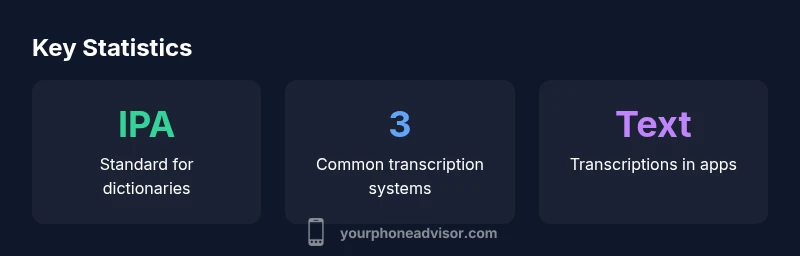
The IPA (International Phonetic Alphabet) is the dominant standard for dictionaries and linguistic research because its symbols map to real speech sounds across languages. SAMPA and X-SAMPA are ASCII-based encodings that make IPA possible on older systems or environments without special characters. In practice, you’ll see IPA strings like /ˈwɜːrld/ in dictionaries, while some teaching materials rely on SAMPA for easier typing. Choosing the right system depends on your goal: precision and cross-linguistic comparability favor IPA, while accessibility and legacy software might lean on SAMPA/X-SAMPA. For most smartphone users, IPA is the best starting point, with ASCII encodings serving as practical backups in constrained environments.
Phonetic transcription in dictionaries and language learning apps
Dictionaries present pronunciation using IPA within their entry blocks, often accompanied by audio pronunciations. Language-learning apps use transcription to guide learners through new sounds and to align recognition feedback with the learner’s output. In both cases, a clear transcription helps break down silence into phonetic details—tone, stress, length, and place of articulation. When you encounter unfamiliar words, compare multiple sources to see how accents or dialects affect pronunciation. This not only reduces anxiety about mispronunciation but also improves listening comprehension and the accuracy of voice-activated features on your phone.
Reading IPA: vowels, consonants, and diacritics
IPA covers a broad range of phonemes, including vowels (/iː/, /æ/, /ɔː/) and consonants (/p/, /t/, /ʃ/). Diacritics add nuance, signaling length, stress, nasalization, or voicing differences. For example, ˈ indicates primary stress, while ˌ denotes secondary stress. Length can be shown with a colon-like mark, as in /iː/ for a long vowel. Reading IPA is a matter of mapping symbols to sounds you actually hear, then practicing with real words. Start with familiar words in your native language, compare your pronunciation against IPA references, and gradually extend to unfamiliar languages by focusing on a single phoneme at a time. Consistency matters; the more you align your speech with IPA conventions, the clearer you’ll be to both people and devices.
How to write IPA for a word: step-by-step
- Listen to the word carefully, noting distinct sounds. 2) Break the word into phonemes (individual sounds). 3) Choose IPA symbols that represent each sound precisely. 4) Add diacritics for length, stress, or nasalization if needed. 5) Cross-check with a trusted source (dictionary or pronunciation guide). 6) Practice by saying the word aloud and comparing your rhythm and intonation. 7) Repeat for related words to reinforce consistent pronunciation. 8) Use IPA-friendly resources on your smartphone to reinforce correct sound production in real time.
Tools and resources that help with transcription
A wide range of resources can support learners and professionals: visual IPA charts, online dictionaries with audio, language-learning apps with pronunciation exercises, and browser extensions that display IPA transcriptions on word pages. For mobile users, dedicated pronunciation apps offer guided practice, phoneme drills, and voice feedback. It’s also helpful to bookmark reputable dictionaries that provide IPA entries and example words. When in doubt, rely on multiple sources to verify symbol-to-sound mappings and to understand regional variations in pronunciation.
Common pitfalls and how to avoid them
One common pitfall is equating orthography with pronunciation; many languages have irregular spelling-sound correspondences. Another is overlooking regional variation; a word may have several IPA realizations depending on dialect. Diacritics are often misused or omitted, leading to confusing, inaccurate transcriptions. To avoid these issues, always reference a primary IPA source for the target dialect, check multiple dictionaries, and practice with native audio. Finally, avoid over-reliance on ASCII approximations when high-precision IPA is available, especially in professional or educational contexts.
Example contexts where phonetic transcription is used
| Context | What it shows | Notes |
|---|---|---|
| Dictionaries with IPA entries | Pronunciation guidance | Often standard IPA is used |
| Language-learning apps | Pronunciation practice | May use simplified notations |
| Speech therapy | Articulation focus | Specialist transcription may be used |
Got Questions?
What is phonetic transcription?
Phonetic transcription is a system that uses symbols to represent the sounds of speech. It enables precise pronunciation descriptions that are consistent across dialects and languages. This helps users learn, teach, and compare how words are pronounced.
Phonetic transcription turns speech into symbols so everyone can pronounce words the same way.
How is IPA used in dictionaries?
In dictionaries, the IPA transcription appears next to a word to show its standard pronunciation. This helps users reproduce the word sounds correctly, even if spelling is confusing. Audio cues complement the symbols for a fuller pronunciation guide.
Dictionaries show IPA to guide how words sound.
Is IPA universal across languages?
IPA aims to cover sounds used across languages, but actual sounds vary by dialect. While the core set is broad, you’ll sometimes see language-specific adjustments. IPA remains the most widely adopted system for cross-language pronunciation.
IPA is broad and widely used, but dialect differences matter.
Where can I find reliable IPA transcriptions online?
Reliable IPA content is typically found in major dictionaries, university language resources, and well-reviewed language learning platforms. Cross-check IPA strings with audio pronunciation when possible.
Check reputable dictionaries and language resources for IPA.
Does transcription help with pronunciation?
Yes. Transcription provides a precise map of sounds, guiding learners to reproduce accurate pronunciation and improving listening comprehension. Practicing with IPA can also improve pronunciation consistency in speaking and voice input tasks.
Absolutely—IPA helps you pronounce words more accurately.
What’s the difference between IPA and other notation systems?
IPA is the most comprehensive and widely accepted system. Other systems may use ASCII-friendly encodings (e.g., SAMPA) or language-specific conventions, which can be useful in certain software environments but may lack universal comparability.
IPA is the standard; others are often easier to type but less universal.
“Phonetic transcription is a practical bridge between how we hear language and how machines process it. By using stable symbols, you can decode pronunciation across dialects with confidence.”
What to Remember
- Master IPA basics to read pronunciation confidently
- Use multiple sources to verify tricky transcriptions
- Dictionaries and learning apps rely on transcription for accuracy
- Be mindful of dialectal variation when comparing IPA
- Practice regularly with real words to build fluency