What Phone Line Does Cricket Use? A Practical Guide
Discover which network line Cricket uses, how it affects coverage and speed, and practical tips for choosing devices and plans. Learn how Cricket relies on AT&T's backbone for 4G/5G service and what this means for you.


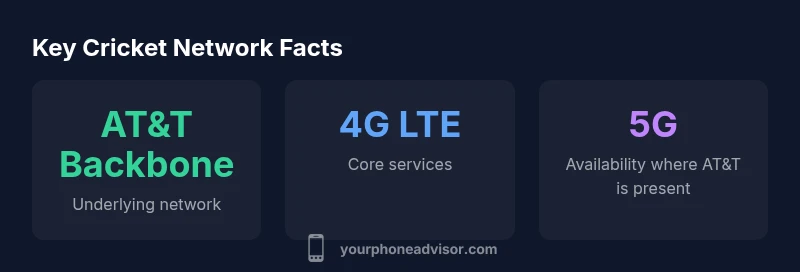
Cricket Wireless operates on AT&T's nationwide network. In practical terms, what phone line does cricket use? It uses AT&T's GSM-based backbone for voice, text, and data, delivering Cricket's prepaid plans on the same infrastructure AT&T uses for its own customers. You’ll experience 4G LTE and 5G services where AT&T has coverage, with Cricket providing service through its own billing and SIM options.
Cricket and the underlying phone line
To answer what phone line does cricket use, consider the fundamentals: Cricket Wireless relies on AT&T's nationwide network to carry voice, text, and data. That means the line, radio access, and core switching are performed on AT&T's infrastructure, while Cricket manages its own prepaid plans, SIM provisioning, and customer support. For the end user, the practical effect is that Cricket customers generally experience the same coverage footprint and technology options as AT&T customers, just with Cricket’s pricing, terms, and customer service approach. This distinction matters if you’re comparing two phones or two plans side by side: the underlying network is AT&T, but your bill, SIM kit, and plan features come from Cricket.
Understanding the question at a granular level helps when troubleshooting: if a device has trouble connecting, the issue is more likely to be a SIM, device compatibility, or regional coverage gap rather than an absence of a Cricket-specific network.
What that means for your experience: coverage and speeds
Because Cricket leverages AT&T’s network, you benefit from AT&T’s broad coverage map, especially in urban and suburban areas where AT&T has dense tower density. Real-world speeds depend on location, device, and network congestion; you’ll typically see solid 4G LTE performance in most cities and towns, with 5G access in markets where AT&T has rolled out 5G. While Cricket does not own its own separate core network, it can offer similar service quality, paired with its own data caps, throttling rules, and plan-specific allowances. If you frequently travel, you’ll notice both the advantages and limits of riding AT&T’s backbone through Cricket: excellent nationwide reach with potential variability in high-traffic rural zones.
From a device perspective, performance aligns with your device’s bands and LTE/5G support. If your phone is optimized for AT&T bands, you’ll see fewer handoffs and faster initial connections when moving between towers.
SIM options, unlocking, and device compatibility
Cricket uses SIM-based access that mirrors AT&T’s network approach. Most GSM-unlocked smartphones that support AT&T bands will work on Cricket, provided the device is compatible with Cricket’s supported frequencies and network services. If you’re bringing a device from another carrier, check that it is GSM-compatible and that it supports AT&T’s 4G LTE and 5G bands sufficient for your region. Some devices locked to a different carrier or that rely on incompatible CDMA settings may require unlocking or might not be fully compatible. In practice, the best path is to confirm device compatibility on Cricket’s support site or by contacting customer care before switching or bringing a phone over.
4G LTE, 5G, VoLTE, and Wi‑Fi calling basics
Cricket supports standard carrier technologies such as 4G LTE and 5G, with Voice over LTE (VoLTE) for high-quality calls and, in many cases, Wi‑Fi calling as a fallback when cellular service is weak. The exact feature availability can vary by plan and region, so check your specific plan details. If you rely on advanced features like VoLTE or Wi‑Fi calling, ensure your device is configured correctly and that the feature is enabled in your phone’s settings. The combination of AT&T’s core network and Cricket’s service terms generally makes these features accessible in most major markets.
Roaming, international use, and SIM swaps
Cricket’s roaming and international-use options depend on the active plan and the country you plan to visit. Within the United States, Cricket users typically roam on AT&T’s network where available, while international roaming features may be more limited and plan-dependent. When traveling abroad or swapping SIMs, verify roaming eligibility, supported bands, and any additional charges with Cricket’s support resources. If you frequently travel internationally, consider a separate international roaming plan or a global SIM option that complements Cricket’s core offering.
eSIM support and future-proofing
eSIM support varies by device and Cricket’s current carrier policies. Many newer iPhone and Android devices can use eSIM for Cricket service, while others require a physical SIM. If you own a device that supports eSIM, confirm Cricket’s eSIM compatibility before committing, as it can simplify switching between carriers or plans without exchanging physical SIM cards. As carriers continue updating their infrastructure, expect ongoing improvements in shared features like multi-SIM management and faster activation processes.
Practical steps to verify device compatibility
If you want to check compatibility quickly, use the following steps:
- Confirm your device is GSM-compatible and supports AT&T bands in your region.
- Check whether your device is unlocked and can be used on other networks.
- Visit Cricket’s official compatibility tool or contact support to verify that your model is supported.
- If you’re bringing a phone, ensure your SIM kit is activated with Cricket and that the IMEI is registered with the carrier.
- For devices with eSIM, verify that your model is supported and that you can activate the eSIM profile through Cricket.
- After activation, test calls, texts, and data in multiple locations to confirm consistent performance.
Choosing a Cricket-friendly device or plan: practical tips
When selecting a device or plan for Cricket, keep these principles in mind:
- Prioritize devices with broad AT&T-compatible bands to maximize coverage across regions.
- Verify 5G compatibility for future-proof performance, especially if you travel to markets where AT&T’s 5G is live.
- Prefer unlocked GSM devices to have flexibility if you decide to switch carriers later.
- Review plan data allowances, including throttling policies and hotspot limits, so you know what to expect during peak usage periods.
- Check if your device supports VoLTE and Wi‑Fi calling, as these features can improve call reliability in low-signal areas.
Cricket’s network foundation and how it maps to user experience
| Aspect | Cricket baseline | Notes |
|---|---|---|
| Underlying network | AT&T network (GSM-based) | AT&T backbone used by Cricket |
| Coverage footprint | Nationwide via AT&T towers | Dependent on local AT&T coverage |
| Technology | 4G LTE and 5G | VoLTE and Wi‑Fi calling where supported |
Got Questions?
What phone line does Cricket use?
Cricket uses AT&T's network as its underlying phone line for voice, text, and data. Cricket manages its own prepaid plans and SIM provisioning on that same infrastructure.
Cricket runs on AT&T's network, with Cricket handling plans and SIMs.
Do I need a Cricket-specific phone?
Not necessarily. Most unlocked GSM smartphones that support AT&T bands will work on Cricket, provided the device is compatible with Cricket's frequencies.
If your phone is GSM unlocked and supports AT&T bands, it should work with Cricket.
Is 5G available on Cricket?
Yes, where AT&T provides 5G, Cricket users can access 5G-enabled plans and devices, subject to plan terms.
Cricket offers 5G where AT&T has 5G coverage.
Can I bring my own phone from another carrier?
Yes, as long as the device is GSM-compatible and supports the right AT&T bands, you can bring it to Cricket with a compatible SIM.
If your phone is GSM-compatible and supports AT&T bands, you can bring it.
Does Cricket offer international roaming?
Cricket’s international roaming options depend on your plan and region. Check plan details or contact support for specifics.
Roaming abroad depends on your plan; check with Cricket for details.
“Cricket’s use of the AT&T network means you can expect broad coverage and solid modern tech, but always verify device compatibility and plan features to maximize performance.”
What to Remember
- Cricket uses AT&T's network backbone
- Your device should be GSM-compatible for best results
- 5G is available where AT&T provides coverage
- Check compatibility for eSIM if your device supports it
- Verify plan features (VoLTE, Wi‑Fi calling) for smooth calls