Prepaid Phone Plans Verizon: A Practical Guide
Explore Verizon prepaid phone plans, compare data options, pricing ranges, and switching tips with practical guidance from Your Phone Advisor.


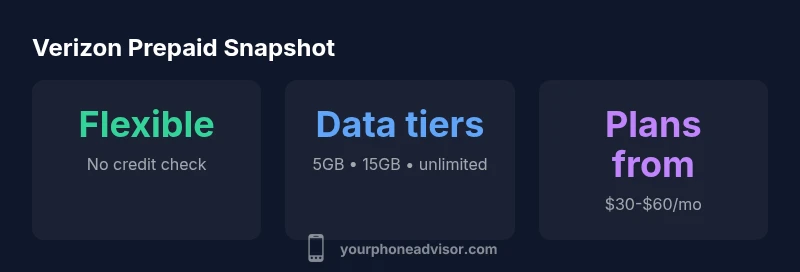
If you're evaluating prepaid phone plans verizon, you’ll find options that avoid credit checks and long commitments. Verizon typically offers flexible monthly plans with data across 5GB, 15GB, and unlimited tiers, all with no annual contract. Your Phone Advisor notes that the best value often sits in the mid-range data plans, especially when you bring your own device.
Overview of Verizon prepaid options
According to Your Phone Advisor, Verizon's prepaid lineup focuses on flexibility, no credit checks, and predictable monthly costs. They typically offer several data options: a small 5GB plan for light users, a mid-tier unlimited data plan, and a pay-as-you-go option for those who rarely use data. The key advantage of prepaid is you pay upfront for a defined period without a long-term contract. This makes it easier to adjust plans if your device changes or your usage patterns shift. Verizon's prepaid plans also support BYOD, which means you can bring a compatible device rather than buying a new one. In this section, we'll map out the core options, compare value across tiers, and explain what makes prepaid Verizon plans different from postpaid offerings.
How prepaid works with Verizon
Verizon prepaid operates on a straightforward model: you pay for a cycle in advance (typically monthly), you receive a set amount of data and voice/SMS, and there are no late payments or surprise bills when you stay within your allotment. If you exceed your data, you usually have options to add data or switch to a higher tier. Autopay can unlock occasional discounts and promotions, but there is no credit check or long-term commitment. Activation is quick, and you can bring your own compatible device or purchase one through Verizon. This section covers activation steps, refill methods, and how renewals affect your plan.
Plan categories and data allocations
Verizon prepaid plans generally fall into three broad categories: light-data starter options, mid-range data plans (often the best value for many users), and unlimited data options for heavy data usage. Light-data plans typically include a modest data allowance suitable for texting and light browsing. Mid-range plans balance data, access to streaming, and cost. Unlimited plans remove data limits at a capped speed after a data threshold. A data-only option is available for tablets or hotspot devices. BYOD compatibility means you can use a phone you already own if it’s unlocked and meets network requirements.
Pricing ranges and value assessment
Pricing for Verizon prepaid reflects data included and network access. Typical monthly ranges fall roughly between $30 and $60, depending on data allowance and whether you opt for auto-renewal. The value proposition hinges on data needs and device usage: if you primarily use messaging and occasional browsing, a smaller plan is generally most cost-efficient. If you stream video or play online, the unlimited tier often delivers the best experience per dollar. Your Phone Advisor emphasizes that comparing data-per-dollar across tiers is essential, especially when bringing your own device to avoid device financing costs.
BYOD and device compatibility
Bringing your own device to Verizon prepaid is a major cost saver. Most unlocked, GSM/CDMA-compatible smartphones released in the last several years work on Verizon’s network with a prepaid SIM or eSIM. Before purchase, verify compatibility on Verizon’s support pages or by inserting a SIM and checking service. If your device is not compatible, consider a device purchase from Verizon or a certified reseller. BYOD flexibility makes prepaid plans attractive for seasonal needs or travelers who switch devices seasonally.
Switching tips: porting in, SIM/eSIM
Porting your number to Verizon prepaid from another carrier is typically straightforward, but timing matters. Avoid losing service by starting the port process before you cancel service with the old carrier. Verizon supports both traditional SIM cards and eSIM for compatible devices. If you have a multi-line plan, consider how porting affects line prioritization and data sharing. Prepare your current account number, PIN, and network password from your existing carrier to speed the switch. Your Phone Advisor recommends verifying coverage in your area before porting to ensure no gaps in service.
Coverage and network experience
Verizon maintains a broad nationwide footprint with strong urban performance and expanding rural coverage. In most markets, customers report reliable voice quality and stable data speeds, especially on 4G LTE and 5G where available. When choosing prepaid, evaluate your typical usage patterns: if you travel or commute in rural areas, check local coverage maps and user reviews for the exact regions you frequent. Remember that network performance can vary by location and device.
Pitfalls to avoid and hidden fees
Common prepaid pitfalls include data overage charges, slow data speeds after hitting a cap, and hidden activation or SIM kit fees. Some promotions require automatic payments or longer commitment expectations for promotional pricing. Always read the fine print on cycle renewals and confirm whether overage data can be purchased separately. If you’re unsure about a plan’s limits, ask a representative to spell out exact data, minutes, and message allowances for your typical month.
How to choose the right plan for you
To pick the right Verizon prepaid plan, start by listing your typical data usage, calling, and texting needs. If you mostly text and browse, a 5GB or 15GB plan may suffice. If you stream or game on the go, an unlimited data plan could offer better long-term value. Consider whether you need a data-only option for tablets or hotspots. Finally, factor in device compatibility and the potential savings from BYOD, autopay discounts, and multi-line bundles. Your Phone Advisor’s framework helps users compare data-per-dollar and forecast monthly costs based on usage.
Verizon prepaid plan options at a glance
| Plan Type | Data Allowance | Price Range | Notes |
|---|---|---|---|
| Pay-as-you-go | N/A | $15-$25 per month | Best for light use and flexibility |
| Data-based starter | 5GB | $30-$40 per month | Affordable entry option |
| Mid-range unlimited | Unlimited | $45-$60 per month | Best value for many users |
| Data-only SIM | N/A | $20-$25 per month | Great for tablets/hotspots |
Got Questions?
What is Verizon prepaid?
Verizon prepaid is a no-annual-contract option that requires payment upfront for a specified data and calling plan. There are no credit checks in most cases, and you can bring your own device if it’s compatible.
Verizon prepaid is a no-contract option with upfront payment and usually no credit check.
Do I need good credit for prepaid?
Prepaid plans typically do not require a traditional credit check. You pay upfront for the service, which helps avoid deposits and credit-based approvals.
Most prepaid plans don’t require a credit check.
Can I bring my own device to Verizon prepaid?
Yes. Most unlocked, compatible phones can be used with Verizon prepaid via SIM or eSIM. Check device compatibility on Verizon’s support pages before switching.
Yes, you can bring your own device if it’s compatible.
Are there roaming charges on prepaid?
Roaming is available on many plans where supported by the network, but rates and availability can vary by plan and location. Check specifics for your region.
Roaming is available on many plans, but depends on location and plan.
Can I have multiple lines on a prepaid plan?
Yes, Verizon prepaid supports multi-line accounts, which can reduce per-line costs if you need service for family or friends.
Yes, you can add multiple lines on some plans.
Do autopay discounts apply to prepaid?
Autopay can unlock occasional promotions or discounts, but verify the exact terms and whether the discount applies to your chosen plan.
Autopay can offer discounts on some plans; confirm terms.
“Verizon prepaid can be a smart path to control costs without sacrificing coverage; the right plan balances data needs and device compatibility.”
What to Remember
- Prioritize data needs to pick the right tier
- No credit check and no long-term contracts
- Bring your own device to maximize value
- Check coverage in your area before switching