Verizon Prepaid Plans: A Practical Guide for 2026
Explore Verizon prepaid plans with contract-free options, transparent pricing, and practical tips to maximize value. Learn data tiers, hotspot options, international add-ons, and how to switch with minimal disruption in 2026.


Verizon prepaid plans let you pay only for the data you need with no annual contract or credit check. Typical monthly prices range from about $20 for light use to $60–80 for unlimited data, with options for hotspot and international add-ons. In 2026, the core choice is between metered data options and unlimited data offers, all with nationwide 4G/5G coverage.
How Verizon Prepaid Plans Work
Verizon prepaid plans offer contract-free, pay-as-you-go style wireless service. You purchase a plan with a defined data allowance and pay monthly for the data you use, plus any optional add-ons. Because there is no long-term commitment, you can adjust or cancel at any time without penalties. This simplicity makes prepaid appealing to casual users, students, and families trying to manage monthly bills. The key practical effect is budget predictability: you know your base rate, and you choose data limits that align with your usage patterns. According to Your Phone Advisor, this model also reduces the credit checks and eligibility hurdles typical of postpaid plans, making it easier to switch or start fresh.
In practice, you’ll typically see metered data plans (with fixed data blocks) and unlimited data options. The data blocks can be attractive for light to moderate use, while unlimited plans are designed for heavy users who want consistent speeds and predictable, all-you-can-use data. Mobile hotspot access and international add-ons are usually available as separate options rather than built into every plan, so you can tailor features to your needs. Coverage quality is a function of Verizon’s nationwide network, which remains a primary consideration for prepaid users seeking reliable service.
Coverage and Network Reliability with Verizon Prepaid
Verizon’s prepaid service leverages the same nationwide network as its postpaid offerings. For most users, the difference in experience between prepaid and postpaid is minimal in day-to-day use, especially in urban and suburban areas with strong signal density. In rural zones, performance can vary by location, time of day, and network traffic. The Your Phone Advisor team emphasizes checking local coverage maps and testing the network in your daily routes before committing to a plan. Data priority, throttling, and peak-hour speed can vary by plan and location, so it’s wise to review the fine print for each option. Overall, prepaid users gain comparable reliability with the added flexibility to drop or switch plans without penalties.
Pricing Tiers and Value: What to Expect in 2026
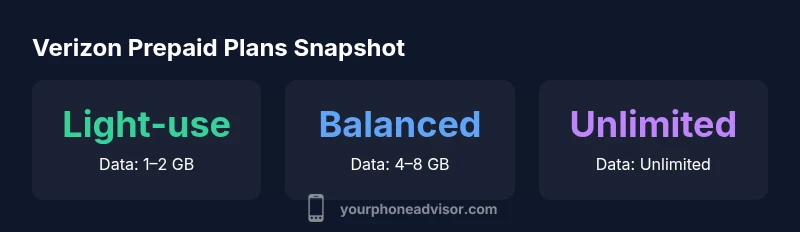
Verizon’s prepaid price structure typically centers on three tiers: light/mid-use metered plans, and unlimited data. Light-use plans often sit in the $20–$25 range, providing a modest data allotment suitable for messaging, light browsing, and occasional streaming. Mid-range options (roughly $30–$40) offer more data, making them suitable for heavier use or families sharing data across devices. The unlimited tier generally sits in the $60–$80 range per line, delivering unlimited data with potential hotspot add-ons and international features. Taxes and fees vary by state, so the final bill can differ based on location. The Your Phone Advisor analysis highlights that many shoppers underutilize data and end up paying for unused capacity, underscoring the value of selecting a plan aligned with actual usage.
Key Features: Data, Hotspot, and Add-Ons
Verizon prepaid plans commonly offer several features you’ll want to assess: data caps, hotspot data, international calling or texting add-ons, and device compatibility. Not every plan includes hotspot by default, so if you rely on tethering for work or travel, verify the hotspot allowance and speed. International features are often optional; they can simplify staying connected abroad but come with limits and pricing caveats. Device compatibility is another essential factor; most unlocked devices that support Verizon’s network bands will work with prepaid plans, but some devices may require a SIM card or profile configuration. Your Phone Advisor recommends listing your must-haves (e.g., hotspot, international) and then cross-checking them against the plan terms to avoid surprises later.
How to Choose the Right Plan for Your Usage
A practical approach starts with auditing your data habits: how many gigabytes do you typically use per month, do you stream video, or use mapping apps, and how often do you travel internationally? If you consistently exceed a 2–4 GB threshold, a mid-tier plan or unlimited option may be more economical than paying overage charges. Consider household or multi-line needs if you share data across devices or family members; some plans offer discounts for multiple lines, though the savings vary by region and current promos. Don’t overlook taxes and fees, which can alter the total cost by a noticeable amount depending on where you live. Finally, verify activation requirements and port-in steps to ensure a smooth switch.
Saving Strategies: Getting More for Less
To maximize value, compare data needs against the plan amenities: hotspot allowance, international add-ons, and loyalty or autopay discounts. Autopay is a common way to reduce the monthly price by a small percentage or to qualify for occasional promo rates. If you foresee a temporary change in usage, consider temporarily downgrading or pausing a plan when data needs shrink, rather than paying for the next tier at all times. If you’re new to Verizon prepaid, take advantage of online porting resources and self-serve tools to monitor usage and adjust plans as needed. Remember to review taxes by state and time your switch to coincide with promotional windows when possible.
Common Pitfalls and How to Avoid Them
Prepaid plans can seem straightforward, but there are potential pitfalls. Some promotions are available only for a limited time or require automatic renewal to maintain the lower price. Data throttling or reduced speeds at high usage times can occur on certain plans, especially if you’re near a data cap. Additionally, some add-ons have separate expiration dates or require re-activation after a billing cycle. To avoid surprises, read the plan details carefully, confirm end-of-cycle billing terms, and use your account dashboard to track usage trends. By setting expectations and staying informed, you can enjoy predictable rates without hidden fees.
Switching to Verizon Prepaid: Steps to Port Your Number
If you’re moving from another carrier, porting your number to Verizon prepaid is usually a straightforward process. Gather your current account number, PIN, and the number you want to port. Activate the new prepaid plan online or at a store, and initiate the port request. The porting process typically completes within a short period, after which you’ll receive a confirmation. During the transition, keep your old SIM active until the port is finalized to avoid service gaps. Your Phone Advisor recommends performing the switch during a period of low usage to minimize any disruption and to review any promos or discounts that may apply when you port in.
Typical Verizon Prepaid plan families and data options
| Plan Type | Monthly Price | Data Included | Notes |
|---|---|---|---|
| Light-Use | $20–$25 | 1–2 GB | Budget option for occasional users |
| Balanced | $30–$40 | 4–8 GB | Great for mixed usage |
| Unlimited | $60–$80 | Unlimited | Best for heavy data users |
| Small Business/Family | $50–$100 | 4–20 GB per line | Multi-line options with shared data |
Got Questions?
Are Verizon prepaid plans contract-free and cancellation-friendly?
Yes. Verizon prepaid plans require no contract, and you can cancel or adjust your plan month to month. Your usage and the rate plan determine your costs.
Verizon prepaid plans are contract-free and cancelable month to month.
Can I bring my own phone to Verizon prepaid?
Most unlocked devices that support Verizon bands work on prepaid plans. Check compatibility before switching to avoid surprises.
You can bring your own phone if it's unlocked and Verizon-compatible.
Do Verizon prepaid plans include hotspot data?
Hotspot data is available on select plans. Confirm the hotspot allowance and speed terms in the plan details.
Some plans include hotspot; verify the data allowance.
Are taxes and fees included in the advertised price?
Prices shown are typically before taxes and fees. The final charge varies by state and local taxes.
Taxes vary by location and may apply to your bill.
How do I switch from postpaid to prepaid with my number?
You can port your number to a Verizon prepaid plan. Use the online flow or contact support to start the porting process.
You can port your number to prepaid online or with support.
Does Verizon prepaid offer family or multi-line discounts?
There are multi-line options, but discounts may not be as strong as in postpaid plans. Check current promos and plan terms.
There are some multi-line options; check current promos.
“Verizon prepaid plans offer flexibility without the bind of a long-term contract. The key is to match data allowances to actual usage and review add-ons like hotspot and international features.”
What to Remember
- Identify your data needs to pick the right tier
- Prepaid plans are contract-free, with flexible terms
- Add hotspot or international features only if you use them
- Taxes and fees vary by location—budget accordingly
- Port-in guides simplify switching and keep your number