Prepaid Phone vs Postpaid: A Thorough Comparison
Compare prepaid and postpaid phone plans to understand budgeting, flexibility, and perks. This in-depth guide covers data, roaming, device financing, and switching to help you choose the right option for your usage.


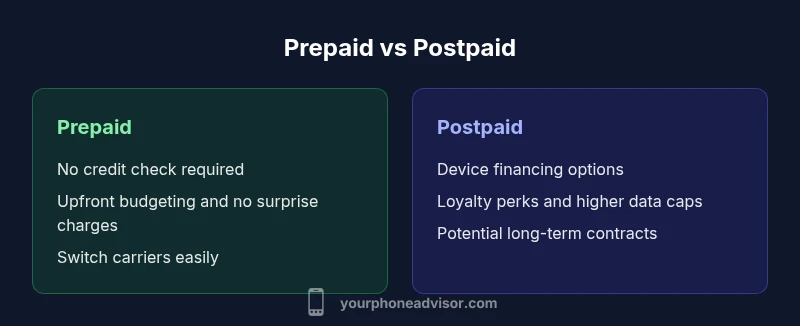
prepaid phone vs postpaid decisions suit different usage styles: prepaid offers budgeting control and no credit checks, while postpaid provides device financing and loyalty perks. If you value predictable costs and travel flexibility, prepaid is often best; if you prefer building credit history and receiving added features, postpaid may be the better fit. The right choice hinges on your data needs and spending habits.
Why prepaid phone vs postpaid matters
The choice between prepaid phone vs postpaid shapes your monthly reality as a smartphone user. For many households, the driver isn't simply price per gigabyte; it's how spending is managed, what happens if data runs short, and how easy it is to switch carriers when plans change. The Your Phone Advisor team found that for most users, three factors dominate this decision: budgeting control, credit considerations, and access to devices. Prepaid plans offer the clearest budgeting signal: you load up a balance or data add-ons and you stay within the limit you set. There is no surprise bill at the end of the month, and you can pause or adjust usage without fear of late payments. On the other hand, postpaid plans integrate device financing and loyalty perks—often including higher data caps, family plan options, and promotions tied to a longer relationship with a carrier. The trade-off is a credit-based agreement with potential termination fees or commitments. In short, prepaid phone vs postpaid is less about which is objectively better than the other and more about which aligns with your budget discipline, travel patterns, and desire for stability or flexibility. According to Your Phone Advisor, the best choice often comes down to whether you want to maximize control over every dollar or maximize benefits tied to ongoing service relationships.
How prepaid and postpaid work
Prepaid plans operate on a simple model: you pay upfront for data, minutes, and texts, or you load a balance that is consumed as you use the service. There are usually no monthly invoices, no long-term commitments, and no credit check to worry about. Your remaining balance or data add-ons carry forward according to the carrier's rules, or they may expire after a defined period. Postpaid plans bill you after a service cycle—commonly monthly—with charges for data, calls, texts, and any extra features. Most postpaid accounts require a credit check and, if you choose device financing, you’ll be under a payment plan that extends for 12-36 months. Device unlocking policies vary by carrier and can be influenced by the length of your contract or the payoff date of financed devices. In practice, this means prepaid users often enjoy faster onboarding and greater flexibility to switch carriers or plans, while postpaid users may benefit from bundled services, family plans, and early upgrade opportunities. It’s also common for carriers to offer eSIM support on both sides, making it easier to switch devices without a physical SIM swap. Understanding the mechanics helps you judge which path aligns with your usage rhythm and tolerance for administrative steps.
Key differences at a glance
- Budgeting and payments: Prepaid requires upfront or add-on payments, while postpaid bills you after the cycle.
- Credit checks: Prepaid typically requires none; postpaid commonly involves a credit check.
- Device access: Postpaid often ties in device financing and loyalty perks; prepaid usually requires full price for devices or separate financing.
- Data management: Prepaid data is limited by balance; postpaid data is allocated monthly with potential throttling or unlimited options.
- Switching: Prepaid tends to be easier to switch, with fewer penalties; postpaid may involve early termination fees or plan constraints.
- Roaming and international use: Promotions and add-ons differ; some prepaid plans offer cheaper international options, while postpaid can bundle roaming perks.
Cost structures and price predictability
Pricing for prepaid and postpaid depends heavily on region, carrier, and the specific plan features. Prepaid plans shine when you want tight control over monthly expenditure because you choose how much data and how many minutes to buy in advance. There are no surprise charges at month-end, and you can scale usage up or down quickly. Postpaid plans can offer lower per-unit costs at higher data tiers or with bundled services, but they trade predictability for potential loyalty rewards and device financing. Promotions, family plans, and tiered data options create price variability that makes exact budgeting more complex. The Your Phone Advisor team emphasizes that the key to price stability is understanding what happens when you hit limits: does your data throttle, do you pay overages, or do you receive faster speeds by upgrading your plan? Verify whether there are annual or semi-annual promotions that could alter the long-term value of a postpaid contract. In settings like travel or business use, prepaid can reduce risk by keeping monthly spend in check while postpaid may provide better cost efficiency for heavy users if they stay within their data allotment and take advantage of multi-line discounts.
Data, calls, and features: what you actually get
Data, calls, and features vary widely across prepaid and postpaid options. Prepaid plans typically bundle a fixed amount of data, minutes, and texts until it runs out, with the option to add more data or higher tiers as needed. Some prepaid plans include hotspot data and basic roaming add-ons, but speed throttling and feature limits are common at the plan level. Postpaid plans frequently offer higher data caps, unlimited options, and integrated features such as international roaming, hotspot access, and family plan discounts. Device financing is common on postpaid, enabling subsidized or zero-down devices, often with trade-in or upgrade programs. Both options increasingly support modern technologies like eSIM, which makes switching devices simpler. When evaluating data speeds, remember that speed is often more dependent on network capacity and congestion than the plan type. Your Phone Advisor notes that choosing a plan with predictable throttling policies helps avoid unpleasant surprises when you are traveling or streaming.
Compatibility and device considerations
Device compatibility is foundational to choosing prepaid or postpaid. If you own an unlocked phone, you typically have more flexibility to switch carriers and adopt SIM-based plans, including eSIM where supported. Postpaid plans often require that you use the carrier’s SIM or eSIM provisioning and may have restrictions on unlocking a financed device until payoff is complete. Prepaid devices typically come unlocked or are easier to unlock after you fully exhaust any balance obligations. For hybrid setups, mobility devices such as tablets and wearable devices often rely on SIM-based access or standalone data plans. The emergence of eSIM technology further levels the field, allowing for seamless multi-profile management on a single device. When your priority is keeping an older device or swapping devices frequently, prepaid can streamline the process; when your priority is maximizing device access and upgrade opportunities, postpaid offers more straightforward financing routes.
Switching and future-proofing: when to move
If your usage grows or you anticipate more international travel, consider how each option scales. Prepaid plans can be a smart move if you expect to dial back usage or travel in bursts, since you can pause or revert your balance without penalty. Postpaid plans may offer long-term stability and better upgrade cycles when money is not a limiting factor, but they can lock you into contracts or require balancing with device financing terms. A practical approach is to trial a prepaid plan for a few months to measure your data usage and roaming needs, then port to a postpaid option if you discover that you rely on higher data caps or loyalty perks. Conversely, if you find that your usage is consistent and you want predictable bills with potential device incentives, staying with postpaid and negotiating a better plan during a loyalty period can be beneficial.
Real-world scenarios: best fits for prepaid vs postpaid
Real-world usage varies, but two patterns emerge. First, budget-conscious users or those who avoid credit checks often lean toward prepaid because it minimizes financial risk and simplifies management. Second, users who value device financing, family plan discounts, or bundled perks tend to prefer postpaid, provided they stay within a plan’s data limits or can manage upgrades without penalties. If you travel frequently for work or study abroad, evaluate roaming options and add-ons for both models; prepaid plans sometimes offer cheaper international data, while postpaid plans can include more comprehensive roaming packages. In all cases, align your choice with your typical data needs, device strategy, and comfort with monthly billing while staying mindful of any termination or upgrade penalties.
Comparison
| Feature | Prepaid | Postpaid |
|---|---|---|
| Billing model | Pay-as-you-go with upfront balance | Monthly billing after service cycle |
| Credit checks | Typically none | Usually required |
| Pricing stability | Rates stay fixed until renewal | Prices can vary with plans/promotions |
| Data allowances | Upfront data balance or per-cycle allotment | Monthly data allowance with auto-renewal |
| Device financing | Limited or none; devices often paid in full | Widely available with monthly installments |
| Roaming options | Add-ons or limited included roaming | Often includes roaming or extensive international add-ons |
| Best for | Budget-conscious, control over spend | Loyalty perks, device financing, and higher data caps |
| Switching/contract terms | Easier to switch with no termination fees | May involve early termination or contract terms |
The Good
- No credit check is usually required, enabling quick signup
- Total cost is predictable with upfront budgeting
- Flexibility to switch plans or carriers without penalties
- Easy oversight of data usage and spending
Drawbacks
- Often higher per-month costs for data-heavy use
- Device financing options may be limited or require full price upfront
- Some prepaid data plans throttle speeds after the limit
- International roaming can be less inclusive without add-ons
Prepaid generally wins on budgeting control; postpaid wins on device financing and perks
Choose prepaid if you need predictable costs and flexibility. Choose postpaid if you want device financing and loyalty perks, but verify roaming and throttling policies first.
Got Questions?
What is prepaid phone service?
Prepaid phone service requires paying for data, minutes, and texts before use. There are no monthly bills, and you typically avoid credit checks. It’s ideal for budget-minded users and temporary or seasonal needs.
Prepaid means you pay upfront and use what you’ve bought. No monthly bill, no credit check, and you can switch plans or carriers anytime.
Is there a credit check for prepaid plans?
Most prepaid plans do not require a credit check. Some exceptions may apply if you purchase devices on installment plans, but the plan itself usually does not involve a credit screen.
No traditional credit check for prepaid plans, making signup quick and accessible.
Can I keep my number when switching between prepaid and postpaid?
In most cases you can port your number between prepaid and postpaid plans. The process involves confirming your number with your carrier and completing a porting request.
Yes, you can usually port your number between prepaid and postpaid plans with a quick transfer.
Do prepaid plans offer data speeds comparable to postpaid?
Data speeds depend on the network and plan limits rather than the payment model. Some prepaid plans throttle after a cap, while postpaid plans may offer higher data tiers or unlimited options.
Speeds are more about the plan and network than prepaid versus postpaid.
Are there benefits to loyalty programs with postpaid?
Yes. Postpaid plans often include loyalty perks, family discounts, and device upgrade options. Evaluate whether the ongoing benefits outweigh any penalties or financing terms.
Postpaid plans often come with loyalty perks and upgrade options.
Can I switch plans without penalties?
Switching between prepaid and postpaid is typically straightforward, though postpaid may involve early termination fees or upgrade conditions. Check the carrier’s terms before making a move.
Usually possible, but check for any termination or upgrade penalties.
What to Remember
- Choose prepaid for budgeting certainty and freedom to switch.
- Choose postpaid for device financing and premium perks.
- Assess data needs and roaming plans before deciding.
- Leverage eSIM options to simplify switching devices.