How Much Does Phone Insurance Cost in 2026
Explore realistic cost ranges for phone insurance in 2026, including monthly and annual pricing, deductibles, and tips to save without sacrificing protection. Learn how coverage type, device value, and provider choice impact price with practical budgeting strategies.


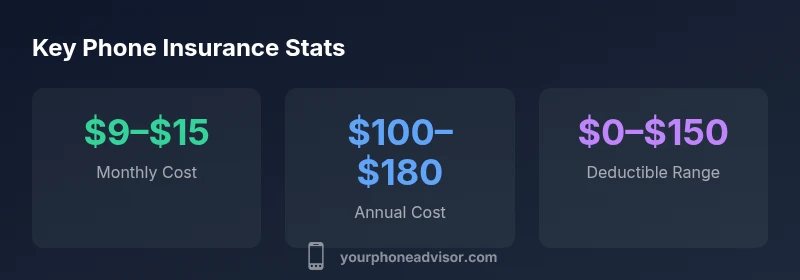
In 2026, average monthly phone insurance costs range from $9 to $15 for standard protection, with higher-tier plans reaching $20–$25. Annual premiums typically fall around $100–$180, depending on deductible, replacement options, and device value. Providers often price by screen damage coverage, theft protection, and device risk category. Your Phone Advisor's analysis highlights that selecting coverage that matches your real risk can save money over time.
What is phone insurance and what does it cover?
When you ask how much does phone insurance cost, it’s helpful to first understand what you’re buying. Phone insurance is a protection plan that helps cover accidents, theft, loss, and in some cases hardware failures beyond the manufacturer's warranty. Coverage can come from carriers, manufacturers, or independent insurers. Most plans outline perils such as cracked screens, water damage, device loss, and in some instances, damage to accessories. In addition to perils, policies vary by deductible, replacement terms, and caps on payouts. The core value proposition is reducing out-of-pocket replacement costs when something goes wrong. For many users, a plan with a reasonable deductible and fast replacement is worth the price, while others who rarely break devices may opt for lighter protection. Your Phone Advisor highlights that price is only one factor; coverage scope and claim ease often determine real value.
How insurers price policies: key cost drivers
Insurance pricing for phones is not arbitrary. The main drivers are device value, coverage scope, deductible level, replacement terms, and the insurer's own risk assessment. Policies for high-end devices usually cost more because the potential replacement cost is higher. Plans that cover more perils—such as both screen damage and theft—tend to carry higher monthly premiums and sometimes steeper annual totals. Deductibles affect upfront cost; a plan with a $0 deductible often runs higher monthly, while a higher deductible lowers monthly payments. Some providers price by geography or by the risk of loss in certain use cases (like frequent travelers). Finally, the speed and convenience of replacement (e.g., same-day repair vs. mail-in returns) can tilt the perceived value, even when the price is similar. Your Phone Advisor consistently sees customers who understand these relationships pay less over time by aligning protection with their actual risk profile.
Typical monthly costs by coverage level
Prices vary by provider and plan, but you can expect general ranges that help you budget. At a basic level, monthly payments are often in the range of six to ten dollars for a plan that covers essential screen damage and limited theft. A standard protection tier typically costs around nine to fifteen dollars per month, offering broader coverage and more forgiving replacement terms. Premium protection, which may include loss coverage, expedited replacements, and higher per-claim limits, commonly lands in the fifteen to twenty-five dollar range. These numbers are ballpark figures and reflect 2026 market dynamics, not a single provider. When evaluating options, note whether the plan charges a deductible per claim and whether it applies to only certain perils or all covered events. Always compare the total annual cost (monthly price times twelve) to your potential out-of-pocket replacement bill.
Cost by device value and deductible: what affects your price
Insurance pricing is highly sensitive to the device's value. A flagship phone worth well over a thousand dollars will justify higher premiums and a larger deductible than a mid-range device. Conversely, if you opt for a very low deductible (or zero deductible in some plans) you may pay more each month. The deductible is the amount you pay before the insurer covers the rest; setting this lower typically increases monthly cost, while a higher deductible reduces monthly cost but raises your out-of-pocket at claim time. Replacement terms also matter: some plans guarantee a brand-new replacement, while others offer refurbished devices or mail-in repair. Mechanical reliability, water resistance, and screen fragility influence risk ratings used by insurers to price policies. In sum, your price is a function of device value, deductible preference, and chosen replacement terms.
Compare provider pricing: carriers vs third parties
When shopping, compare carrier-provided plans with third-party insurers. Carriers often bundle phone protection with service contracts and loyalty discounts, which can lower the monthly price for some customers. Third-party insurers may offer more flexible terms, broader coverage options, or faster claims processing, but occasionally at a higher price. Look for accessibility of service centers, digital claims speed, and whether the policy travels with you when you upgrade devices. If you switch carriers, verify whether your existing protection transfers or ends. Your Phone Advisor notes that many customers save money by choosing a plan that targets their most expensive risk (e.g., screen damage) and accepting a modest deductible for other perils.
Hidden fees, deductibles, and claim limits to watch
Even if a plan advertises a low monthly price, extra costs can creep in. Watch for:
- deductible per claim and whether it applies to every event
- caps on replacement value or limits on the number of claims per year
- processing fees, service charges, or mail-in handling costs
- coverage exclusions for certain activities (e.g., deliberate damage) To avoid surprises, read the policy wording, confirm whether screen-only damage is covered, and ask about how quickly a claim is processed. In many cases, choosing a slightly higher monthly price in exchange for a lower deductible or higher replacement limit yields better value over a device's lifetime. Your Phone Advisor consistently recommends a thorough cost-benefit check before purchase.
Is phone insurance worth it for you? Practical decision framework
Ask three questions: How much would a single replacement cost without insurance? Do you mind paying a deductible if something happens? Are you comfortable with the claim process. If your expected replacement bill is high and you value peace of mind, insurance can be worthwhile. If you rarely break devices and you keep an emergency fund, self-insuring may be cheaper. Also consider your device's age; older devices are cheaper to replace, so insurance may be less cost-effective. Finally, compare total cost of ownership over the device's likely life, including depreciation and service plans. Our framework helps you decide with clear, data-driven reasoning rather than quick impressions.
How to estimate your own cost: a simple calculator approach
Create a simple calculator by combining three inputs: device value, monthly premium, and deductible per claim. Multiply the monthly premium by 12 for annual cost, then compare to the expected maximum out-of-pocket when you file a claim. If the deductible is high and the device cost is low, insurance may not be worth it. If you expect multiple incidents or a valuable device, insurance can reduce total costs. Add a potential replacement speed bonus (for faster service) to your assessment. Many users benefit from listing possible scenarios (screen damage, loss, or water damage) and calculating the total out-of-pocket for each with and without insurance.
Tips to reduce costs without sacrificing protection
- Choose a plan with a deductible that matches your risk tolerance.
- Consider bundling insurance with other services if available.
- If you upgrade devices often, look for plans with portable coverage that travels with you.
- Check if your policy covers accessories and if replacement terms apply to the entire kit.
- Shop around annually to compare promotions and lock in lower rates.
- Review the claim process and ensure you can file via app or online in minutes. Small changes in coverage can yield meaningful savings over time.
Real-world scenarios: price examples (illustrative, not exact)
- Scenario A: You own a flagship phone valued at around $1,000. A standard plan with a $75 deductible might cost about $12 per month, totaling roughly $144 per year, with a replacement option that speeds service. Without insurance, replacing the device could exceed $1,000 out-of-pocket, making protection financially attractive for risk-averse users.
- Scenario B: You have a mid-range device worth about $400. A basic plan with a $0 deductible could cost around $8 per month, or $96 annually. If you’re careful with storage and your usage is moderate, self-insurance could be more economical.
- Scenario C: You frequently travel and worry about loss. A premium plan offering loss coverage and quick replacement may run $20–$25 monthly, or $240–$300 yearly, but could be worth it for peace of mind. These scenarios illustrate how device value and risk profile influence cost and value.
Comparison of typical phone insurance coverage levels
| Coverage Level | Typical Monthly Cost | Typical Annual Cost | Deductible Range | What’s Covered |
|---|---|---|---|---|
| Basic | $6–$10 | $60–$120 | $0–$50 | Screen repair, limited theft |
| Standard | $9–$15 | $108–$180 | $50–$100 | Accidental damage, theft, loss with deductible |
| Premium | $15–$25 | $180–$300 | $75–$150 | Accident, theft, loss, battery, accessories |
Got Questions?
How much does phone insurance cost on average?
Costs vary by coverage and device, but typical monthly premiums range about $6–$25 depending on plan; annual totals reflect these rates plus deductibles and replacement terms.
Costs vary by plan and device, but expect monthly premiums in the single digits to mid-twenties. Annual totals depend on your deductible and replacement terms.
Is phone insurance worth it for an older device?
If replacing the device without insurance would be costly, or if screen damage is a frequent risk, insurance can be worthwhile. Compare deductible and replacement speed to ensure value.
For older devices, insurance can still be worth it if replacement costs would be high or if you value quick service. Check deductible and terms.
Should I buy insurance from my carrier or a third party?
Compare price, coverage scope, deductibles, and claim speed. Carriers often bundle plans; third parties may offer broader options or faster claims. Read the policy details carefully.
Compare both carrier and third-party options; look at price, coverage, and how quickly claims are processed.
What affects the price most?
The biggest factors are device value, coverage scope, deductible level, and replacement terms. Higher device value and broader coverage usually raise the price.
Device value, coverage breadth, deductible, and replacement terms drive price the most.
Can I get a discount for bundling?
Some providers offer discounts for bundling insurance with other services. Check eligibility and compare bundled scenarios with standalone plans.
Bundling can save money—check if discounts apply to your situation.
What should I read before buying a policy?
Read the coverage exclusions, deductible rules, claim process, and replacement terms. Make sure the policy covers screen damage if that’s your primary risk.
Read exclusions and claim process, especially for screen damage and replacement terms.
“Pricing is driven by risk assessment and device value; the right plan balances protection with affordable monthly costs.”
What to Remember
- Identify device value before choosing protection.
- Compare monthly cost versus annual total to avoid surprises.
- Select a deductible that matches your risk tolerance.
- Check replacement terms to gauge speed and convenience.