Will Your Phone Ring If It’s Dead? An Urgent Troubleshooting Guide
If you’re wondering will your phone ring if it’s dead, this urgent guide from Your Phone Advisor walks you through quick checks, common causes, and a step-by-step approach to restore calls and connectivity.


If your phone won’t ring on incoming calls, it’s usually a settings or network issue rather than a hardware fault. Start by turning off Do Not Disturb, increasing the ringer volume, and ensuring call forwarding is disabled. If needed, reboot and charge the device, then follow the deeper steps below for a thorough check.
Why your phone might not ring
The question 'will phone ring if dead' is common when a device seems unresponsive to incoming calls. In most cases, the issue isn't a failed network but a setting or software quirk. According to Your Phone Advisor, the quickest way to verify is to check three things: Do Not Disturb mode, ringer volume, and any silent/vibration-only configurations. If these are correct but calls still don’t ring, the problem may lie with call forwarding, a blocked contact, or a software glitch. This section explains how each of these factors can suppress ringing and what to do about them.
First, confirm the phone isn’t simply silenced by a temporary push of the volume rocker. Then inspect the DND/Focus status and any automation or third-party apps that override default ringing behavior. Finally, consider whether a recent update changed audio permissions or call routing. Your Phone Advisor emphasizes diagnosing the difference between a device setting and a network constraint.
Common causes at a glance
Several everyday culprits can mute or redirect incoming calls. Do Not Disturb or Focus modes are the most frequent offenders, often toggled during a busy day or inadvertently via automation. The ringer volume, vibration settings, and the selected ringtone matter just as much—some devices default to silent or a non-audible ringtone for certain contacts. Call forwarding and carrier-level features can also route calls away from your device. Finally, software glitches or partial OS updates can interrupt how the device handles rings. Understanding these categories helps you target the fix quickly.
Quick checks you can do right now
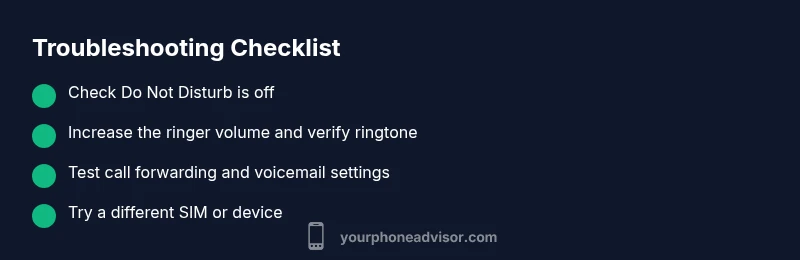
- Verify Do Not Disturb or Focus modes are off. If they’re on, turn them off and test a call.
- Increase the ringer volume and ensure the selected ringtone is audible. Check if silent/vibrate-only mode is enabled.
- Check for any call-forwarding rules that might divert calls to voicemail or another number.
- Look for blocked numbers or recent changes to contact permissions that could suppress ringing.
- Ensure the SIM card is properly seated and the network is available; try toggling Airplane mode off/on.
- Update your OS and essential apps, as glitches can affect call handling.
Diagnostic path: symptom to solution
When the phone fails to ring, start with the simplest explanations. If DND is off and the volume is up but calls still don’t ring, the issue might be a misconfigured app or a network feature. If a fellow user experiences the same phenomenon on the same device model, it’s more likely a carrier or SIM-related problem. The key is to isolate variables: settings, network, SIM, and software.
Your approach should be: confirm device-level settings first, test with a different SIM or network, and finally consider a software update or reset as a last resort. This flow minimizes unnecessary resets and data loss while maximizing odds of a quick fix.
Step-by-step fixes overview
The most common fixes involve quick toggles and basic checks: turn off Do Not Disturb, raise the volume, disable any silent modes, and verify call forwarding. If these do not resolve the issue, the next steps involve network checks and SIM tests. The goal is to build a low-effort, high-yield plan that lets you verify each potential cause before moving to the next. See the separate STEP-BY-STEP block for the detailed, ordered actions.
Safety notes and professional help
- Do not perform a factory reset unless you’ve exhausted all other options and backed up data. A reset can erase personal information.
- If the device is under warranty, consult the manufacturer or carrier before disassembly.
- If you suspect a hardware fault (speaker, microphone, or SIM tray), seek professional service to avoid further damage.
- When in doubt, contact your carrier for a line test or SIM replacement—carrier-level issues may mimic device problems.
Prevention and best practices to avoid future no-ring issues
- Regularly review Do Not Disturb and Focus schedules to ensure critical calls aren’t blocked during busy hours.
- Keep the OS and key apps updated to minimize audio routing glitches.
- Periodically remove unknown automation rules or third-party apps that alter call behavior.
- Store an alternate contact method for emergencies and test ringing with a trusted contact from time to time.
Real-world testing and verification
After applying fixes, verify by asking a trusted contact to call you and leaving a voicemail test. If you can’t replicate the issue on a second device, the problem is likely tied to your specific handset or SIM. Retest after a reboot and monitor for any recurring patterns, such as only certain contacts triggering the issue or only at certain times of day. Your Phone Advisor recommends keeping notes of when the problem occurs to share with a technician if needed.
Steps
Estimated time: 15-30 minutes
- 1
Check Do Not Disturb and ringer settings
Open the quick settings panel and ensure Do Not Disturb is off. Verify that the ringer volume is up and a loud, audible ringtone is selected. Test by having someone call while you watch the screen indicators.
Tip: If you use Focus or DND profiles, check if they auto-activate based on time or location. - 2
Verify call routing and voicemail
Inspect any active call forwarding rules within your phone’s settings and confirm voicemail isn’t set to answer all calls unexpectedly. Remove or disable forwarding in both SIM settings and carrier portal if needed.
Tip: Some carriers offer web portals to manage call forwarding beyond device settings. - 3
Test with another SIM or device
Insert a different SIM card or borrow another compatible phone to see if calls ring there. If the other device rings, the issue is likely with your SIM or handset configuration.
Tip: If possible, request a temporary SIM swap from your carrier to isolate the problem. - 4
Reset network settings and check OS updates
Reset network settings to restore default call routing and network preferences. Then check for pending OS or carrier updates and install them.
Tip: Back up important data before performing resets or updates. - 5
When to seek professional help
If none of the above fixes resolve the issue, contact your carrier for a line test and potential SIM replacement, or visit a qualified service center for hardware inspection.
Tip: Note any patterns (time of day, specific contacts) to help technicians diagnose faster.
Diagnosis: Phone won't ring on incoming calls
Possible Causes
- highDo Not Disturb or Focus mode enabled
- highRinger volume muted or ringtone set to silent
- mediumCall forwarding or filtered calls active
- mediumSIM card or network issue
- mediumSoftware glitch or OS update changed permissions
- lowBlocked numbers or contact-level restrictions
- lowHardware issue with speaker or audio path
Fixes
- easyDisable Do Not Disturb/Focus and test ringing
- easyIncrease ringer volume and verify the selected ringtone is audible
- easyCheck and disable any call forwarding or filtering rules
- easyReseat or test the SIM card and toggle Airplane mode to reset network
- mediumUpdate OS/apps or perform a network settings reset if needed
- hardIf the issue persists, consult the carrier for line tests or consider service repair
Got Questions?
Why won’t my phone ring when someone calls?
Most often the cause is a simple setting like Do Not Disturb, low volume, or incorrect ringtone. Check those settings first, then test with another SIM or device to rule out hardware issues.
Usually it’s a setting like Do Not Disturb or low volume; check that first and then test with another SIM to rule out hardware problems.
How do I turn off Do Not Disturb on my phone?
Open quick settings or the settings app, locate Do Not Disturb or Focus, and toggle it off. You can also review any scheduled or automatic rules that might re-enable it.
Open settings, find Do Not Disturb, and switch it off. Check any schedules that might turn it back on.
How can I test if my SIM is working?
Try the SIM in another compatible phone or borrow a different SIM to see if calls ring. If the other device works, the issue is likely SIM-related or device-specific.
Put the SIM into another phone to see if calls ring there; if it does, your SIM or device settings may be the problem.
Can a software update fix ringing issues?
Yes, updates can fix audio routing, permissions, or carrier-related bugs. Install the latest OS and app updates, then retest incoming calls.
Updating the OS and apps can fix bugs that affect ringing; try updating and testing again.
Why are calls going to voicemail instead of ringing?
Voicemail can be set to answer before ringing for certain conditions or if the line is busy. Check forwarding rules, voicemail settings, and any third-party call-handling apps.
Voicemail routing happens when forwarding or settings are configured to answer early; review those settings.
When should I contact my carrier about ringing problems?
If the problem persists after basic troubleshooting, contact your carrier for a line test, SIM replacement, or network-side investigation.
If basic fixes don’t help, reach out to your carrier for a line test or SIM replacement.
Watch Video
What to Remember
- Start with basics: DND off, volume up, correct ringtone.
- Test with different SIM or device to isolate the issue.
- Check call forwarding and blocked numbers first.
- Update OS/apps and reset network settings if needed.
- Seek carrier help if hardware or network problems persist.