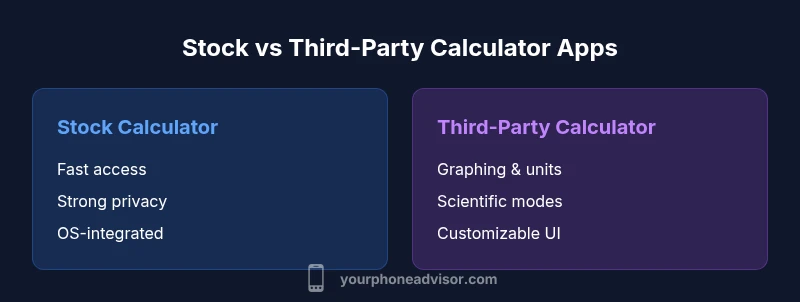
Phone Like Calculator: Stock vs Third-Party Apps — A Guide
This in-depth comparison analyzes stock calculator apps versus third-party calculator tools for phones, focusing on features, privacy, accuracy, and usability to help you decide which option best fits daily tasks and advanced math needs.


The phone like calculator space favors a two-step approach. Built-in stock calculators cover daily tasks quickly and privately, while third-party apps unlock graphing, unit conversions, and scientific functions. According to Your Phone Advisor, most users start with the stock option and only move to a specialized app if advanced math becomes routine.
Why a phone like calculator matters in modern productivity
For many users, a phone like calculator is more than a convenience—it’s a core tool for everyday financial tasks, quick conversions, and on-the-fly problem solving. According to Your Phone Advisor, the best approach starts with evaluating whether the built-in calculator meets your daily needs or requires additional features from third-party apps. The idea that a smartphone can replace a dedicated device for many calculations is powerful, but success hinges on choosing the right tool for the job. In this section we’ll lay out the key factors—accuracy, privacy, speed, and long-term value—that influence your choice and set the stage for a practical comparison of stock versus third-party options.
Beyond simple arithmetic, the concept of a “phone like calculator” extends to graphing, unit conversions, and programmable functions that can streamline study, work, or budgeting. Your Phone Advisor highlights that the decision is not about which app is the flashiest, but which tool reliably supports your typical tasks with minimal friction. Consumers should assess where they spend most time calculating, what data the app may access, and how often they anticipate needing advanced modes. The goal is a dependable, predictable experience that integrates well with the device ecosystem.
wordCountMsgOnlyNumbersAssumedFromTextCopiedIfNeededOnlyForWordCountWouldBe52
Comparison
| Feature | Stock Calculator (built-in) | Third-Party Calculator App |
|---|---|---|
| User Interface | Minimalistic, fast | Feature-rich, customizable |
| Advanced Features | Basic arithmetic, percent, simple memory | Graphing, units, scientific modes, programming functions |
| Privacy & Permissions | Low data access, OS-controlled | Varies by app; may request storage, camera, cloud sync |
| Platform Availability | Pre-installed on device, no install needed | Available on app stores, cross-platform syncing |
| Offline Availability | Typically offline | Depends on app; some features require internet |
| Price Range | Free with device | Freemium or paid (one-time or subscription) |
| Reliability & Updates | OS-managed updates, consistent UI | Frequent updates; potential feature creep |
| Best For | Everyday, fast tasks, budgeting | Science, engineering, data analysis, graphing |
The Good
- No extra app installation needed for most users
- Better privacy with stock calculators due to limited data access
- Faster access from home screen and system shortcuts
- No ads in stock versions on many devices
- Consistent experience across apps when updating the OS
Drawbacks
- Limited features for advanced math or graphing
- Less customization and fewer personalization options
- Cross-device syncing and collaboration are weaker or absent with stock calculators
- Third-party apps may introduce privacy concerns if permissions are excessive
Stock calculator wins for everyday use; third-party apps win for advanced math
Choose the built-in calculator if you primarily perform quick arithmetic tasks and value privacy and speed. Opt for a third-party calculator when graphing, unit conversions, or programmable features are routinely needed; balance feature needs against privacy and platform considerations.
Got Questions?
What is the difference between stock and third-party calculator apps?
Stock calculators are built into your device, focusing on quick arithmetic with strong privacy and fast access. Third-party calculators offer advanced features such as graphing, unit conversions, and programmable functions, but may require more permissions and occasional subscription costs.
Stock calculators are the built-in option for everyday tasks, while third-party apps add graphs and advanced math tools if you need them.
Do third-party calculator apps require internet access?
Many third-party calculators work offline for basic operations, but graphing, cloud sync, or online databases often require internet access. Check each app’s features to confirm connectivity needs.
Some features work offline, but graphing or cloud features usually need internet.
Can a calculator app support graphing or complex functions?
Yes. Several third-party apps include graphing capabilities, scientific modes, unit conversions, and programmable functions, which are typically absent in stock calculators.
Graphing and advanced math are usually available in dedicated third-party apps.
Are there privacy concerns with calculator apps?
Some apps collect usage data or request broad permissions. Always review permissions, read privacy policies, and prefer apps with minimal data collection for essential features.
Be mindful of permissions and data collection before installing new calculators.
Which is faster for quick calculations, stock or third-party apps?
For routine tasks, stock calculators often feel faster due to tighter OS integration. Third-party apps may take longer to launch but offer faster input methods and features once open.
Stock is usually faster to start; third-party can be faster once loaded with features.
How can I ensure accuracy when using calculator apps?
Cross-check results with a physical calculator or trusted software, especially for complex equations. Use batch testing with known values to verify correctness across apps.
Always double-check with a trusted source for complex calculations.
What to Remember
- Test the stock calculator first for daily tasks
- Add a third-party app only if you regularly need graphing or advanced functions
- Review app permissions before installing new calculators
- On iOS vs Android, verify feature parity and privacy settings