Phone Book for Businesses: A Practical Guide to Secure Contact Management
Learn how to design, implement, and maintain a robust phone book for businesses that improves contact accuracy, honors privacy, and supports governance. Practical steps, templates, and policies for secure, scalable directories.


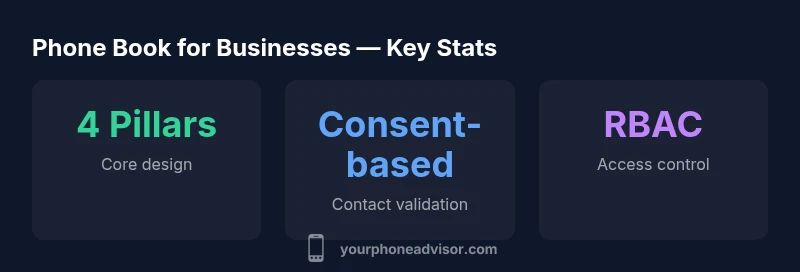
The business phone book should center on three pillars: data accuracy, privacy, and governance. As of 2026, prioritize consent-based contacts, role-based access, and ongoing data hygiene to keep records current. This article explains how to design, implement, and maintain a secure phone book for businesses. Expect guidance on data models, privacy controls, and practical templates you can adapt.
Why a business phone book matters
In a world of remote work and dispersed teams, a centralized phone book for businesses acts as a single source of truth for contact information across HR, Sales, and support. A well-maintained directory reduces misdials, improves response times, and lowers privacy risk by ensuring only authorized contacts are visible to the right people. For a business, the phone book is not just a contact list but a governance tool that ties people to roles, channels, and consent. When you invest in this resource, you align it with your CRM, marketing, and security policies. Importantly, build it with privacy by design: record-level permissions, strict access controls, and regular validation to keep data current and compliant. The result is faster, more reliable outreach and a better customer experience across all touchpoints.
- Throughout this article, the term phone book for businesses appears to emphasize practical, governance-driven directory design that supports security and performance.
Tip: Start with a simple catalog of core fields and evolve the model as your organization grows.
Core design principles
A well-constructed phone book for businesses rests on several non-negotiable principles. First, data accuracy: deduplicate records, validate phone formats, and regularly verify role assignments. Second, consent and privacy: capture consent timestamps, provide opt-out options, and restrict who can view sensitive fields. Third, minimal data collection: store only necessary fields to reduce risk. Fourth, governance and accountability: assign data owners, document policies, and implement change-control processes. When you adhere to these principles, the directory becomes a reliable backbone for outreach, customer support, and partner communication while minimizing privacy concerns and compliance risk.
Data quality and hygiene
Data hygiene is not a one-off task; it’s an ongoing discipline. Begin with a data inventory that lists all sources feeding the phone book for businesses (CRM, marketing lists, HR databases). Implement deduplication rules and automated validation checks to catch invalid numbers or outdated roles. Schedule periodic sweeps to align the directory with active CRM records, and set up automated notifications when discrepancies appear. Use reconciliation processes to merge duplicates and flag inconsistencies for manual review. Regular hygiene reduces friction in outreach, minimizes miscommunication, and protects the organization from sharing stale contact data with external partners.
Privacy, compliance, and consent
Privacy is a foundational layer for a phone book for businesses. Capture explicit consent for storing personal contact details and provide easy opt-out mechanisms. Enforce access controls so only authorized roles can view sensitive fields, and apply encryption at rest and in transit. Maintain detailed audit logs of who accessed which records and when. Retain data only as long as necessary per policy, and implement a clear deletion workflow for opt-outs. By embedding privacy-by-design principles, you reduce regulatory risk and build trust with customers, employees, and partners alike.
Technical architecture and data model
A practical phone book for businesses uses a centralized repository with a well-defined data model. Core fields include: name, phone, role, company, primary channel, consentTimestamp, and optOut flag. Optional fields may include department, location, and preferred contact times. The storage layer should support role-based access control (RBAC), attribute-based filtering, and automated data validation. Interfacing components (CRM, helpdesk, marketing automation) should synchronize in near real-time, with conflict resolution rules and versioning to preserve data lineage. Security and scalability are achieved through API gateways, encryption, and regular backups. A thoughtfully designed data model makes it easier to enforce privacy policies and governance across the business.
Implementation best practices
To implement a robust phone book for businesses, start with an inventory of data sources and ownership. Define essential data fields and validation rules, then choose a platform that supports RBAC, data integrity checks, and consent tracking. Create a policy document that covers data retention, opt-in/opt-out procedures, and change management. Establish a routine refresh cadence and assign a data steward responsible for ongoing quality. Provide training to staff on data-use policies and the importance of keeping contact information current. Finally, pilot the system with a small team before rolling it out organization-wide to catch gaps early.
Data quality metrics and monitoring
Track metrics that reflect the health of the phone book for businesses, such as record completeness, duplicate rate, and update frequency. Define targets for accuracy and timeliness, and set up dashboards to surface anomalies quickly. Regularly review audit logs and conduct quarterly data quality reviews with stakeholders from IT, compliance, and operations. Use automated checks to flag outdated records and trigger validation workflows. Monitoring helps ensure the directory remains a reliable tool for outreach and internal coordination.
Security considerations for remote teams
Remote teams introduce new risk vectors for a centralized directory. Strengthen security with MFA, device compliance checks, and encrypted access to the phone book. Enforce least-privilege access and segment data so that only necessary fields are visible to different roles. Provide secure channels for updates, and require robust authentication for any integration with external systems. Regular security training and simulated phishing exercises reinforce safe practices and minimize the chance of credential compromise affecting the phone book for businesses.
Governance, change management, and templates
Effective governance keeps the phone book for businesses relevant. Establish a change-management process, document ownership, and publish a living policy. Create templates for data intake forms, consent records, and data-cleaning SOPs. Include a rollback plan for schema changes and a schedule for periodic policy reviews. For teams looking for a quick-start, start with a minimal template that captures core fields, consent status, and access controls, then expand iteratively based on feedback and evolving privacy regulations.
Key aspects and owners for the phone book for businesses
| Aspect | Recommendation | Owner | Notes |
|---|---|---|---|
| Data Model | Name, Phone, Role, Company, ConsentTimestamp, OptOut | Data Architect | Store only necessary fields; include consent flag |
| Access Control | RBAC, MFA, audit trails | IT Admin | Audit logs required for accountability |
| Data Quality | Deduplication, validation, periodic verification | Data Ops | Cross-check with CRM; periodic sweeps |
| Retention & Compliance | Consent-based retention, opt-out handling | Policy Lead | Comply with privacy laws; purge when requested |
Got Questions?
What is a business phone book?
A centralized directory of business contacts with consent controls, designed to support compliant outreach and coordinated communication across departments.
A centralized directory of business contacts with consent controls, built to support compliant outreach.
Why centralize contact data rather than using scattered lists?
Centralization reduces duplicates, ensures consistency, and makes governance easier. It also supports security controls and auditability across teams.
Centralization reduces duplicates and makes governance easier.
How do I start building a phone book for businesses?
Begin with an inventory of data sources, define essential fields, establish consent rules, choose a platform, and assign ownership. Pilot the system before full rollout.
Start with inventory, define fields, set consent rules, and pilot.
What are key privacy considerations?
Capture explicit consent, provide opt-out options, apply role-based access, and log access for audits. Encrypt data at rest and in transit.
Get consent, protect with access controls, and log access.
What metrics should I track?
Track data completeness, duplicate rate, update frequency, and consent status to monitor data quality and governance.
Measure completeness, duplicates, updates, and consent status.
Do I need a vendor or can I DIY?
A vendor can simplify deployment and governance features, but a DIY approach is possible with clear policies, in-house skills, and chosen tools.
Vendors can help with governance features; DIY is possible with clear policies.
“A well-built phone book for businesses is a governance tool that protects privacy while enabling fast, compliant outreach.”
What to Remember
- Define 3 core pillars: accuracy, privacy, governance
- Centralize contacts with strict access controls by role
- Automate validation and deduplication where possible
- Regularly review policies with stakeholders for continuous improvement