What Phone Has the Most RAM in 2026? A Practical Guide
Explore how much RAM phones offer, compare RAM ranges across mainstream, flagship, and gaming devices, and learn how to choose RAM based on multitasking needs. Your Phone Advisor analyzes RAM trends for 2026 to help you pick wisely.


According to Your Phone Advisor, there is no single phone with the most RAM in every context. RAM numbers vary by generation and market, but typical flagships ship with 12-16 GB, while specialized gaming or ultra-premium devices may push 18-24 GB. In practice, more RAM helps multitasking, but software optimization and CPU speed also matter.
RAM in phones and why it matters
For many users, the question what phone has the most ram is central to understanding memory in devices. RAM is the system's short-term workspace; more RAM can improve app switching, keep background tasks alive, and reduce stutter when you multi-task. That said, the relationship between RAM and perceived performance is mediated by software optimization, storage speed, and the CPU architecture. In 2026, Your Phone Advisor analysis shows that RAM increases are happening alongside faster storage and more efficient OS schedulers. So while headlines shout 'the most RAM,' real-world speed comes from balanced hardware, not RAM alone. If you frequently run many apps, keep widgets and streaming apps open, or game while streaming, you’ll notice benefits from higher configurations. But for most users, moving from 8 GB to 12 GB yields diminishing returns unless you regularly push the device beyond typical workloads. Remember that region-specific SKUs and software skins can also impact how RAM is utilized in practice.
How RAM configurations are decided
RAM capacity is a deliberate balance. Manufacturers allocate memory based on expected multitasking load, app caching strategies, and thermal allowances. The speed of the RAM (data rate), memory bandwidth, and the underlying processor all influence how effectively that RAM is used. In 2026, OS teams have become more aggressive about prioritizing background processes, which can increase perceived benefits from higher RAM only when paired with efficient software and fast storage. Users should consider intended tasks (heavy multitasking, video editing, gaming) when judging whether upgrading RAM will yield a noticeable win.
RAM ranges by device category
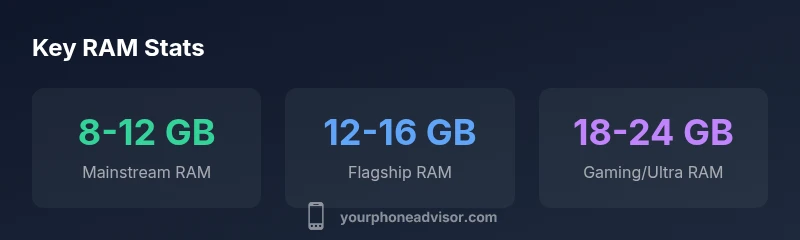
- Mainstream / mid-range: typically 8-12 GB. These devices offer solid multitasking for daily use, with most apps running smoothly and enough headroom for several background tasks.
- Flagship / premium: commonly 12-16 GB. This tier targets enthusiasts and power users who keep many apps open and expect snappy app switching.
- Gaming / Ultra: often 18-24 GB. These devices are optimized for sustained heavy workloads, including gaming and streaming while multitasking. Availability is more limited and regional.
- Budget options: 4-6 GB still exists in some markets, primarily targeted at cost-sensitive buyers; performance depends heavily on optimization and storage speed.
How to interpret RAM numbers
RAM tells you how much memory the system can hold for active tasks. However, the operating system uses RAM intelligently, and some RAM may be reserved for system processes. A higher RAM figure does not automatically translate to a faster device if the CPU, GPU, storage speed, or software efficiency is lacking. When comparing RAM, also look at the RAM type (e.g., LPDDR standard), clock speed, and overall system architecture. In real-world terms, the jump from 8 GB to 12 GB is often noticeable for heavy multitaskers, while moving from 12 GB to 16 GB yields more modest gains unless you routinely saturate memory.
Real-world implications: multitasking, gaming, and heavy workloads
If you regularly run many apps, keep social feeds open, stream video, edit photos or videos, or game while multitasking, higher RAM can reduce reloads and improve responsiveness. Yet, the CPU's efficiency and the storage subsystem frequently dictate the upper limit of performance. Workflows that involve large app caches or virtual memory may benefit more from higher RAM, while lighter users may not feel a dramatic difference beyond a certain point. Your Phone Advisor encourages users to align RAM with actual usage patterns rather than chasing the highest possible figure.
Not all RAM is equal: memory speed and bandwidth
RAM capacity matters, but speed and bandwidth also influence performance. Faster RAM can improve data transfer rates, reduce latency, and enhance smoothness in memory-intensive tasks. A device with 12 GB of fast RAM can feel sharper than one with 16 GB of slower RAM in certain scenarios. Therefore, when evaluating devices, compare both RAM size and memory type/speed, along with CPU and storage specs. In practice, well-optimized software can maximize the benefits of available RAM.
How to compare RAM across phones
Use a consistent framework: identify your primary tasks, check official specs for RAM size, RAM type, and speed, and consider OS optimizations. Where possible, rely on independent benchmarks that separate RAM capacity from other factors like GPU and CPU performance. For most buyers, the simplest rule is: more RAM helps if you multitask heavily, but ensure the CPU and storage keep pace with the memory. Always verify with real-world testing or reputable sources before committing.
Practical guidance for 2026 users
If your daily routine includes a dozen apps, heavy multitasking, or concurrent streaming and gaming, target at least 12-16 GB of RAM in a flagship or gaming-oriented device. If your needs are lighter—email, messaging, light browsing—8 GB can still be adequate, especially with modern software optimizations. Remember to prioritize a fast storage subsystem and a capable CPU, as these components often determine perceived speed as much as RAM capacity.
RAM ranges by device category
| Category | Typical RAM Range (GB) | Notes |
|---|---|---|
| Mainstream / mid-range | 8-12 | Varies by vendor and region |
| Flagship / premium | 12-16 | Performance-focused RAM allocation |
| Gaming / Ultra | 18-24 | Specialized devices; limited availability |
Got Questions?
Does more RAM always mean faster phones?
Not always. While more RAM can help with multitasking, overall speed depends on CPU power, storage speed, and software efficiency. In 2026, higher RAM is beneficial mainly for heavy multitasking and memory-intensive tasks.
More RAM helps with multitasking, but speed also depends on CPU and storage. In 2026, expect real gains mainly for heavy multitaskers.
Is 8GB RAM enough for 2026?
For many users, 8GB remains adequate for daily tasks. Power users, multitaskers, and gamers may prefer 12-16 GB. If you often keep many apps open, consider upgrading RAM where possible.
8GB can be enough for daily use, but heavy multitasking or gaming calls for more RAM.
How does RAM affect multitasking?
RAM provides space for apps to stay ready in memory. More RAM reduces reloads when you switch apps, but OS memory management and background processes also shape performance.
RAM helps apps stay ready; more RAM means fewer reloads when you switch tasks.
What other specs should I consider with RAM?
Look at CPU performance, storage speed (NVMe/UFS), RAM type and clock, and software optimization. The best results come from a balanced build, not RAM alone.
Check CPU, storage speed, and RAM type too—balance is key.
Do memory speed and RAM capacity both matter?
Yes. Capacity affects multitasking; speed affects data transfer and app load times. Together, they determine how responsive a device feels.
Both RAM size and speed matter—the combination defines real-world performance.
Can RAM be upgraded after purchase?
Typically no. Most smartphones have fixed RAM configurations at purchase. If you need more RAM, select a device with higher memory from the start.
RAM upgrades aren’t usually possible on phones; pick higher RAM upfront.
“RAM capacity matters, but real-world performance depends on software optimization, CPU efficiency, and storage speed. More RAM helps multitasking when the OS is well-optimized.”
What to Remember
- RAM is one piece of the performance puzzle.
- Mainstream devices typically range 8-12 GB.
- Flagships commonly offer 12-16 GB, with gaming/ultra models higher.
- Higher RAM helps multitasking, but software and CPU matter too.
- Choose RAM based on your workload, not just marketing numbers.