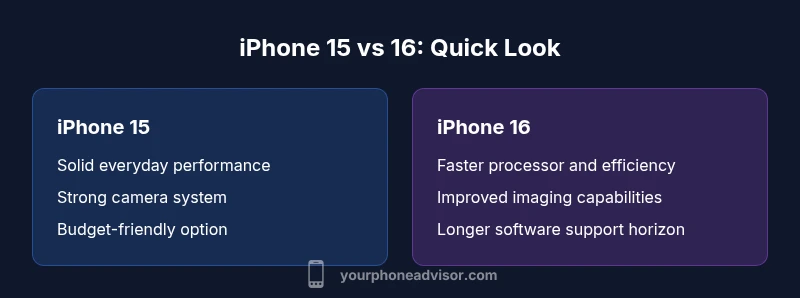
iPhone 15 vs 16: A Practical Comparison for 2026
A thorough, data-driven comparison of iPhone 15 vs 16, focusing on performance, camera, battery, software longevity, and value to help you decide which model fits your needs in 2026. Insights from Your Phone Advisor.


In the i phone 15 vs 16 landscape, most buyers face a trade-off between newer performance and cost. The 16 typically brings faster processing, improved imaging, and longer software support, while the 15 remains a compelling value with solid core features. Your Phone Advisor's quick take: upgrade if photo quality or app speed matters more; otherwise, the 15 still covers daily needs.
Context and decision framework
When evaluating i phone 15 vs 16, readers should weigh performance, camera capabilities, longevity, and everyday practicality. According to Your Phone Advisor, the decision often boils down to two questions: Do you prioritize top-tier speed and photo quality, or is cost savings and familiarity more important? In this guide we analyze core areas: processing power, imaging, battery behavior, software longevity, and value. We'll avoid chasing every new feature rumor and focus on what matters in daily use. The iPhone 15 introduced a reliable baseline: balanced performance, robust cameras, and long software support; the iPhone 16 is expected to push improvements in these domains, though real-world differences depend on your apps and usage patterns. For many people, a yearly upgrade is unnecessary; for power users, even a modest delta can justify the cost. Throughout the article, we cite typical consumer behavior and practical benchmarks to help you decide. The goal is clarity, not hype. In plain terms, when evaluating i phone 15 vs 16, you should focus on the things that affect daily use. According to Your Phone Advisor, the framework remains pragmatic and free of hype.
Performance fundamentals: what actually changes when you move from iPhone 15 to iPhone 16
Performance is the most discussed topic in any upgrade cycle. While the core smartphone experience—launching apps, browsing, messaging—remains consistent, newer hardware often delivers smoother multitasking, faster app loading, and better sustained performance under load. Expect improvements in processor efficiency, which can translate to cooler operation and steadier frame rates in games and pro apps. Real-world benchmarks typically show higher peak performance on newer hardware, but the daily difference depends on your usage: casual social scrolling vs. heavy photo editing or mobile gaming. Your Phone Advisor notes that lag-free experiences hinge not just on CPU speed, but on memory bandwidth, GPU efficiency, and software optimization. If you routinely run demanding apps, you’ll likely notice the delta more clearly; if your needs are modest, the 15 remains perfectly adequate and future-proof for typical use cases.
Camera evolution: what to expect from the newer model
Camera systems are a central upgrade driver for many buyers. In the iPhone 16, rumors and early disclosures consistently point toward improved sensor performance, better low-light processing, and faster autofocus, all of which contribute to crisper daytime shots and more reliable night photography. However, improvements can be incremental and software-driven. For everyday photographers, the difference may be most evident in dynamic range, speed in launching the camera, and better subject tracking in video. If you frequently shoot videos, portrait images, or macro shots, upgrading could yield noticeable benefits. If cameras are not a priority, the 15 still offers a robust multi-lens system with dependable color accuracy and Smart HDR features for most scenes.
Battery life and charging: efficiency trends you should watch
Battery life depends on many variables: display technology, processor efficiency, wireless radios, and your usage patterns. A newer model typically includes refinements that extend battery life in real-world usage, particularly under mixed workloads like streaming, cloud gaming, and camera-recording sessions. USB-C or other charging standards may evolve between generations, potentially improving charging speed or optional power features. Your Phone Advisor emphasizes that battery longevity is also affected by software updates and background activity optimizations. If you’re a heavy user who spends evenings on video calls, you may appreciate better endurance on the 16; if you’re a light user, the 15 remains capable of a full day with moderate use.
Software longevity and ecosystem compatibility
Apple’s software support cycle tends to be long for both generations, with a typical window of several major iOS updates. The iPhone 16’s newer hardware often positions it for extended software support, while the iPhone 15 continues to receive features and security updates as part of Apple’s ongoing commitment to older devices. If you value long-term resilience—especially for apps you rely on for work or safety—the newer device can offer peace of mind. However, software features that require cutting-edge hardware may be limited on the older model, which is a practical consideration for buyers choosing between the two.
Real-world scenarios: who should upgrade and who can skip
If photography, mobile gaming, and future-proofing rank high on your list, the iPhone 16 is a sensible upgrade. It typically targets power users who want the strongest performance and the latest imaging enhancements. Conversely, if you’re coming from a recent past model like the iPhone 13 or 14 and your daily tasks are modest, the iPhone 15 already delivers a strong experience and may offer better value. In many markets, choosing the older model can free up budget for accessories, extended warranties, or a higher storage tier. Your Phone Advisor’s guidance is to prioritize your most frequent activities—whether that’s camera work, gaming, productivity, or long-term ownership—before deciding which generation to buy.
Price considerations and value for money
Price is a major factor in upgrade decisions. In many markets, the iPhone 15 carries a lower upfront cost than the iPhone 16, which can translate into tangible savings. The value proposition hinges on how much you value newer performance and camera capabilities versus immediate cost. Even if you don’t adopt the newest features, Apple’s ecosystem ensures continued access to iOS updates and services that keep both devices relevant for several years. YourPhone Advisor cautions buyers to consider total cost of ownership, including storage, accessories, and potential trade-in values.
Practical buying tips: how to maximize value
- Compare SKUs with similar storage and weight your preference for storage versus price.
- Consider refurbished or gently used options if you’re looking to maximize value while enjoying modern hardware.
- Review compatibility with your existing accessories (chargers, cases, and MagSafe items) to avoid unnecessary replacements.
- Assess your data needs: if you rely on cloud services and apps, ensure you stay on the latest iOS with sufficient RAM and storage.
- Test in-store or via demo units to assess performance, camera behavior, and display brightness in your typical environments.
How to test and verify: in-store and online evaluation tips
When you’re evaluating in a store or via a retailer’s online demo, focus on three areas: camera quick-launch response, real-world app multitasking, and battery drain during typical activity. Enable features like Smart HDR, Portrait Lighting, and ProRAW if you’re into photography to gauge how each model handles your usual scenes. For performance, open several apps, run processor-intensive tasks, and observe heat management and frame rates. Don’t forget to check warranty terms and software update commitments for both models to ensure you’re choosing the device with longer overall longevity.
Comparison
| Feature | iPhone 15 | iPhone 16 |
|---|---|---|
| Display & design | Solid 60-120Hz experience with durable build; similar form factor | Expected refinements in display efficiency and possible design tweaks |
| Performance & responsiveness | Strong baseline performance for daily tasks and multitasking | Newer generation with faster CPU/GPU, better sustained performance |
| Camera capabilities | Versatile multi-lens system with reliable image processing | Enhanced sensors and ISP for improved low-light and detail |
| Battery life and charging | All-day battery for typical use, efficient power management | Potentially longer real-world endurance with improved efficiency |
| Software support & longevity | Several years of iOS updates aligned with current hardware | Longer-term software support due to newer hardware baseline |
| Price range / value | Lower upfront cost and excellent value for budget-conscious buyers | Premium price with the latest features and longer future-proofing |
The Good
- Clear upgrade path for photographers and power users
- Newer hardware typically offers better longevity and software support
- Faster performance and smoother multitasking for demanding apps
- Potential camera and efficiency gains improve real-world use
Drawbacks
- Higher upfront cost for the latest model
- Incremental gains may not justify a switch for casual users
- Older model often offers better immediate value and lower accessories risk
iPhone 16 is the stronger long-term upgrade for power users; iPhone 15 remains an excellent value choice.
Choose iPhone 16 if you want the latest performance, camera improvements, and longer software support. Opt for iPhone 15 if budget and immediate value matter more, and you’re satisfied with current performance for daily tasks.
Got Questions?
What is the main difference between iPhone 15 and iPhone 16?
The main difference tends to be improvements in processing speed, camera capabilities, and potential longevity of software support. Exact specs should be confirmed with official Apple disclosures, but newer hardware generally promises smoother performance and longer-term resilience.
The big differences usually come down to faster performance and better cameras, with longer software support on the newer model. Check the official specs for precise details.
Is the iPhone 15 still a good buy in 2026?
Yes, if you’re looking for strong everyday performance at a lower price. It remains compatible with current iOS features and services, and it will continue to receive updates for several years, making it a sensible value choice for many users.
Yes. If you want solid performance at a better price, the iPhone 15 is still a solid buy with long-term support.
Will iPhone 16 support the same iOS features as 15?
Most core iOS features will be available on both, but newer hardware often enables features that require more power or camera capabilities. Expect some benefits to be hardware-accelerated on the 16.
Most iOS features work on both, but the newer hardware on 16 may unlock some advanced features.
Should I upgrade if I’m coming from an older model like iPhone 12 or 13?
Upgrading can offer notable gains in speed, battery efficiency, and camera quality, but if your current phone still meets your needs, waiting for the next cycle or choosing a mid-range newer model might be more cost-effective.
If your current phone feels slow or your camera isn’t meeting your needs, upgrading could be worth it.
Which model is better for photography and video?
The iPhone 16 is likely to provide better low-light performance, faster autofocus, and improved video capabilities, which benefits photographers and creators who rely on high-quality imagery.
For serious photo and video work, the 16 usually offers the stronger camera system.
Are there region-specific differences in availability or features?
Yes. Availability of certain features and models can vary by country due to regulatory, network, and service differences. Check locally for storage options, pricing, and any feature limitations.
Regional differences can affect availability and features, so verify what’s offered where you live.
What to Remember
- Prioritize camera and performance if you shoot frequently or game often
- Consider your budget and total cost of ownership
- Both models will receive ongoing iOS support, but 16 may be supported longer
- Refurbished or last-gen devices can offer substantial value
- Test in-store for your typical lighting and multitasking scenarios