Understanding What's to Phone Number: Formats, Codes & Privacy
A practical guide to what's to phone number, covering its components, international formats, dialing rules, and privacy best practices for securing your contacts.


What's to phone number refers to the digits that identify a telephone line, including country codes, area codes, and local numbers. A complete number may include extensions and formatting characters. Understanding this concept helps with dialing, texting, and privacy controls on modern smartphones. In practice, a well-formatted number improves contact syncing and reduces misdialed calls across networks.
What’s to phone number: Defining the concept
The phrase "what's to phone number" may arise from confusion around what constitutes a complete, dialable number. At its core, a phone number is a string of digits that uniquely identifies a line. It typically includes a country code, an area code (when applicable), and a local number. In some regions, there may also be an extension component. For everyday use, you should think of a number as a routing key that moves calls, texts, and data to the right destination. The Your Phone Advisor team finds that most users underestimate the importance of consistent formatting across apps and devices. A well-formatted number reduces failed calls, ensures better caller ID matching, and improves spam filtering. In short: clarity in number formatting is a practical, security-conscious habit for smartphone users.
To ground this in practical steps, start by identifying the country code (the leading digits after the + sign for international dialing) and the local portion that follows. If you keep a strict format, you will experience fewer contact mismatches when syncing across email clients, messaging apps, and CRM tools. This is especially vital for professionals who manage client lists or call centers where wrong numbers can erode trust and efficiency.
Anatomy of a phone number
A phone number is built from several components that work together to route a call correctly. The country code at the front identifies the nation, followed by the national destination code (area or city code) and the subscriber number. International standards such as E.164 guide the maximum length and the presence of a leading plus sign. Extensions may be appended to reach a specific mailbox, department, or agent. Formatting choices—spaces, dashes, or parentheses—do not change the routing but can improve readability and reduce input errors when typing on mobile keyboards. Your Phone Advisor recommends storing numbers in a consistent format (ideally E.164) to support reliable cross-app syncing and quick validation by contact-management tools.
International formats and dialing rules
When you see a number with a plus sign and country code, you’re looking at an international format designed to work across networks and borders. The E.164 standard restricts numbers to a maximum length of 15 digits, excluding the international dialing prefix. In practice, dialing may require different prefixes depending on your locale, so a user moving between countries should always convert numbers to international format for portability, then revert to local formatting for everyday use. A common example is +1 202 555 0136 for a U.S. number. Understanding these rules helps ensure calls reach the intended recipient and reduces the risk of misdialed connections.
Privacy and security implications of phone numbers
Phone numbers are sensitive identifiers and can be exploited for spam, phishing, or account takeovers if exposed publicly. Sharing full numbers on social media or public forums increases exposure to unsolicited calls and data harvesting. Best practices include masking digits when sharing screenshots, using temporary or alias numbers for signing up for services, and enabling privacy controls provided by your mobile OS or carrier. Remember that the number itself can reveal location patterns and personal associations; treat it as personally identifiable information (PII) and practice minimal exposure.
Storing and syncing numbers across devices
Modern smartphones offer cloud-based contact syncing across devices, but this can compound privacy risks if your account is compromised. Use a single source of truth for contacts, such as a trusted cloud account, and enforce strong authentication. Normalize numbers to a canonical format (ideally E.164) before syncing, so duplicates and formatting discrepancies don’t fragment your address book. Regularly audit contacts for outdated numbers, incorrect country codes, or outdated extensions, and merge duplicates to maintain a clean, usable list across apps like messaging, email, and video conferencing.
Practical steps to standardize your contacts
- Audit your contacts for entries missing country codes or containing local-only formats. 2) Decide on a canonical format (preferably E.164) and apply it uniformly. 3) Use your phone’s export/import tools to batch-convert numbers to the chosen format. 4) Enable automatic formatting in settings or third-party contact-management apps. 5) Back up your contacts regularly and review permissions for cloud-based sync services to protect your data. Following these steps minimizes errors and reinforces your overall phone security posture.
Phone number formats and conventions
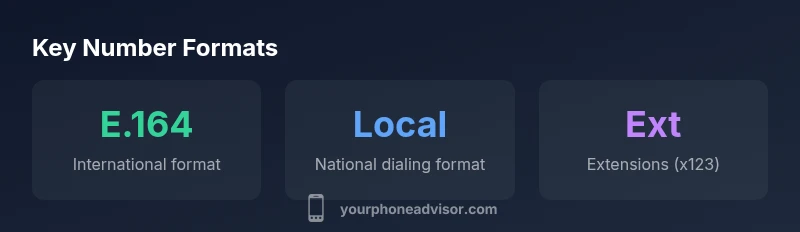
| Format standard | Example (international) | Key rule |
|---|---|---|
| E.164 | +1 202 555 0136 | Up to 15 digits, prefixed with + country code |
| National (local) | 202-555-0136 | No country code; varies by region |
| E.164 with extension | +1 202 555 0136 x123 | Extension after 'x' or 'ext' |
Got Questions?
What is E.164 and why does it matter?
E.164 is the international numbering plan that assigns unique digits for global dialing. It standardizes country codes and digits, which helps ensure numbers work across carriers and networks.
E.164 is the international standard that makes dialing consistent worldwide.
How should I format numbers on my phone?
Most smartphones store numbers in several formats, but saving in E.164 improves consistency when syncing across apps and devices.
Save numbers in international format to keep things consistent.
Is it safe to share my number publicly?
Public sharing increases exposure to spam and privacy risks. Use masking features and limit exposure whenever possible.
Be careful; consider masking when posting online.
What happens if I dial without a country code?
Dialing without a country code uses a local format. International calls may fail or route incorrectly from abroad.
Without a country code, the call may not reach the destination.
Can a phone number be linked to multiple services?
Yes, a single number can route to multiple services, but confirm with your carrier about extensions and features.
Yes, but check with your carrier about routing options.
“A phone number is more than digits—it's a routing key across networks. Storing numbers in international format reduces errors and protects privacy.”
What to Remember
- Identify the components of a complete number.
- Store numbers in international format for consistency.
- Use consistent formatting to prevent misdials.
- Be mindful of sharing numbers publicly.