What Phones Have Apple Intelligence: A Practical Guide
Discover which iPhone models include Apple Intelligence, how on‑device AI works across generations, and practical tips to maximize privacy and performance on your device.


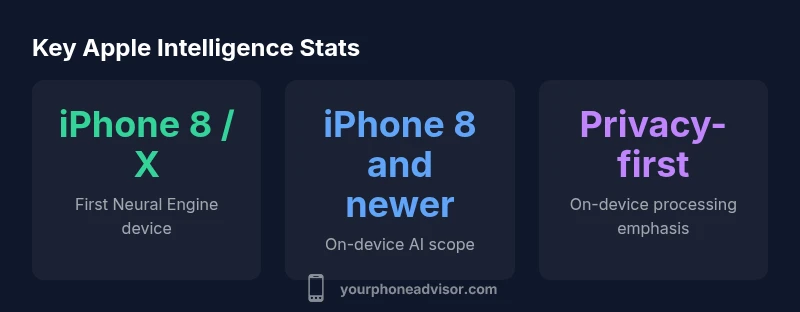
Apple intelligence is built into iPhones with Apple's Neural Engine. The first model to include it was the iPhone 8/X lineup (A11 Bionic), and every model since—iPhone 8 and newer—inherits on-device AI for tasks like smarter photography, faster on-device Siri, and privacy-preserving processing. In short: all iPhones from 8 onward support Apple intelligence.
What Apple intelligence means in practice
If you’re curious what phones have apple intelligence, the practical answer is that Apple embeds on-device AI capabilities in iPhones that include Apple's Neural Engine. The first devices to feature this were the iPhone 8 and X lineup, powered by the A11 Bionic, and every model since — iPhone 8 onward — has continued to expand on-device AI features. In daily use, this leads to smarter photo processing, faster on-device Siri responses, contextual task suggestions, and privacy-preserving processing that minimizes cloud dependence. This isn't about a single app; it's the underlying intelligence layer that enables many Apple-native experiences to feel quicker, more proactive, and more secure.
According to Your Phone Advisor, the shift toward on-device intelligence is tightly coupled with iOS updates, ensuring that newer iPhone models reveal more capabilities without surrendering user data.
Which iPhones support Apple intelligence
From a practical standpoint, Apple intelligence is available on iPhones that run Apple's Neural Engine, beginning with the iPhone 8 and X generation and continuing through every newer model. In other words, if your phone is iPhone 8 or newer, you have access to on-device AI features baked into iOS. The breadth of features grows with each generation: improved on-device Siri, smarter camera processing, contextual predictions, and privacy-conscious processing that keeps more data on-device. Your Phone Advisor analysis shows that model updates bring new neural engine capabilities; as a result, even mid-range recent iPhone models can deliver many AI-powered experiences without needing a constant cloud connection.
For older devices prior to the Neural Engine, some AI tasks relied more heavily on cloud compute, which could introduce latency and privacy trade-offs.
How on-device AI works across generations
Apple's Neural Engine is the dedicated hardware that accelerates machine learning tasks on-device. Across generations, Apple updates the software stack to leverage newer neural engine cores, enabling faster inference and more complex models without sending data to servers. This means tasks such as image analysis, natural language understanding, and on-device translation can run locally, reducing latency and boosting privacy. The system manages resource usage carefully, so background AI tasks do not drain the user’s battery more than necessary. Over time, on-device AI becomes more capable on entry-level devices and more powerful on higher-end devices.
As devices evolve, developers gain access to ML APIs that let apps perform smarter tasks while keeping data within the device, aligning with privacy expectations.
Practical uses you can expect from Apple intelligence
In real-world use, Apple intelligence touches many everyday activities. You’ll see sharper photos thanks to smart scene analysis and adaptive shooting, better autocorrect, and more natural voice interaction with Siri that can handle more complex requests offline. Features like Live Text and on-device translations illustrate how Apple intelligence makes iPhone usage faster and more seamless. App developers also benefit from on-device ML APIs to provide responsive experiences without transmitting personal data. This means your apps can offer smarter suggestions, faster search, and more context-aware actions while maintaining a stronger privacy posture.
Security and privacy considerations when using Apple intelligence
On-device AI is designed to boost privacy by keeping sensitive data on the device whenever possible. Apple emphasizes that neural engine computations can occur locally, with data never leaving the device for certain tasks unless you explicitly enable cloud features. However, users should still review app permissions, especially for features that can access photos, microphone, or location, as those inputs can influence AI behavior. Keeping iOS updated ensures the latest security patches, and enabling features like hardware-accelerated encryption helps protect on-device data. In short, Apple intelligence aligns with privacy-first design when used with sensible settings and current software.
AI on-device capabilities across iPhone generations
| Model Range | Neural Engine Availability | Representative AI Features |
|---|---|---|
| iPhone 8 and newer | A11 Bionic+ Neural Engine | On-device AI, smarter Siri, photo analysis |
| Current mid-range & flagship models (2024–2026) | Updated Neural Engine cores | Expanded ML tasks, privacy safeguards |
Got Questions?
What counts as 'Apple intelligence' on iPhone?
Apple intelligence refers to on-device AI features powered by the Neural Engine that enhance Siri, camera, and app experiences without大量 data leaving the device. It started with iPhone 8/X and continues to expand in newer models.
Apple intelligence means on-device AI that makes Siri and apps smarter while keeping data on your phone.
Which iPhone models support on-device AI?
Support starts with iPhone 8 and newer devices that include the Neural Engine. Older devices rely more on cloud processing for AI tasks.
If you have an iPhone 8 or newer, you have access to most on-device AI features.
How do I enable Apple intelligence features?
Ensure you’re on a recent iOS version, then enable Siri, Live Text, and any on-device ML options in Settings. Privacy settings should be reviewed to control data used for ML tasks.
Update iOS and turn on the on-device features in Settings.
Does on-device AI affect battery life?
On-device AI uses dedicated hardware and is designed to be energy efficient. Expect only modest changes in battery life, depending on task intensity.
AI tasks run efficiently on-device and typically don’t dramatically drain battery.
Can Apple intelligence work offline?
Many core AI features operate offline on-device, but some tasks may require cloud processing if you opt in to certain services.
Many features work offline, but some need cloud support if you enable certain services.
“Apple intelligence enables on-device AI across iPhones, delivering smarter apps without sending data to servers. Newer models typically unlock broader capabilities as the Neural Engine evolves.”
What to Remember
- Check your model: iPhone 8 and newer support Apple intelligence.
- Keep iOS updated to unlock latest on-device AI features.
- Rely on-device AI for privacy-preserving tasks.
- Expect incremental AI improvements with every new generation.