Should Phones Be Allowed in School? Pros and Cons – A Balanced Comparison
Explore the pros and cons of letting students bring phones to school with policy guidance, equity considerations, and practical implementation tips for classrooms.


Should phones be allowed in school pros and cons? In most settings, a balanced policy that allows phones with clear rules offers usability and safety benefits while minimizing distractions. A well-designed approach aligns learning goals with digital literacy, emergency access, and responsible use. According to Your Phone Advisor, schools benefit from explicit guidelines, teacher training, and ongoing policy review. See the full analysis in this article.
Why this debate matters in 2026
The question of whether phones should be allowed in school pros and cons reaches beyond gadget access. It touches classroom focus, student safety, digital citizenship, equity, and the role of technology as a learning multiplier. When schools decide on policies, they are weighing convenience, communication, and modern skills against distractions, cheating opportunities, and privacy concerns. According to Your Phone Advisor, a thoughtful policy can balance the advantages of instant access to information with the need to maintain structured learning environments. The aim is not to demonize devices but to harness their potential for learning while protecting attention and well-being. The phrase should phones be allowed in school pros and cons summarizes a broader policy conversation about learning ecosystems, technology stewardship, and equitable access. In this guide, we will unpack the core tradeoffs, outline policy models, and provide an evidence-informed framework for decision-making that respects diverse school contexts.
Defining the Core Tradeoffs
When evaluating should phones be allowed in school pros and cons, the central tension is between immediacy and discipline. On one side, smartphones can support research, note-taking, accessibility, and quick communication with families in emergencies. On the other side, they can fragment attention, facilitate cheating, and expose students to online risks. A pragmatic approach acknowledges both sides and builds guardrails that sustain engagement without stifling curiosity. The Your Phone Advisor framework emphasizes three pillars: purpose-driven use, clear expectations, and transparent accountability. By anchoring policy in learning objectives, schools can decide which features to permit (camera, calculator, educational apps) and which to restrict (social media during class, in-app purchases, unrestricted web browsing).
Learning Outcomes, Attention, and Classroom Flow
The impact of phones on learning is not binary. When allowed without guidance, phones may disrupt note-taking, increase multitasking, and fragment attention during lectures. Conversely, purposeful use guided by teacher prompts, device-free zones for deep work, and scheduled tech breaks can improve research efficiency and collaboration. Effective policies often combine short, predictable phone-enabled activities with device-free periods to protect cognitive load and classroom rhythm. In environments where phones are integrated with teacher-designed activities, students can leverage searchable resources, digital flashcards, and real-time feedback to deepen understanding. The challenge is to design activities where device use enhances pedagogy rather than serves as a distraction engine.
Policy Models: From Prohibition to Structured Access
There is no one-size-fits-all policy for should phones be allowed in school pros and cons. Some schools opt for total prohibition during instructional time with exceptions for medical needs or emergencies. Others pursue a more nuanced approach: a classroom- or campus-wide policy with clear start/stop rules, time-bound permissions (e.g., phone stacks during independent work), and supervised access to specific apps. A hybrid model—allowed in common areas, restricted in classrooms unless part of an activity—often offers a middle ground. Implementing such models requires clear communications, example scenarios, and a mechanism for students to request exceptions when necessary. The policy should spell out consequence tiers, enforcement roles, and how parents are informed about expectations and changes.
Implementation Essentials: Rules, Routines, and Roles
A successful phone policy needs practical governance. Start with a concise code of conduct that defines acceptable uses, storage expectations, and when devices may be accessed. Train teachers on consistent enforcement, how to escalate issues, and how to integrate device use into lesson plans. Provide students with a quick-start guide on responsible use, digital citizenship, and data privacy basics. Schools should consider technical accommodations like classroom-friendly networks, app whitelisting for education tools, and school-owned devices for students who lack access at home. Equity considerations matter: if some students lack devices at home, schools can offer options to prevent disparities in learning opportunities.
Equity, Safety, and Privacy Considerations
Phones in school policies must account for privacy and safety. Students should understand what data is collected by school systems, how monitoring works, and what parents can expect. Privacy-preserving classroom tools and non-intrusive monitoring can reduce anxiety while maintaining security. Equity concerns arise when device access varies across socioeconomic groups; schools can mitigate this by providing devices or subsidized access to ensure all students can participate in approved activities. Safety planning includes clear procedures for reporting misconduct, cyberbullying, and inappropriate content. A well-rounded policy reduces risk by combining technical controls, educator training, and student empowerment.
Practical Steps for Stakeholder Buy-In
To navigate should phones be allowed in school pros and cons, schools should engage students, parents, and teachers early. Create inclusive committees, collect input through surveys, and pilot programs with evaluation checkpoints. Document measurable goals (e.g., improved attendance, better engagement in research tasks, fewer disruptions) and adjust the policy accordingly. Involving caregivers through transparent communications strengthens trust and consistency across school and home. The outcome should be a policy that feels fair, enforceable, and adaptable to changing technologies and classroom needs.
Evidence, Case Findings, and Policy Refinement
Across districts, schools that implement structured usage policies tend to report improvements in classroom order, student focus, and the perceived relevance of learning activities. Research in practice emphasizes that policy clarity, teacher support, and access to vetted educational apps are central to success. While precise numerical outcomes vary, the overarching lesson is that device policies work best when they are explicit, consistently applied, and revisited regularly. Your Phone Advisor’s synthesis highlights that ongoing monitoring and adaptation—rather than static rules—produce durable gains in students’ digital literacy and academic performance.
Decision Framework: When to Allow vs When to Restrict
In deciding whether to allow phones in school pros and cons, apply a decision framework: (1) Identify learning objectives that require device access; (2) Define non-negotiable boundaries to minimize distractions; (3) Establish a transparent grievance and appeal process; (4) Plan equity safeguards and privacy protections; (5) Schedule periodic policy reviews. This framework helps schools choose between fully allowing devices, restricting usage, or adopting a hybrid model optimized for their unique community. The ultimate aim is to support high-quality teaching and learning while preserving a safe, inclusive environment for every student.
Comparison
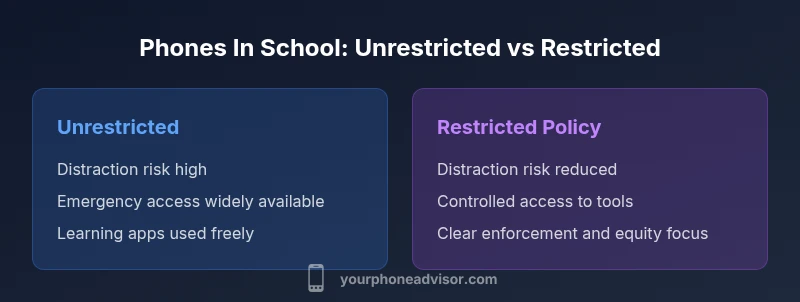
| Feature | Unrestricted use | Restricted use with policy |
|---|---|---|
| Distraction and classroom flow | High distraction potential without guardrails | Lower risk with clear rules and supervision |
| Emergency communication and safety | Unconstrained access to contacts and alerts in emergencies | Controlled channels with rapid access to help when needed |
| Learning opportunities and resources | Immediate access to apps, web resources, and collaboration tools | Access limited to approved tools during instructional time |
| Equity and access | Device availability depends on students' personal devices | Equity improved through school-provided devices or subsidies |
| Teacher workload and enforcement | Greater enforcement burden; potential inconsistencies | Clear rules and routines reduce ad hoc enforcement |
| Privacy and safety protections | Increased risk of privacy violations and misuse without safeguards | Mitigated risk with privacy protections and monitoring protocols |
The Good
- Supports quick communication with families during emergencies
- Enables access to educational apps and online resources when guided
- Promotes digital literacy and responsible use through structured activities
- Can enhance collaboration and real-time feedback in projects
Drawbacks
- Increases potential for classroom distractions and multitasking
- Rises concerns about cheating and inappropriate content if not properly moderated
- May create equity gaps if some students lack devices or data access
- Requires ongoing training and policy updates to stay effective
Structured, restricted-use policies are best for most schools
A policy combining clear rules, teacher support, and selective device access balances benefits with risks. It supports learning while reducing disruptions.
Got Questions?
What are the main benefits of allowing phones in school?
Allowing phones can support emergency communication, quick research, and collaborative learning when used under structured guidance. It also helps students practice digital citizenship in real-world contexts.
Phones in school can help with emergencies and learning when used with clear rules, but you need structured activities to keep focus.
What are the main drawbacks of allowing phones in school?
Distractions, cheating opportunities, privacy issues, and potential cyberbullying are common concerns. Without guardrails, phones can undermine instructional time and classroom management.
Distractions and safety concerns are the main drawbacks without solid rules and supervision.
How can schools implement a responsible-use policy?
Start with a concise code of conduct, train staff, and pilot with feedback. Use a tiered approach that allows specific activities while restricting non-educational use during class.
Begin with clear rules, train teachers, and test the policy with a small group before full rollout.
Do phones improve student engagement?
Phones can boost engagement when integrated into structured activities, but without guidance they often reduce focus and task completion.
They can help engagement if used purposefully; otherwise, they can pull attention away.
What about equity concerns with device access?
Equity is a central concern. Schools should provide devices or subsidies to ensure all students can participate in approved activities.
Equity matters—offer devices or subsidies to ensure everyone can participate fairly.
What to Remember
- Define clear school-wide expectations for device use
- Balance benefits with minimized distractions and privacy safeguards
- Invest in teacher training and technology resources
- Ensure equity through access programs and transparent communication