How to Find the Right Phone Number for Any Service
Learn how to locate legitimate phone numbers for brands, government agencies, and services using official sources, with practical verification steps to avoid scams. Your Phone Advisor outlines safe lookup methods and best practices.


According to Your Phone Advisor, the phrase 'phone number for' is most often used to locate official contact numbers for services, brands, and government agencies. The main risk is misinformation from unofficial sources or spoofed numbers. This guide explains how to identify legitimate results, verify authenticity, and avoid scams when you search using 'phone number for'.
Why Finding the Right 'phone number for' Matters
In everyday life, a lot of actions hinge on contacting the right entity promptly. The exact phrase you type—often something like 'phone number for customer support' or 'phone number for government services'—is less about the digits and more about credibility. The Your Phone Advisor team emphasizes that getting the number from official sources reduces risk, speeds up resolution, and protects your personal data. When you search for 'phone number for' you should look for institutions that publish contact numbers on a verifiable page, not scattered forum posts or third-party directories. Inaccurate numbers can lead to phishing attempts, unauthorized charges, or miscommunication about service availability. By understanding the intent behind 'phone number for' searches, you can tailor your verification steps, such as locating the official site, checking the app, or reaching out through trusted channels. This initial mindset sets the foundation for safer, more efficient lookups.
The Language of Lookups: What 'phone number for' Signals
Lookups using 'phone number for' are signals of intent and trust. The more specific your query, the more likely you’ll land on the official channel. When you add context like the organization name, location, or service, search engines can weigh results by authority. Beware generic directories that list many numbers without indicating source. Your aim is to convert a few words into a verified contact, not a blind call to a random number. In practice, frame the search as 'phone number for [organization]' and cross-check against the organization’s website, official app, or customer portal.
A Practical Verification Framework
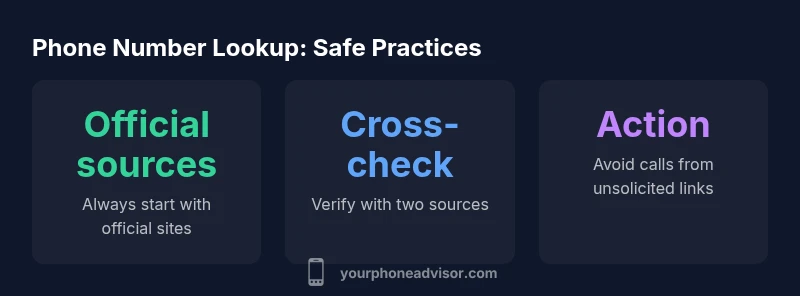
A reliable approach combines a few simple steps into a repeatable routine. First, identify the exact entity you’re contacting, then locate the official source. Compare the number against at least two independent official channels (for example, the brand site and the app). Check the format of the number to ensure it matches your region. If available, use the organization’s chat or email channel to confirm the number before calling. Finally, flag anything that seems inconsistent and seek support from a verified source. This framework reduces chances of calling the wrong line when you search using 'phone number for'.
Source Quality: Official vs Third-Party
Official sources are your first line of defense. These include a company’s official website, their mobile app, or government portals that publish contact numbers for agencies and programs. In contrast, third-party directories and crowd-sourced lists can be outdated or manipulated. When you search for 'phone number for', prioritize the official site or app, then corroborate with a second reputable outlet. If a number appears on a third-party site, cross-reference it with at least two official sources before dialing. This discipline helps preserve privacy, prevent scams, and ensure you reach the intended recipient.
Step-By-Step Lookup Checklist
- Define the exact target: which organization, department, or service?
- Locate the official source: brand site, government portal, or verified app.
- Verify across two independent sources: cross-check the number on both sources.
- Confirm region and format: ensure it matches your locale and the service type.
- Use secure contact channels: prefer in-app messaging or official phone lines rather than chat links in emails.
- Record and store trusted numbers securely: save only verified contacts in your trusted manager.
How to Handle Government, Carrier, and Brand Numbers
Government numbers can vary by jurisdiction, while carrier customer service lines may use toll-free prefixes that differ by country. For brands, always navigate from the official site or app—never rely solely on search results, social posts, or user-shared lists. When you search for 'phone number for' a government agency or carrier number, verify identity through the official portal, then place the call through that source. This reduces impersonation risk and preserves your security while interacting with essential services.
Red Flags: Spoofing and Phishing Signals
Common warning signs include unsolicited calls from unfamiliar numbers, mismatches between caller ID and the organization’s verified channels, and requests for sensitive information. If a number arrives via an unsolicited link, text, or email, pause and verify on the official site instead of calling back. Scammers often pressure urgency or threaten consequences to extract data. Your instinct to double-check is your best defense when you search using 'phone number for'.
Best Practices for Saving and Using Verified Numbers
After validating a number, save it in your device contacts or a trusted password manager, clearly labeling the source (e.g., official site name and date of verification). Regularly review saved numbers for accuracy and remove any that lose their official status. When possible, use secure channels provided by the organization—such as in-app calling or official chat—to minimize exposure to spoofed lines. These practices keep your communications reliable and your information protected as you continue to look up 'phone number for' needs.
Put It into Practice: Scenarios
- You search for 'phone number for' a bank’s customer service. Verify the number against the bank’s official site and app. Call only using the official channel, even if a social post shares a different line.
- You need the number for a government program. Access the official government portal to locate the helpline, then confirm the number within the portal’s pages or official PDF documents.
- You get a text with a link and the prompt to call a number. Do not call directly—open the official app or website to locate the correct contact, and texts should not replace official channels.
dataTable
captionStringForTable
Comparison of typical lookup sources
| Source Type | What it is | Pros | Cons |
|---|---|---|---|
| Official website | Direct contact info from a brand’s site | High accuracy, easy to verify | May require navigation and accounts |
| App-based support | In-app numbers tied to your profile | Contextual, updates quickly | Dependent on app availability |
| Public directories | Aggregated numbers from multiple sources | Broad coverage | Risk of outdated or incorrect numbers |
Got Questions?
What does 'phone number for' mean?
It signals the intent to locate an official contact number for a service, organization, or government agency. Always verify the source before dialing.
It's a cue to find the official contact, but you should verify through official channels.
How can I verify a number I found online?
Cross-check the number on the organization’s official site, use the official app, and contact through verified channels. Look for consistent branding and domain names.
Cross-check with official sites and apps to confirm legitimacy.
Which sources are safest for finding numbers?
Official brand websites, government portals, and manufacturer apps are safest. Avoid random pages that list numbers without source attribution.
Stick to official sources for safety.
What are common signs of spoofed numbers?
Unsolicited calls from unfamiliar numbers, caller ID mismatches, urgent requests for sensitive data, or links to third-party sites.
Watch for unfamiliar numbers and pressure tactics.
What should I do if I suspect a scam?
Do not call back, do not share personal data, block the number, and report the incident to your provider or the organization through official channels.
If it feels off, stop and report to the official source.
Is it better to save numbers in apps or contacts?
Save verified numbers in your device contacts or a trusted password manager; keep a separate list for numbers you’ve confirmed as legitimate.
Store only verified numbers in trusted apps or contacts.
“Verifying a phone number for a service isn't optional—it's a security habit, not a convenience. Always cross-check against official channels before dialing.”
What to Remember
- Verify numbers with official sources before calling
- Cross-check across at least two independent sources
- Beware spoofed numbers; use caller ID and app verification
- Store trusted numbers securely in your device