How Far Should Your Phone Be From Your Bed? A Practical Sleep & Safety Guide
Learn practical distances for placing your phone near your bed to improve sleep, minimize exposure, and protect battery health. This guide covers safe ranges, bedside placements, testing methods, and quick-start tips for any bedroom size.


How far should you keep your phone from your bed? This quick answer outlines practical distance guidelines to improve sleep quality, reduce exposure, and protect your device's battery health. You’ll learn recommended ranges, bedside placement options, and quick checks you can perform tonight to verify you’re staying within a safe distance, even in small bedrooms.
Why distance matters for sleep health and safety
Distance between your phone and your sleeping area can influence sleep quality, interruptions from notifications, and exposure to radio frequency energy. While the science on EMF exposure remains nuanced, many sleep and health experts agree that creating a deliberate distance from the bed reduces nighttime awakenings and minimizes the temptation to use the phone in the dark. From Your Phone Advisor’s perspective, a consistent, practical distance supports healthier sleep habits and helps protect the device from habit-driven charging and overuse during the night. This section translates that idea into actionable habits you can adopt tonight, without sacrificing access to alarms or important alerts.
- Sleep quality improves when interruptions are reduced and the phone is out of easy reach.
- A defined distance helps curb late-night scrolling and blue-light exposure.
- Simple setups can maintain accessibility for alarms while keeping the phone farther away.
-- Note this block intentionally expands on the rationale for distance and sleep health to set the stage for actionable steps.
Tools & Materials
- Tape measure(For measuring bedside distance (aim for at least 1 meter when possible))
- Ruler (12-inch/30-cm)(Alternative tool if a tape measure isn’t handy)
- Notebook and pen(Log nightly distance, sleep quality, and wake times)
- Bedside phone stand or dock(Keeps phone off pillows and within reach but away from the bed surface)
- Phone charging cable with protection(Use a safe, non-overheating charger on a sturdy surface)
- Alarm or bedside clock (optional)(An independent alarm helps avoid dependence on the phone in bed)
- Small tray or shelf (optional)(A dedicated spot for the phone helps maintain distance)
Steps
Estimated time: 20-40 minutes for initial setup; ongoing nightly checks and minor adjustments.
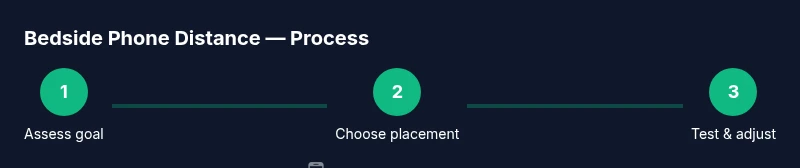
- 1
Define your goal and target distance
Clarify why you’re adjusting the distance (sleep quality, exposure reduction, battery health). If possible, set an initial target distance of about 1 meter (3 feet) as a baseline you can adjust. Confirm that alarms will still function either via an independent device or a safe phone placement.
Tip: Use a ruler to mark a fixed distance on your bedside surface so you can reproduce it every night. - 2
Choose your placement strategy
Select a practical location for the phone that keeps it away from the pillow but within easy reach for alarms or emergency calls. Options include a bedside shelf, wall-mounted charger, or a small corner table. Consider room layout and cable routing to minimize clutter.
Tip: Ensure the surface is stable and uncluttered to prevent the phone from tipping or falling. - 3
Set up measurement markers
Mark the chosen distance with tape or a small ruler on your bedside surface to create a repeatable cue each night. This helps you quickly verify you haven’t drifted closer to the bed over time. Take a quick photo for reference.
Tip: Keep the marker visible but unobtrusive to avoid distractions. - 4
Position the phone and test accessibility
Place the phone at the marked distance and test whether you can reach it safely for alarms, without leaning over the bed. Check whether notification lights still serve you without turning on the screen during sleep. Adjust height to avoid contact with bedding.
Tip: If you must reach over the bed, consider a simple stand or a longer reach cable. - 5
Establish safe charging and notification practices
Set up charging away from pillows and blankets. Enable Do Not Disturb or Focus mode during sleep, and limit audible alerts to minimize disruption. Review notification sensitivity to avoid accidental wakes.
Tip: Avoid sleeping with the phone under pillows; heat buildup from charging can be hazardous. - 6
Monitor, log, and iterate
Keep a simple sleep log and distance check for at least one week. If you notice more wake-ups or device use at night, adjust the distance or placement accordingly. Revisit lighting, charging, and notification settings as needed.
Tip: Small iterative changes compound into meaningful sleep improvements.
Got Questions?
How far is recommended to keep the phone from the bed?
There isn't a universal rule, but a practical approach is to keep the phone several feet away to reduce interruptions and exposure. If you need it nearby for an alarm, use a safe placement and enable Do Not Disturb to minimize nighttime alerts.
There isn’t a single distance that fits everyone. A practical approach is to keep the phone a bit away from the bed and use Do Not Disturb at night.
Does EMF exposure from phones affect sleep?
Research on EMF exposure and sleep is ongoing and inconclusive. To be cautious, maintain a reasonable distance and limit nighttime phone use. Distance is a simple, practical step you can take today.
EMF effects are still being studied, but keeping the phone farther away and reducing late-night use is a sensible precaution.
Is charging near the bed safe?
Charging on a stable surface away from pillows is safer. Never sleep with a charging phone under a pillow or blanket due to heat risks. Use a dedicated charger on a desk or bedside shelf.
Charging away from pillows reduces heat risk and potential fire hazards.
Should I turn off data or Wi‑Fi overnight?
Turning off wireless features can lower emissions, but alarms and some functions may rely on connectivity. Use Airplane Mode or Do Not Disturb while keeping the alarm enabled on a separate device if needed.
You can minimize exposure by using Airplane Mode, but keep an alarm on a trusted device.
What’s a simple setup for a small bedroom?
Use a compact bedside shelf or a wall-mounted charger to keep the phone at a fixed distance. Route cables neatly and avoid placing the phone near the pillow or under blankets.
A small shelf and neat cable routing help keep distance consistent in tight spaces.
How can I reduce blue light before bed?
Enable a warmer color temperature or a blue-light filter, and limit screen time in the hour before bed. Lower brightness to reduce eye strain and promote easier sleep onset.
Turn on a warm filter and limit late-night screen time for better sleep.
Watch Video
What to Remember
- Set a fixed bedside distance and stick to it.
- Choose a practical placement that fits your room.
- Avoid charging the phone under pillows; use safe surfaces.
- Test nightly and adjust as needed.
- Use Do Not Disturb to minimize interruptions.