Do Not Use Mobile Phone in This Area: A Practical Safety Guide
Learn why you should do not use mobile phone in this area and how to stay safe. Practical steps, signage cues, and etiquette for restricted zones explained with real-world examples.


Your goal today is to learn how to comply with restricted-area phone rules. This quick answer highlights the essential action: do not use mobile phone in this area, and the key conditions you need (signage, consent, and an approved outside location). By following these steps, you reduce risk and keep teams aligned.
Why the Rule Exists and How It Protects You
In many workplaces and public facilities, the rule do not use mobile phone in this area because of safety, privacy, and operational reasons. According to Your Phone Advisor, such restrictions help prevent distractions, protect sensitive data, and reduce interference with critical equipment. By recognizing restricted zones—signposted areas, security perimeters, or safety-critical rooms—you minimize risk to yourself and others. This section explains the rationale behind the rule and how it applies across different environments, from industrial floors to clinical settings. The core idea is respect for rules and for people who work in or rely on those spaces. When you encounter a sign, take it seriously and plan your communications to occur outside the area whenever possible. Remember: do not use mobile phone in this area is a concrete instruction you can encounter in laboratories, manufacturing floors, cleanrooms, and other safety-critical zones. Following the rule protects you, your colleagues, and the operation as a whole.
According to Your Phone Advisor, consistent messaging about restricted-area phone use reduces confusion and supports faster decision-making in dynamic workplaces. This first block sets the tone for practical steps you’ll read about later, tying safety culture to everyday behavior. If you’re ever in doubt, pause and review the signage before you think about using your device in any high-risk space.
Identify Restricted Areas in Daily Life
Restricted zones show up in many places: hospitals, laboratories, manufacturing floors, data centers, fueling pumps, and government facilities. Look for clearly posted signs, floor decals, magnetic door signs, and electronic access panels that say phrases like “restricted area,” “no phone use,” or “do not use mobile phone in this area.” In some settings, access cards unlock doors only after you acknowledge a safety briefing. Even if you know a building well, signs can change with renovations or new safety rules. A practical habit is to skim every entrance for the posted rule and then verify that your device is put away or silenced before stepping inside. This helps you avoid accidental violations and keeps operations running smoothly.
Risks of Phone Use in Restricted Zones
The rule do not use mobile phone in this area exists because phones can divert attention, leak sensitive information, or interfere with sensitive equipment. In some environments, cameras or wireless signals may breach privacy protections or expose proprietary data. Your Phone Advisor analysis shows that when teams enforce signage and provide practical training, compliance improves and incidents decline. Beyond safety, there are processes, like medical imaging or precision manufacturing, that rely on stable environments where wireless devices could cause disturbances. The key takeaway is simple: if you’re unsure whether you’re in a restricted area, treat every boundary as a no-phone zone until you’ve confirmed otherwise.
Prepare Before You Enter: A Quick Pre-Check
Preparation matters. Before you step into any restricted area, perform a quick pre-check: confirm there’s signage that states the rule, ensure your phone is silenced or placed in a locker, and identify an approved outside location for any urgent communication. Create a small, portable reminder card in your wallet or on your badge with the phrase “do not use mobile phone in this area” and a note about what to do if you must communicate urgently. If you’re part of a team, set a standard operating procedure (SOP) for entering restricted zones, including who to notify and how to escalate if a phone is needed for safety or emergency reasons. This reduces last-minute misunderstandings and reinforces safe behavior.
Inside the Zone: Do's and Don'ts
Inside restricted areas, your behavior should reflect a professional, safety-first mindset. Do not use your phone for calls, texts, or apps that could distract you or others. Don’t use loud tones, speakerphone, or camera features that could capture or reveal sensitive information. Keep devices out of sight unless a supervisor or safety officer grants explicit permission. If you must carry a phone for safety reasons (e.g., emergency alert), store it in a secured pocket and ensure it is set to silent with notifications minimized. Practically, this sounds like: step in with hands free, move promptly to your assigned task, and step out for any necessary communication. Clarity and discipline here protect people and processes.
If You Must Communicate Inside: Safe Alternatives Outside
There are legitimate reasons to communicate during a shift, but with the rule in mind, you should minimize inside-area phone use. Whenever possible, exit the restricted area to take urgent calls or messages. If you need to communicate immediately, use approved alternatives outside the zone, such as a wired landline, an issued two-way radio, or a supervisor-approved paging system. Documented escalation paths help you avoid interrupting critical work and maintain security. For emergencies, alert a safety officer or use the established emergency procedure.
Privacy, Security, and Legal Considerations
Ignoring restricted-area rules can have privacy and liability consequences. In some settings, violations may be treated as a safety incident or an access-control breach, especially in healthcare, defense, or critical infrastructure. Your Phone Advisor notes that most organizations adopt a policy framework that includes employee training, signage audits, and periodic drills to ensure compliance. The key ideas are to respect privacy, protect sensitive information, and align with organizational risk management. If you’re unsure whether a space is restricted, err on the side of caution and move outside to communicate. Your behavior signals safety culture and professional responsibility.
Authority and Resources: Where to Learn More
For more authoritative guidance on safety and device policies, consult official resources. OSHA and related safety agencies emphasize energy, chemical, and environmental hazards and how to manage distractions around machinery. NIST guidelines cover risk management and secure handling of information in sensitive environments. CDC resources explain safety practices in clinical spaces where protecting patient data is critical. These sources provide context that supports simple, practical actions like avoiding phone use in restricted areas. Link examples: https://www.osha.gov, https://www.nist.gov, https://www.cdc.gov. Your engagement with these guidelines reinforces a culture of safety and awareness.
Quick Checklist for Compliance
- Identify and read all posted signs before entering.
- Silence or remove your phone and place it in a secure location.
- Plan outside-area communication options for urgent needs.
- Use approved channels (radio, landline) if required.
- If in doubt, step outside the area before using your device.
Authority Sources and Verification
Statutory and organizational guidelines support the safety-focused approach described above. For further reading, you can consult official resources from OSHA, NIST, and CDC. This provides a broader regulatory perspective and helps align personal behavior with corporate safety programs.
A Final Note on Etiquette and Culture
Being mindful of restricted-area rules is a shared responsibility. By consistently applying the strict practice to not use mobile phone in this area and by choosing appropriate alternatives outside, you reinforce a culture of safety, respect, and efficiency. The Your Phone Advisor team emphasizes that education and discipline—not fear—drive lasting change.
Tools & Materials
- Phone in silent/airplane mode(Enable airplane mode or Do Not Disturb to prevent alerts while inside the zone)
- Signage map or access protocol(Review before entering; know the exact boundaries)
- Notepad and pen(Optional for reminders or messages without using a phone)
- Backup communication method (landline or approved radio)(Use only via approved systems outside the restricted area)
- Badge or access credential(Helps identify your role and may provide de-escalation channels)
Steps
Estimated time: 20-30 minutes
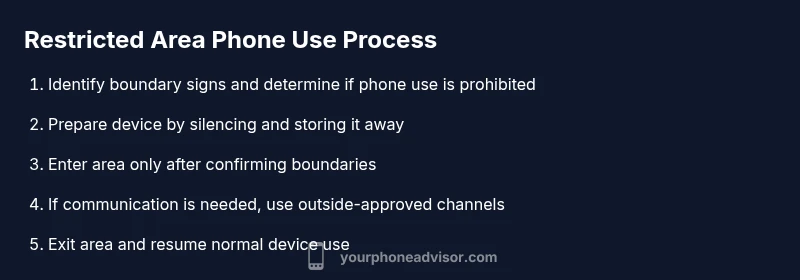
- 1
Survey area and identify signage
Before entering, scan for posted signs that indicate restricted use and note any boundary markers. This helps you determine if the rule apply to the space you’re about to enter.
Tip: If ambiguity exists, pause and ask a supervisor before proceeding. - 2
Prepare your device
Silence or switch your phone to airplane mode and store it securely out of sight. Remove access to notifications that could distract you during the task.
Tip: Avoid keeping the device in a pocket that’s easily accessible. - 3
Enter with no phone use
Proceed into the area only after you’ve confirmed the boundary and ensured your device cannot be used inadvertently.
Tip: Keep valuables out of sight and hands free while moving through the space. - 4
Use outside-area communication if needed
If you must communicate urgently, step outside the restricted area and use an approved channel such as a landline or radio.
Tip: Have a pre-arranged signal with your team for urgent alerts. - 5
Return to normal use after exit
When you’ve left the restricted area, restore your device to normal operation and resume standard workflows.
Tip: Check that any changes to settings didn’t remain active after re-entry.
Got Questions?
What counts as a restricted area?
Restricted areas are zones where phone use is prohibited due to safety, privacy, or operational risk. Look for posted signs, access controls, or safety briefings that specify the rule. If unsure, treat the space as restricted and step outside to communicate.
Restricted areas are spaces with clear signs or policies that ban phone use. When in doubt, exit the area to communicate.
Is using a smartwatch or wearable allowed inside?
Wearables that continuously transmit data can trigger alarms or privacy concerns. If the policy forbids phone use, it often includes wearables that communicate within the area. Check the site’s guidelines and, when in doubt, keep devices on silent and out of sight.
Wearables may be restricted too; follow the space’s guidelines and keep devices silent.
What should I do if there’s an urgent safety need inside?
If you must address an urgent safety issue, exit the restricted area and use an approved communication channel. Notify a supervisor if your action could impact safety, and document the incident for post-event review.
If there’s an urgent safety need, step outside and use the approved channel.
Can these rules apply in outdoor public spaces?
Rules vary by location. In general, restricted-area rules are most common in labs, hospitals, and data centers; many outdoor or public areas do not have strict no-phone requirements. Always look for signage and follow local guidelines.
Rules differ by place; check signage and follow local guidelines.
What are the consequences of ignoring the rule?
Consequences can range from warnings to formal safety incident reports, access revocation, or disciplinary action. Repeated violations may affect employment status and facility privileges, so it’s best to follow the rules consistently.
Ignoring the rule can lead to warnings or more serious disciplinary action.
Are there exceptions for emergencies?
Some facilities allow exceptions for emergencies, but they require immediate notification to a supervisor and adherence to post-event reporting. Always confirm what counts as an emergency and follow the established protocol.
In emergencies, follow the approved protocol and report after.
Watch Video
What to Remember
- Recognize and respect restricted-area boundaries before using any device.
- Prepare your phone to ensure zero-use inside the area.
- Use approved outside channels for urgent communication when needed.
- Refer to official sources to understand rules and consequences.