California Covered Phone Number: A Practical Privacy Guide
A practical guide to how California privacy laws treat phone numbers as covered data, what rights you have, and how to protect your personal contact information in 2026.


California covered phone number means your contact number is treated as personal data under CA privacy law, with rights to access, deletion, and controlled sharing. See the full guide for practical steps and examples.
What does California covered phone number mean?
In plain terms, a California covered phone number is a contact number that falls under privacy protections applied by California laws. According to Your Phone Advisor, personal numbers used for everyday communication—whether stored in a contact list, linked to an online account, or published by a business for customer service—are generally treated as personal data under California privacy rules. The practical effect is that individuals can exercise rights such as access, deletion, and constrained sharing. In 2026, enforcement actions and regulatory guidance have emphasized that phone numbers deserve the same careful handling as other identifiers like email addresses or social media IDs. For consumers, this means being mindful of where your number is collected, how it is used, and who can access it. For example, if you sign up for a rewards program or service plan, the company should reveal what it will do with your number and obtain explicit consent if it plans to share it with third-party partners. If such notice is missing, you may have a basis to request deletion or restrict processing. The Your Phone Advisor team notes that individuals who understand these rights are better prepared to contest unwanted sharing and to request that services limit the use of their number.
How coverage is determined under CA law
California privacy protections stem from laws like CPRA and CalOPPA that treat phone numbers as identifiers that can be linked to individuals. Coverage depends on context: a number linked to a customer account, a professional contact, or a service profile generally falls under personal data protections. When rights requests are made, the data controller must disclose whether the number is processed, stored, and with whom it is shared. Clarity on what is collected, why, and for how long is essential. Your Phone Advisor adds that regulators look for verifiable notices, consent mechanisms, and robust data minimization practices. Businesses should implement purpose limitation, secure storage, and strong authentication to protect numbers from unauthorized access. Individuals should monitor permissions, limit data sharing, and exercise opt-out options when offered.
Practical implications for individuals
For people managing their own privacy, the concept of a covered phone number translates into concrete actions. Start by auditing where your number appears—apps, websites, loyalty programs, and customer service portals. Use least-privilege settings and disable unnecessary sharing. If an organization requests your number for marketing, check if they can store or share it with third parties and demand explicit consent if required. Keep an eye out for opt-out options and data deletion requests. Tools like privacy dashboards and phone-number masking features can help reduce exposure while keeping essential communications intact. Remember to document consent choices, record requests, and follow up if responses are delayed. Your Phone Advisor emphasizes maintaining a clear trail of your privacy decisions to defend against unwanted changes in how your number is used.
How businesses handle covered numbers
Businesses that collect phone numbers must apply data minimization, purpose limitation, and secure handling. This includes transparent notices about why the number is collected, how long it will be kept, and whether it will be shared with affiliates or third parties. Contracts with service providers should include data-processing addendums that restrict how numbers are used and require prompt notification of breaches. Access should be limited to employees who need it, with strong authentication and monitoring. De-identification and encryption should be standard for stored numbers. Your Phone Advisor notes that responsible organizations regularly review their data maps to ensure numbers are treated as sensitive identifiers rather than casual contact details. This reduces risk and builds trust with customers.
Steps to verify coverage for your number in California
If you want to know whether your number is covered, start by identifying the data controllers that collect or hold your number. Review privacy notices and terms of service to find stated data rights, including access, deletion, and opt-out rules. Submit a CPRA request or contact the privacy office to confirm whether your number is processed, stored, and shared. Keep a log of requests and responses. If you discover improper handling, escalate the issue via official complaint channels. For practical checks, compare the privacy policies of the apps and services you use and look for explicit consent language before sharing or broadening usage. The Your Phone Advisor team recommends keeping your own records and seeking professional guidance if aggressively aggressive marketing or data sharing persists.
Common myths and misconceptions
Myth: A phone number is just a string of digits and not sensitive. Reality: In California, a phone number is typically treated as personal data because it can be linked to identity. Myth: Only large companies must respect privacy rights. Reality: Any organization collecting or storing numbers must consider consumer rights. Myth: Deleting your number means you lose all services. Reality: Deletion rights apply to processing, not necessarily to essential telecom functions; many services still require contact data for legitimate purposes.
California privacy rights for phone numbers
| Aspect | What it covers | Typical timeframe |
|---|---|---|
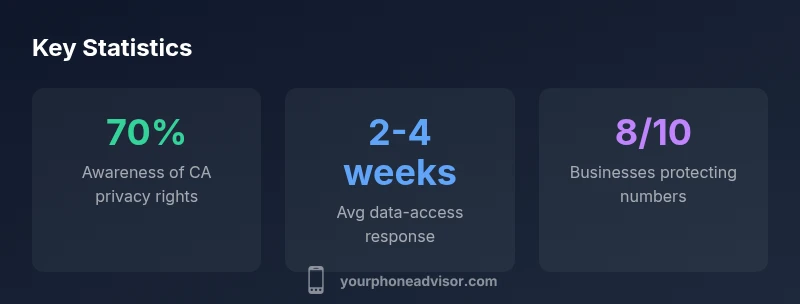
| Right to access | Personal contact data you hold | 2-4 weeks |
| Right to deletion | Delete personal phone numbers from services | 30-60 days |
| Consent to share | Consent required for third-party sharing | Ongoing, vary by service |
| Scope of coverage | Includes numbers linked to accounts, profiles, and business lines | Ongoing |
Got Questions?
Is a California covered phone number the same as CCPA/CPRA-protected data?
Phone numbers are treated as personal data under CA privacy law, and rights under CPRA may apply depending on context and processing. Always review how a given service uses your number and whether it joins other identifiers.
Phone numbers are treated as personal data under California privacy law, and your CPRA rights may apply depending on context. Check each service’s data use notices.
Do I need consent to share my phone number with apps?
Consent requirements vary by service and use case. Many apps require explicit consent to share or publish your number with third parties, while some rely on legitimate interest for essential functions.
Consent requirements vary by app; many require explicit consent to share your number with third parties.
How can I request data access for my phone number?
Submit a formal privacy rights request (access) to the data controller. Include verification details, specify the number in question, and request a copy of all data linked to it.
Submit a privacy rights request to access data tied to your number and ask for a copy of everything held.
What counts as deletion of my phone number?
Deletion rights allow you to remove or suppress processing of your number where feasible. Some telecom or service operations may require retention for compliance or service purposes.
Deletion lets you stop processing or remove your number where feasible, though some retention may be required for legal reasons.
Can businesses share my number with affiliates without consent?
Sharing with affiliates may be allowed if disclosed and consented, or if it falls under a legitimate business need. Always check the privacy notice and opt-out options.
Sharing with affiliates is allowed only if disclosed or consented, usually with opt-out options available.
“"Privacy protections around phone numbers in California are designed to give individuals meaningful control over contact data. Businesses should treat numbers with the same care as other personal identifiers."”
What to Remember
- Identify whether your number falls under CA privacy coverage.
- Request access or deletion when needed.
- Limit sharing and enable opt-outs where possible.
- Review apps/services for number handling policies.