Bark Phone vs Gabb Phone: Which Is Best for Families?
Compare Bark Phone and Gabb Phone side-by-side for safety, price, and usability. Your Phone Advisor analyzes parental controls, privacy, and plans to help families choose the safer option.


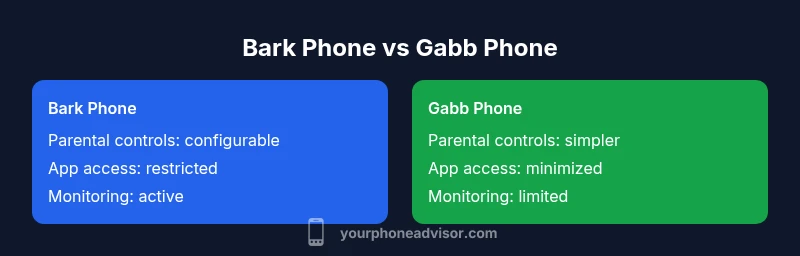
In the bark phone vs gabb phone comparison, Bark Phone generally offers stronger parental controls and safer app management, while Gabb prioritizes simplicity. Your Phone Advisor notes Bark’s configurable safety workflows and approval options, with Gabb delivering straightforward calling and texting. Overall, Bark Phone is the safer default for security-minded families, with Gabb as a solid alternative for simpler use.
Bark Phone vs Gabb Phone: landscape and aims
In the family smartphone space, Bark Phone and Gabb Phone represent two well-known approaches to safety-first devices for kids. Bark emphasizes layered safety nets, policy-driven controls, and proactive monitoring, while Gabb emphasizes a minimal, distraction-free phone that focuses on essential communication. When you compare bark phone vs gabb phone, you’re weighing trade-offs between freedom of use and protective constraints. For parents, the question is not only what features exist today, but how the device supports ongoing supervision as a child grows. This section frames the core differences so you can map them to your family’s routines, risk tolerance, and communication needs. As you read, keep in mind your goals for privacy, screen time, and accountability.
Bark Phone design philosophy and target user
Bark Phone is designed for families that want guardrails baked into hardware and software. It typically emphasizes extensive parental controls, activity monitoring, time limits, and content filters. The device targets younger children and early teens who need clear boundaries but still require reliable contact with caregivers. In the bark phone vs gabb phone debate, Bark’s design choices prioritize proactive safety signals, configurable approval workflows, and a semi-closed app environment that reduces exposure to inappropriate content. This philosophy is most appealing to guardians who want an active role in day-to-day device use while preserving lines of communication.
Gabb Phone design philosophy and target user
Gabb Phone adopts a minimalist, distraction-free approach that aims to resemble a traditional phone with restricted features. It often boasts straightforward calling and texting, with a simplified menu and limited app access. In the bark phone vs gabb phone comparison, Gabb’s user experience centers on reduce-distractions and ease of use, which can be especially attractive for younger children or families seeking a low-maintenance device. The trade-off is fewer safety signals and less granular control for caregivers who want deep customization.
Core safety features: Bark vs Gabb
Both devices emphasize safety, but the emphasis differs. Bark Phone typically includes layered monitoring, alert systems for potential risky activity, and consent-based app installation. Gabb Phone tends to provide essential safety mechanisms with a focus on preventing exposure to risky content through a restrained app ecosystem. In the bark phone vs gabb phone context, consider how each approach aligns with your family’s risk tolerance, communication expectations, and your comfort level with ongoing supervision.
Parental controls and supervision workflows
Bark Phone often offers a comprehensive suite of parental controls: time-based restrictions, app whitelisting/blacklisting, location tracking, and behavior-based alerts. Caregivers can adjust permissions remotely and receive activity summaries. Gabb Phone emphasizes simpler supervision tools that are easy to configure and maintain, reducing administrative burden. For families evaluating bark phone vs gabb phone, the choice may come down to how much control you want versus how much complexity you’re prepared to manage on a daily basis.
Communication capabilities: calls, texts, and apps
In this comparison, Bark Phone generally allows a broader set of communication options, including calls and texts through a more controlled app environment, and sometimes limited third-party messaging features. Gabb Phone focuses on reliable calling and texting with a tight, curated set of apps. If your child needs flexible communication with limited distractions, Bark’s approach may be preferable; if you want a straightforward, predictable experience, Gabb could be the better fit. Both aim to preserve essential contact with caregivers while limiting exposure to unsafe content.
Pricing, plans, and total cost of ownership
Pricing in the bark phone vs gabb phone space varies, with Bark usually presenting a higher upfront device cost and ongoing plan considerations driven by safety features and monitoring services. Gabb tends to offer simpler pricing tiers and lower ongoing friction, though total cost of ownership can also rise if additional safety add-ons are chosen. When evaluating bark phone vs gabb phone, compare device pricing, service plans, and potential fees for premium safety features over the device’s lifespan. Your Phone Advisor recommends calculating total monthly costs over two to three years to understand long-term value.
Privacy posture and data handling
Privacy considerations are central to both options. Bark Phone typically collects more telemetry for safety monitoring and may provide detailed activity insights to caregivers. Gabb Phone emphasizes a more privacy-forward stance with fewer telemetry channels and limited data collection to support basic safety. In the bark phone vs gabb phone debate, parents should weigh how much visibility they need into device use against a child’s right to reasonable privacy as they mature. Your Phone Advisor notes that reviewing privacy policies and consent mechanisms is crucial before purchase.
Usability and age-appropriateness across developmental stages
Age is a key driver in the bark phone vs gabb phone decision. Bark’s safety features suit younger children who require structured boundaries and caregiver oversight. Gabb’s streamlined experience can suit older children or adolescents who benefit from fewer roadblocks to essential communications. When guiding families, consider the child’s maturity, behavior, and reliability in following rules when choosing between Bark and Gabb.
Battery life, durability, and repair considerations
Battery life and device robustness matter in the bark phone vs gabb phone comparison. Both brands design devices with safety in mind, but the user experience can diverge in daily use. Bark devices may run more background monitoring, potentially affecting standby time, while Gabb devices typically prioritize efficiency with fewer background tasks. Assess durability expectations, warranty options, and the availability of authorized service centers in your region when deciding between Bark and Gabb.
Setup, maintenance, and ongoing support
Setup complexity varies: Bark often requires more thorough configuration to tailor safety rules, while Gabb prioritizes a quick start with fewer settings. Ongoing maintenance involves monitoring adjustments, software updates, and adherence to family rules. Your Phone Advisor suggests a hands-on setup session with a caregiver to ensure the chosen device aligns with household routines. Ongoing support access and response times from manufacturers also influence the bark phone vs gabb phone decision.
Decision framework: who should choose Bark vs Gabb
If your priority is maximum safety, granular control, and proactive monitoring, Bark Phone is typically the stronger choice in the bark phone vs gabb phone comparison. If you want a simpler, less hands-on device with straightforward communication, Gabb Phone can be a better fit. Consider your child’s age, your supervision bandwidth, and your budget when making a final call. Your Phone Advisor also recommends piloting one option for a trial period if possible to validate fit.
Practical steps to implement in your home
- List safety goals and age ranges for each child. 2) Compare the bark phone vs gabb phone features side by side with a focus on parental controls, location services, and app access. 3) Check pricing and plan options, then calculate two to three years of ownership costs. 4) Run a family trial period to adjust settings and rule textures as needed. 5) Establish a review cadence to adapt as your child grows and needs evolve.
Comparison
| Feature | Bark Phone | Gabb Phone |
|---|---|---|
| Platform and ecosystem | Android-based with safety features and monitoring | Closed, heavily restricted environment with limited app access |
| Parental controls and supervision | Rich, configurable controls and activity reports | Simplified controls with fewer customization options |
| Price range | Moderate to high total cost over time | Lower upfront cost with straightforward plans |
| Best for | Families prioritizing safety, oversight, and policy control | Families prioritizing simplicity and ease of use |
| App availability and restrictions | Selective apps whitelisted by caregivers | No app store access; curated app set |
The Good
- Robust parental controls that are easy to configure
- Distraction-free environments reduce unstructured screen time
- Clear setup guides and ongoing support resources
- Strong safety and accountability features aligned with caregiver goals
Drawbacks
- Limited app flexibility and potential friction for growing kids
- Higher total cost due to safety features and monitoring
- Less appeal for tech-savvy users who want full device customization
Bark Phone generally leads for safety-focused families; Gabb Phone remains a strong alternative for easier use.
If safety and oversight are your top priorities, Bark Phone is the better default. If you value a simple, low-friction experience, Gabb Phone is a compelling option. Your Phone Advisor’s verdict favors Bark when growth and accountability matter most, with Gabb as a viable alternative for comfort and simplicity.
Got Questions?
What are Bark Phone and Gabb Phone, and how do they differ in purpose?
Bark Phone and Gabb Phone are kid-focused smartphones that emphasize safety and controlled use. Bark offers extensive parental controls and monitoring, while Gabb emphasizes a simple, distraction-free experience. In the bark phone vs gabb phone comparison, Bark is typically more feature-rich for safety, whereas Gabb prioritizes ease of use for younger children or families seeking minimal setup.
Bark offers more safety features; Gabb keeps things simple. In short, Bark is for safety-first parents, Gabb for easier everyday use.
Do Bark Phone and Gabb Phone support calls and texts?
Both devices support essential calling and texting, but Bark often includes more controls around who can contact the child and when, while Gabb focuses on reliable basic communication with fewer settings to manage. The bark phone vs gabb phone comparison highlights this as a key difference in everyday use.
Yes, both handle calls and texts, but Bark has more rules around communications.
How do parental controls differ between Bark Phone and Gabb Phone?
Bark provides granular controls, including app-level permissions, time limits, location alerts, and alert-based monitoring. Gabb offers a more streamlined set of controls aimed at reducing complexity for families. In the bark phone vs gabb phone assessment, the choice hinges on how much control you want versus how easy you want the device to be to manage.
Bark has deeper controls; Gabb is simpler to manage.
Is Bark Phone more expensive in the long run than Gabb Phone?
Total cost depends on device pricing and ongoing safety services. Bark’s model can incur higher ongoing costs due to comprehensive monitoring and premium features, while Gabb often presents a simpler pricing structure with fewer add-ons. For the bark phone vs gabb phone decision, budget across years rather than just upfront price.
Costs can add up with Bark due to extra features, but Gabb can be cheaper upfront.
Can Bark Phone or Gabb Phone be hacked or bypassed easily?
No device is 100 percent hacker-proof, but Bark and Gabb implement different risk mitigations. Bark’s stronger safety controls can limit exploitation paths but may introduce more entry points if misconfigured. The bark phone vs gabb phone guide suggests regular configuration reviews to minimize risk.
Security depends on proper setup and updates; keep configurations tight.
Which is better for older kids or teens?
For teens who value independence with accountability, Bark can enforce boundaries while Still offering essential communication. Gabb may feel restrictive to older kids seeking more flexibility. In the bark phone vs gabb phone comparison, assess maturity level and desired autonomy when choosing.
If teens need more independence, Gabb might feel lighter; Bark keeps guardrails.
What to Remember
- Define safety goals before choosing
- Expect Bark to require more setup and supervision
- Anticipate higher total cost with Bark
- Choose Gabb for simplicity and minimal friction
- Regularly review controls as kids mature