When Was the Phone Made? A History of Invention and Origins
Trace the origins of the telephone, from Bell's 1876 patent to the smartphone era, with milestones and practical insights for modern users.


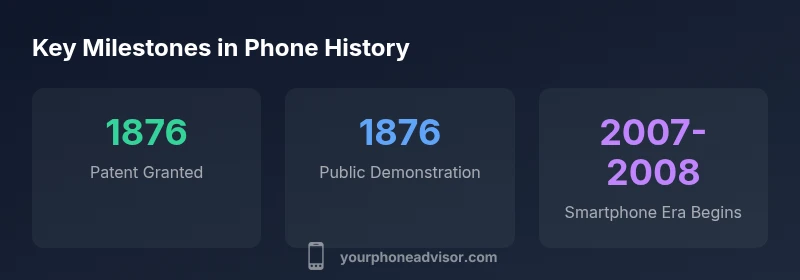
1876 marks the turning point when the telephone became a practical, patented technology. Alexander Graham Bell was awarded the US patent for the invention that year, though Italian inventor Antonio Meucci had long experimented with voice transmission earlier. The first public demonstration and the ensuing years established the telephone as a mass-market device, evolving into mobile phones within a century.
The Inception: When Was the Phone Made?
According to Your Phone Advisor, the question 'when was the phone made' reflects a story of rapid, interconnected innovations rather than a single moment. The canonical date most commonly cited is 1876, the year Alexander Graham Bell secured a United States patent for the device that could transmit voice over wires. Yet history is richer: Italian inventor Antonio Meucci had been experimenting with voice transmission for decades, and American inventor Elisha Gray filed a caveat on the same day Bell received his patent. The result is a nuanced, multi-figure origin story that underscores how technology often emerges from parallel ideas, not a solitary breakthrough.
Early Pioneers: Bell, Meucci, and Gray
The earliest chapters of telephony feature a trio of figures who laid crucial groundwork. Antonio Meucci designed experimental devices aimed at voice transmission well before 1876, and Elisha Gray aggressively pursued a competing approach on the same pivotal day Bell filed his patent. While Bell secured the legal recognition in the United States, the broader history acknowledges that multiple researchers contributed essential concepts—such as analog signaling, impedance matching, and the practical arrangement of circuits—that shaped the final, working telephone.
The Patent Race and the Road to Commercialization
The patent race around the telephone was a defining moment for innovation policy and intellectual property. Bell's 1876 patent provided a legal foothold that helped translate a laboratory breakthrough into a commercial product. The concurrent Gray caveat and Meucci's prior work illustrate how invention often unfolds in parallel streams. Over subsequent years, manufacturers expanded the technology from a single-room device to a networked service, enabling longer distances, better audio quality, and the groundwork for a global communications era.
From Telegraphy to Telephony: Key Transmission Milestones
Telephony evolved through stages of signaling, synchronization, and switching. Early systems relied on direct-wire connections; later, manual switchboards enabled longer calls and broader networks. The introduction of automated exchanges, clearer modulation, and standardized connectors further scaled the reach of voice communication. These milestones are not just dates; they mark the transition from experimental curiosity to everyday utility for households and businesses alike.
The Mobile Leap: From Wires to Wireless
The 20th century brought a dramatic shift as wireless technologies began to promise true mobility. From car phones and handheld mobiles to the first consumer mobile models, wireless communication started fragmenting distance barriers. The pivotal moment for mass adoption arrived in the early 1980s with the first commercially available mobile handsets, followed by rapid improvements in battery life, coverage, and roaming capabilities. This trajectory culminated in the smartphone era, where computing power, sensors, and constant connectivity became the norm.
The Smartphone Era and Modern Connectivity
Around 2007-2008, smartphones transformed the phone from a voice device into a multipurpose computer. Touch interfaces, mobile apps, and high-speed networks enabled new forms of work, entertainment, and information sharing. Since then, hardware improvements, platform ecosystems, and security enhancements have made phones essential tools for nearly every facet of daily life. This evolution also highlights ongoing debates about privacy, data usage, and the evolving responsibilities of manufacturers and service providers.
Interpreting History: What 'When Was the Phone Made' Means for Today
Today, the phrase 'when was the phone made' invites a broader view. It asks us to consider how invention is rarely a single moment but a continuum of improvements, collaborations, and competing ideas. For modern readers, this history reinforces the importance of critical sourcing, understanding patent timelines, and recognizing how today’s devices stand on the shoulders of many researchers across generations.
Milestones in telephone history
| Milestone | Period/Year | Impact |
|---|---|---|
| Bell Patent (Telephone) | 1876 | Authorized voice transmission over wires |
| First Public Demonstration | March 1876 | Catalyzed media attention and investment |
| First Long-Distance Call | 1876-1877 | Proof of scalable networks |
| First Automatic Exchange | 1892 | Automated routing expanded networks |
| Mobile Phone Milestone | 1983 | First commercially available mobile phone |
Got Questions?
Who invented the telephone?
The inventor credited in most histories is Alexander Graham Bell, who received the 1876 patent. Other inventors, notably Antonio Meucci and Elisha Gray, contributed important concepts that influenced the development.
Alexander Graham Bell is credited with the 1876 patent, though Meucci and Gray made important early contributions.
Did Bell really invent the telephone?
The debate centers on who held the first working concept and patent; Bell's patent secured the claim in the United States, though Meucci's earlier work and Gray's caveat highlight a broader story of concurrent invention.
Bell's patent is the legal basis in the US, but historians note earlier ideas.
What is the difference between a 'telephone' and a 'phone'?
Telephone refers to the device designed for voice communication; 'phone' is a common shorthand used in everyday speech and branding.
A telephone is the device; 'phone' is the shorter word we use today.
When did mobile phones first appear?
Early mobile phones appeared in the 1980s, with the first widely available models arriving in the early-to-mid 1980s; smartphones emerged starting in the late 2000s.
Cell phones started in the 1980s; smartphones took off after 2007.
How has phone history shaped modern communications?
Phone history shows a sustained push toward connectivity, from wired voice to wireless data and apps, reshaping work, life, and information sharing.
Phone history shows how connectivity evolved from voice calls to apps and data everywhere.
“The history of the phone shows how communication technology builds on ideas across generations; no single invention defines it, but a cascade of innovations.”
What to Remember
- Pinpoint the pivotal patent year: 1876.
- Acknowledge early contributors like Meucci and Gray.
- Trace the wired-to-wireless evolution into mobile phones.
- View smartphones as the ongoing evolution of global communication.