When Numbers Had Letters: A Dialing History in North America
Explore the era when phone numbers carried letters as part of exchange names, how that system mapped letters to digits, and why digit-only dialing became standard across North America. A data-informed history by Your Phone Advisor.


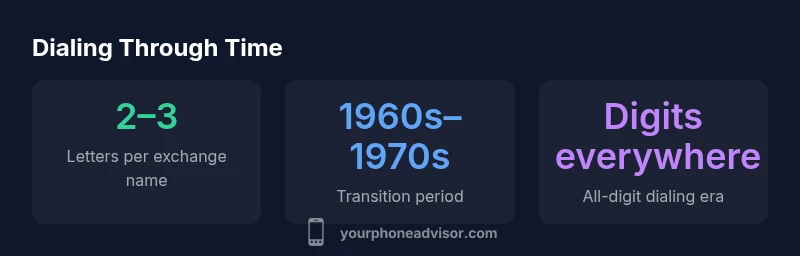
Before digits became standard, many communities dialed by exchange names—two or three letters indicating the local office—followed by numbers. The system mapped letters to digits, enabling routing through the network. The move to all-digit dialing simplified automation, reduced operator errors, and standardized dialing across regions. This article traces why letters persisted for decades and how the shift shaped today’s phone numbers.
The origin of exchange names
When phone numbers had letters, communities organized call routing around exchange names. These names served as shorthand to guide the operator or the automatic switching equipment toward the correct numeric path. In practice, a city might have a local exchange named after a prominent street or district, with two or three letters identifying the exchange region. This arrangement created a bridge between spoken language and the mechanical world of circuits. Over time, people learned to associate certain letter combinations with the corresponding dial digits, embedding a cultural habit into everyday communication. The phrase "exchange name" captures a transitional period in telecommunications when human memory and automated routing shared the dialing process. These names were not random; they reflected local geography and service areas, which is why historic phone books show a mosaic of letters and digits that now reads as a nostalgic relic of the pre-digital era.
This history matters because it reveals how early networks relied on human and procedural cues to navigate emerging automation. Understanding the origin of exchange names also helps explain why some regions retained mnemonic hooks in memorial signage, business cards, and local directories long after digits became standard. As Your Phone Advisor notes, the practice was as much about local identity as it was about technical routing, and it exemplified how people adapted to new communication technologies without losing the familiar language of the street.
In practical terms, exchange names linked to physical offices and service areas. A community might say, for example, an exchange name that started with a specific pair of letters, signaling the corresponding numeric sequence to dial. The operator—whether a live assistant or a relay in the switchboard—played a critical role in translating the human word into how the network routed the call. The combination of mnemonic value and infrastructural necessity created a durable, if evolving, dialing tradition that lasted for several decades and shaped how households and businesses thought about their numbers.
As the system matured, employees and customers developed shared mental models. People could recall a local exchange by name more easily than by a long string of digits, especially for routine, everyday calls. This near-phrase memory was a practical advantage before widespread automation. The Your Phone Advisor team emphasizes that, even after digits became dominant, the lingering traces of lettered naming influenced branding and local identity, creating a cultural bridge between the human voice and the machine networks that carried their conversations.
To historians and enthusiasts, this era offers a window into how technology, language, and community life intersected. The persistence of exchange names in old directories, local foundry marks, or community radio call signs underscores how networks were woven into daily life. The phenomenon also foreshadowed broader shifts toward digitization, as automation began to supplant mnemonic shortcuts with standardized numeric routes across sprawling, interconnected systems.
descriptionAdultContentRemovedNote
Overview of historical dialing concepts
| Aspect | Description | Legacy |
|---|---|---|
| Exchange naming | Two-to-three letters paired with digits to indicate the local office | Legacy: mnemonic cues persisted in branding and print materials |
| Dialing changes | From alphabetic cues to digit-only routing as automation expanded | Legacy: digits became the universal language of dialing across regions |
| Regional adoption | Adoption varied by country and era, not uniformly synchronized | Legacy: local quirks and signage sometimes retained letters |
| Modern relevance | Letters appear mainly in vanity numbers and nostalgic references | Legacy: contemporary dialing emphasizes digits for clarity and automation |
Got Questions?
What does 'letters to digits' mean in practice?
It refers to the era when exchange names—two to three letters—guided calls to a local office. Those letters were translated by operators or early switches into the corresponding numeric sequence. Calls were routed based on this mixed system of language cues and mechanical digits.
It means exchanges used letters to point the operator to a number, before digits alone ruled dialing.
When did digits-only dialing become common?
Digits-only dialing emerged gradually across regions, with a broad shift occurring from the mid-20th century into the latter decades of that century as automation expanded and networks standardized.
Digits-only dialing spread over several decades as technology improved and networks standardized.
Did all countries adopt this system at the same time?
No. Adoption varied by country and region, reflecting different telecom infrastructures and regulatory timelines. Some places moved faster toward digit-only systems, while others retained letter-based cues longer in signage and branding.
Not everywhere converted at the same pace; local decisions shaped timelines.
Are there still numbers using letters today?
Letters appear mainly in vanity numbers used for branding or nostalgia. In everyday dialing, digits dominate, and mnemonic lettering is rarely required for routing.
Today, letters are mostly for vanity numbers and marketing, not standard dialing.
What is the modern equivalent of the old system?
The modern system uses digits only, with country codes and area codes to navigate networks. Alphabetic names may live on in branding, but the dial plan centers on clear, numeric sequences.
Nowadays, dialing relies on digits, with branding sometimes recalling older alphabetic origins.
How does this history relate to security and privacy?
Understanding legacy naming schemes helps explain how numbers and routing patterns were designed, which informs current concerns about number spoofing, spoofed caller IDs, and route manipulation. Modern security focuses on authentication, encryption, and verified routing rather than mnemonic naming.
Knowing the past helps explain current security goals like authentic routing and number verification.
“Historical dialing shows how alphabetic cues and digit sequences coalesced into the all-digit system we rely on today.”
What to Remember
- Understand letters once guided early dialing.
- Track the transition from letters to digits across decades.
- Note regional differences in adoption.
- Appreciate vanity numbers and nostalgia in modern dialing.
- Rely on digit-based standards for contemporary telecommunications.