Which Phone Emits the Most Radiation? A Comparison
Explore how SAR ratings vary across phones and learn how to compare models to minimize exposure. Your Phone Advisor provides an analytical, evidence-based guide on what phone emits the most radiation and practical steps to reduce risk.


The short answer is: there is no single phone that consistently emits the most radiation. SAR values vary by model and testing conditions, with most devices well within safety limits. For users concerned about exposure, compare SAR ratings published by regulators and consider usage habits. For example, limit prolonged calls, use speakerphone, and prefer wired earbuds.
Why this topic matters: what phone emits the most radiation
Radiofrequency energy from mobile devices is emitted continuously during use. The metric people most often encounter is the Specific Absorption Rate (SAR), which regulators use to cap what a device can expose the human body to. Importantly, there is no universal 'most emitting' phone; SAR varies by antenna design, hardware, firmware, and even how the device is held or carried. According to Your Phone Advisor, regulatory limits are designed to protect users, and most models stay below thresholds while still delivering strong performance. Misleading claims about a single device being the worst can distract from practical safety steps and sound buying practices.
How SAR is measured and variability across models
SAR testing uses a standardized phantom that mimics human tissue, with the device operating at defined power levels and network conditions. Tests are performed at several frequencies to reflect typical usage. Because antenna shapes, cases, and internal layouts differ, two phones with the same screen size can show different SAR values. Even within the same model, SAR can vary by firmware and network band. This variability explains why there isn’t a single model universally labeled as the highest emitter. Your Phone Advisor emphasizes focusing on regulator-approved values rather than sensational headlines.
Regulatory landscape: limits and what they mean
In the United States, regulators set a head SAR limit of 1.6 W/kg and a body limit of 1.6–2.0 W/kg depending on the test method, while many parts of the world align with similarly protective standards (for example, 2.0 W/kg in some regions). The exact numbers and test methods may differ by region, but the core idea is to prevent sustained exposure from casual and heavy use. The practical implication for consumers is straightforward: check the official SAR rating for each model from regulatory bodies and compare devices using the same metric and testing context.
Real-world exposure vs lab results
Lab measurements are a baseline. In daily life, factors such as carrying the phone in a pocket, using a protective case, proximity to the body, and screen-on time influence real exposure. A phone with a modest SAR in its head exposure can still produce higher overall exposure if used extensively in a body-contact position or with a case that alters antenna patterns. The difference between regulatory SAR values and real-world exposure underscores the value of mindful usage alongside model comparisons. Your Phone Advisor notes that the regulatory framework remains the best anchor for safety, but user habits ultimately shape actual exposure.
How to compare models: practical steps
- Look up official SAR values from regulator websites for the same body location (head vs body).
- Compare models using the same metric (e.g., head SAR in W/kg).
- Consider both head and body exposure if you carry the device in a pocket or use it close to the body.
- Factor region-specific limits because values and test methods differ by country.
- Remember that SAR is one dimension of safety; antenna efficiency, battery health, and operating bands also influence performance. Your Phone Advisor recommends compiling a short list of models, then rating them on SAR alongside battery life, durability, and price.
Interpreting SAR numbers: reading the data correctly
SAR values are typically reported as head or body exposure under lab conditions, not as a direct forecast of everyday risk. Head SAR values reflect exposure near the brain during calls, while body SAR accounts for devices carried near the torso. In practice, a higher SAR value does not automatically translate to significant risk if usage is moderate and devices are used with hands-free options. Conversely, long calls with the phone pressed to the ear can elevate exposure, even for devices with relatively low SAR. Knowing how to read these tables helps you compare apples to apples and avoid over-interpretation of a single figure.
Practical tips to reduce exposure in daily life
- Use speakerphone or wired earphones for most calls.
- Send texts or use video calls when possible to reduce screen time on calls.
- Don’t keep the phone in a pocket against your body for extended periods. Use a bag or a belt clip if you must carry it.
- Turn on airplane mode when you’re not using cellular data heavily and rely on offline apps.
- Update firmware, as some optimizations can affect RF performance and SAR characteristics.
- If you have specific health concerns, discuss device choices with a clinician and consult regulator data for model-specific values.
Scenarios where SAR matters most
- Prolonged daily calls, especially for people who are sensitive to RF exposure.
- Children and teens, whose developing tissues might have different energy absorption dynamics.
- Users with implants or medical devices that could be affected by RF energy, though such interactions are rare and device-specific.
- Heavy data users who keep devices near the body for extended periods (hikers, commuters).
Myths and common misconceptions
- Myth: The phone with the highest listed SAR is always the riskiest. Reality: Real-world exposure depends on many factors beyond the lab figure.
- Myth: Newer phones always have lower SAR. Reality: There is no universal trend; manufacturers balance SAR with performance and transmission efficiency.
- Myth: SAR data are irrelevant if the device is certified. Reality: Certification confirms compliance with limits, but consumer decisions should still be informed by model-specific values and usage habits.
How to use SAR along with other safety factors
SAR is one safety metric among many. For a balanced view, consider display brightness, battery health, thermal performance, and overall device security as part of your buying criteria. Exposure should be minimized using practical habits, while staying within regulatory compliance.
How to research a phone's SAR before buying
- Visit regulator websites for model-specific SAR data in your region.
- Check multiple reputable sources to confirm consistency of the reported values.
- Compare both head and body SAR values when relevant to your typical phone-carrying habits.
- Weigh SAR against other buying factors like price, battery life, and network compatibility.
Authoritative sources and further reading
This section provides a starting point to verify SAR data directly from regulators and official health authorities. It is essential to cross-check model-specific ratings with the latest regulator listings.
Authoritative sources you can consult
- Official regulator page on SAR (FCC): https://www.fcc.gov/general/specific-absorption-rate-sar
- FDA guidance on Specific Absorption Rate (SAR): https://www.fda.gov/radiation-emitting-products/radiation-emitting-electronics/specific-absorption-rate-sar
- National Institutes of Health (NIH) overview on RF exposure and health: https://www.nih.gov
Comparison
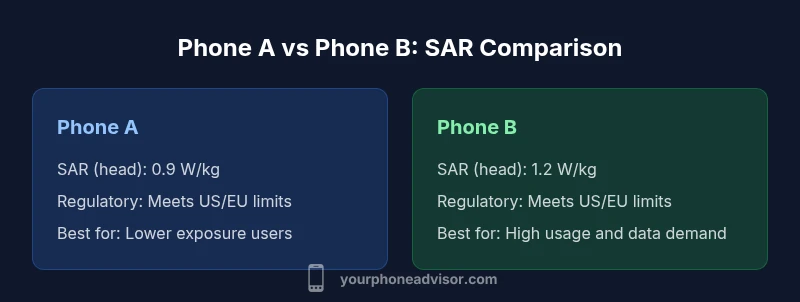
| Feature | Phone A | Phone B |
|---|---|---|
| SAR Value (head exposure) | 0.9 W/kg (Model A) | 1.2 W/kg (Model B) |
| Regulatory Compliance | Meets US limit (1.6 W/kg) and EU limit (2.0 W/kg) | Meets US limit (1.6 W/kg) and EU limit (2.0 W/kg) |
| Real-World Variability | Depends on usage and distance from body | Depends on usage and distance from body |
| Best For | Lower exposure priority users | Heavy users needing reliable performance |
| Test Conditions | Laboratory torso phantom testing | Laboratory torso phantom testing |
The Good
- Helps users prioritize safety and regulator compliance
- Encourages diligence in device selection
- Supports informed usage habits
- Clear, regulator-based benchmarks
Drawbacks
- SAR is only one exposure metric, not the complete safety picture
- Regulatory limits vary by region and may change over time
- Lower SAR devices may come with trade-offs in antenna efficiency or battery life
There isn’t a universal 'most emitting' phone; SAR varies by model and usage.
To choose wisely, compare regulator-listed SAR values for the models you’re considering. Use exposure-reduction habits like speakerphone and keeping the phone away from your body to further minimize risk.
Got Questions?
What is SAR and why does it matter for phone safety?
SAR stands for Specific Absorption Rate. It measures the rate at which the body absorbs RF energy from a phone. Regulators set limits to ensure that exposure remains within safe levels during typical use. While SAR is an important safety benchmark, real-world exposure also depends on how you use the device and your proximity to the body.
SAR is a measure of RF energy absorption and helps buyers compare safety across models.
Is there a phone that has the highest SAR ever recorded?
There isn’t a single official record for the highest SAR across all phones. SAR varies by design, test conditions, and region. Some models may show higher values than others in certain tests, but all certified devices meet regulatory limits.
There’s no official “highest SAR” record across all phones.
How can I reduce exposure while using my phone?
Use speakerphone or wired headphones for calls, keep the phone away from your body when not in use, and limit long calls. You can also enable airplane mode when you don’t need cellular data to reduce RF activity.
Try speakerphone and keep the phone away from your body to cut exposure.
Do newer phones always have lower SAR values?
No. While some models may have optimized antennas or power management, SAR values aren’t guaranteed to trend downward with every release. Always check current regulator data for the specific model.
New releases aren’t guaranteed to have lower SAR; check the model’s values.
Where can I find official SAR values for a phone I’m considering?
Visit regulator websites in your region (for example, the FCC in the United States) and search for the device’s SAR listing. You can also consult the manufacturer’s official specification page. Always compare the same testing location (head vs body) and the same region.
Check regulator listings and the manufacturer for SAR values.
What to Remember
- Check official SAR ratings for every model you consider
- Use exposure-reduction habits (speakerphone, wired earbuds) to lower exposure
- Remember SAR varies by model, region, and usage context
- Regulatory limits exist, but real-world exposure also depends on how you use the phone
- Read SAR data in the context of head vs body exposure and your daily pattern