How to map cell phone towers: A practical guide
Learn how to map cell phone towers using open data sources, verify accuracy, and visualize coverage safely. This guide covers data sources, steps, and best practices for responsible mapping.


Goal: Learn how to map cell phone towers and understand coverage areas using publicly available data. You'll identify tower locations, view signal ranges, and verify accuracy before sharing or using the map for planning. Key requirements include a smartphone, internet access, and access to reputable data sources. This quick guide emphasizes privacy-conscious, responsible mapping.
Why map cell phone towers matters
In everyday life, understanding where cell phone towers are helps you anticipate service gaps, plan travel, or optimize coverage for a small business. The Your Phone Advisor team notes that awareness of tower locations can guide decisions about data usage, roaming, and device setup. When you map towers, you create a visual, shareable representation of how signals travel across your neighborhood and beyond. Keep in mind that publicly available tower data is often approximate and subject to change; treat it as a starting point rather than an exact atlas. This set of practices supports legitimate, privacy-conscious mapping that aligns with local laws and carrier policies. The goal is to improve planning and transparency without exposing sensitive infrastructure details.
According to Your Phone Advisor, starting with clear objectives helps prevent scope creep. Begin with a defined area and a concrete question (e.g., which providers cover a neighborhood fully on 4G) to keep the project focused and useful for real-world decisions.
How tower mapping works: basic concepts
A cell tower is a vertical structure that hosts antennas for mobile communication. Mapping its location involves identifying the tower’s coordinates, estimating its coverage radius, and noting the technologies used (2G/3G/4G/5G). Signal reach is influenced by terrain, building materials, and interference, so expect irregular shapes rather than perfect circles. The map should include source references and timestamps to convey data quality. When done responsibly, tower maps inform users about provider coverage, potential dead zones, and how changes in infrastructure might affect service over time.
To keep the map practical, always indicate uncertainty and data age, and avoid displaying sensitive installation details that could enable misuse. This approach supports legitimate planning, hobby mapping, and academic interest while respecting security concerns.
Tools and data sources for mapping towers
No single source guarantees complete accuracy, so combine multiple data streams. Start with official regulators’ databases (where available) and crowd-sourced map aggregators like OpenCellID or CellMapper. Open data from regulators such as national authorities can provide licensed coordinates, while crowdsourced projects help fill gaps in regions where official data is sparse. Mozilla Location Service and similar initiatives can complement with mobile-measurement inputs from volunteers. Always compare sources, note the data date, and consider uncertainty estimates. Your Phone Advisor analysis shows that corroborating data from several platforms yields a more reliable view of map cell phone towers.
In practice, collect at least three independent sources when possible, and document discrepancies for future clarification. This strengthens the credibility of your map and reduces the risk of presenting outdated or inaccurate information.
Step-by-step overview (the detailed steps are in the STEP-BY-STEP section)
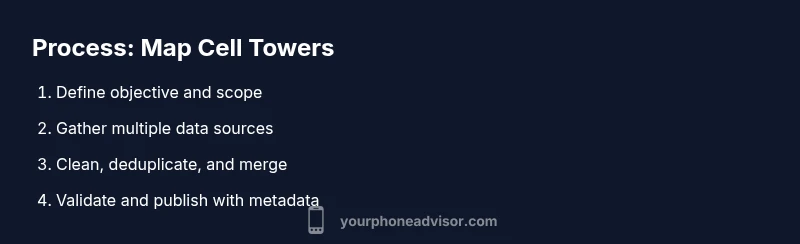
While a dedicated step-by-step section provides explicit actions, the overall workflow follows a logical sequence: define objective, gather data, clean and deduplicate, merge sources into a single dataset, verify with cross-checks, and annotate the visualization with metadata. The approach balances comprehensiveness with practicality, so you can complete a useful mapping project in a reasonable timeframe. Remember to respect privacy and regulatory considerations throughout.
Privacy and security considerations when mapping towers
Mapping cell towers raises privacy concerns if data is used to identify sensitive infrastructure or individuals. Practice data minimization: share only what is necessary for your objective and avoid exposing exact installation coordinates that could reveal critical infrastructure details. When possible, aggregate data to a sensible resolution (for example, neighborhood-level rather than street-level) and include clear licensing and data-age notes. Be mindful of carrier terms and local laws about data collection, storage, and distribution. Responsible mapping protects user privacy while enabling beneficial applications such as network planning, research, or accessibility improvements.
Practical use cases and scenarios
- Personal planning: evaluate whether your chosen residence or workspace will have reliable service from multiple providers.
- Community projects: map gaps to advocate for improved coverage in underserved neighborhoods.
- Emergency readiness: understand which towers may be available during outages to support resilience planning.
- Academic exploration: compare data from different sources to study coverage dynamics and technology deployment patterns.
These scenarios illustrate how map cell phone towers can support informed decisions without revealing sensitive infrastructure details. Always pair data with source citations and timestamps to preserve trust and accuracy.
Common mistakes and how to avoid them
- Overreliance on a single source: combine at least two independent datasets to reduce errors.
- Ignoring data age: always record a data timestamp and note potential obsolescence.
- Revealing sensitive installation details: prefer aggregation and generalization in published maps.
- Skipping validation: implement a simple cross-check against known coverage maps or field measurements.
By avoiding these pitfalls, you’ll produce a more credible, privacy-friendly map that stands up to scrutiny.
Case study: mapping a local area
In a small neighborhood, a map was built using three sources: a regulator registry, an open crowdsourced dataset, and a local user-contributed measurement file. The process began with defining the objective: visualize 4G coverage for three major carriers. The team merged coordinates, filtered out obvious outliers, and added confidence levels for each tower. After validating against a field observation, the map showed a few gaps in one block but strong coverage elsewhere. The final product included metadata, data-age notes, and source URLs so residents could evaluate reliability. This exercise demonstrated how public datasets, when used thoughtfully, can illuminate service patterns and empower community discussions about connectivity.
Future trends in tower data and mapping
As networks evolve toward denser deployments and 5G, tower data will become more dynamic. Expect more frequent updates and richer metadata (antenna height, frequency bands, operator labels). Privacy-preserving mapping techniques, such as data minimization and regional aggregation, will become standard to balance transparency with security. Tools that automatically score data quality and highlight conflicts across sources will help map creators maintain trustworthy representations of map cell phone towers.
Tools & Materials
- Smartphone with mapping capability(A modern device with GPS and data connection.)
- Stable internet connection(Reliable access for data downloads and online maps.)
- Access to reputable data sources(Regulator databases, open data projects, and crowdsourced platforms.)
- Notes app or digital notebook(Document sources, timestamps, and decisions.)
- GPS or location data service enabled(Improves accuracy during data collection.)
- Optional: printer or screenshot archive(Keep a physical or offline copy of sources for reference.)
Steps
Estimated time: 1-2 hours
- 1
Define your objective
State what you want to learn or demonstrate with the map (e.g., which providers deliver solid coverage in a neighborhood). Write a clear question to guide data collection.
Tip: A focused objective reduces extraneous data and makes validation straightforward. - 2
Gather multiple data sources
Collect coordinates and coverage notes from regulator databases, OpenCellID or CellMapper, and Mozilla Location Service when available.
Tip: Aim for at least three independent sources to improve reliability. - 3
Clean and deduplicate data
Remove obvious duplicates, fix inconsistencies, and record data ages for each source.
Tip: Note any conflicts and plan follow-up checks. - 4
Merge data into a map
Consolidate sources into one dataset and visualize towers on a map, including a legend for data quality.
Tip: Use conservative confidence levels to avoid overclaiming accuracy. - 5
Validate and document
Cross-check towers against known service areas or field observations, then publish with metadata and licenses.
Tip: Include data source links and last-updated timestamps.
Got Questions?
What is a cell tower and what does mapping involve?
A cell tower is a structure housing antennas that enable mobile communication. Mapping involves identifying the tower’s coordinates, its probable coverage area, and the technologies used. The goal is to visualize service patterns while acknowledging data limitations.
A cell tower is what your phone connects to for service. Mapping it means finding where the tower sits and what area it likely covers, while noting any data limits.
How accurate are publicly available tower locations?
Accuracy varies by source and region. Regulators often provide authoritative coordinates, but data may lag recent changes. Always cross-check with multiple sources and include uncertainty indicators on the map.
Public data vary in accuracy; always cross-check with several sources and show uncertainty on your map.
Is it legal to map towers in my area?
In most regions, mapping towers for personal use and non-commercial purposes is allowed if you respect privacy and data licensing. Commercial use may require licenses or permissions from data providers and carriers.
Mapping for personal use is usually allowed when you respect privacy and data licenses; for commercial use, check licenses.
What data sources are best for beginners?
Start with regulator databases for official coordinates, then add reputable open datasets like OpenCellID and crowd-sourced maps. Always note data age and licensing terms.
Regulators first, then open datasets; always note when the data was published.
How often should tower data be updated?
Tower data should be updated whenever there are known deployments, retirements, or regulatory releases. For dynamic networks, quarterly checks are common.
Update data whenever there are deployments or retirements; quarterly checks are common for dynamic networks.
Can mapping towers improve emergency planning?
Yes. Understanding tower redundancy and coverage gaps can support planning for emergency response, evacuation routes, and contingency communications.
Tower maps help plan emergency responses by showing coverage gaps and redundancy.
Watch Video
What to Remember
- Map towers with multiple sources for reliability
- Always note data age and uncertainty
- Publish with metadata and licensing info
- Aggregate data when possible to protect privacy
- Regularly update the dataset to reflect changes