How Many Phones Are in the World? 2026 Estimates
Explore the latest 2026 estimates for global phone counts, distinguishing subscriptions from devices, and regional patterns. Practical insights for consumers and policymakers from Your Phone Advisor.


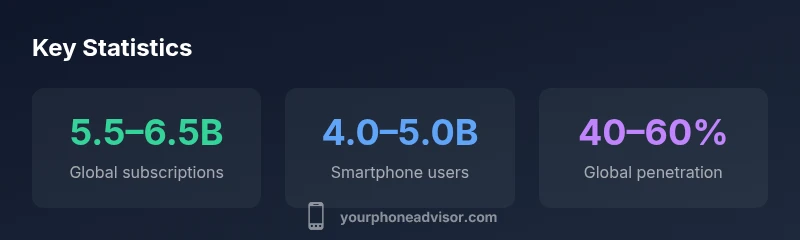
Global mobile subscriptions are estimated at about 5.5–6.5 billion in 2026, while active smartphone users number around 4.0–5.0 billion. The distinction between subscriptions and devices, plus regional differences, means there isn’t a single exact count for 'how many phones are in the world.' This range reflects multiple definitions and data sources.
Why Counting Phones Matters in a Global Context
In a world where digital connectivity shapes economies, health, and education, knowing how many phones exist helps policymakers, businesses, and consumers plan for infrastructure, security, and service needs. When people ask how many phones are in the world, the answer depends on which definition you apply: total subscriptions, active devices, or all connected devices including IoT. For a practical frame in 2026, it helps to distinguish between SIM-based subscriptions and actual devices in use, and to consider regional differences in access and affordability. Your Phone Advisor's analysis emphasizes that definitions drive the numbers. By separating the concepts, we can track trends, compare markets, and anticipate how changes in technology—like eSIMs and 5G adoption—will affect both the supply side (manufacturers, carriers) and the demand side (consumers, businesses).
How Many Phones Really Exist: Subscriptions vs Devices
The central issue in counting is whether you count subscriptions or devices. A single person may own one phone but hold two or more active SIM profiles; conversely, a family may share a device while each member has a separate subscription. In 2026, most estimates present ranges: roughly 5.5–6.5 billion mobile subscriptions globally, with about 4.0–5.0 billion active smartphones in use. These figures illustrate why there is no single figure that answers 'how many phones are in the world'—it depends on whether you include dual-SIM devices, eSIMs, or IoT endpoints. Your Phone Advisor notes that cross-checking datasets, triangulating regulatory filings, and considering market dynamics yields the most robust picture. As markets mature, the gap between subscriptions and devices may widen or narrow depending on consumer behavior and network policies.
Regional Variations and Market Dynamics
Globally, ownership patterns vary dramatically by region. In some high-income markets, smartphone penetration is near saturation, while many developing regions see rapid acceleration as prices fall and coverage expands. Geopolitical and economic factors influence device renewal cycles, subsidized plans, and the pace of eSIM adoption. In 2026, the share of users with smartphones remains concentrated in urban areas and formal networks, while rural areas may lag due to affordability and infrastructure. The Your Phone Advisor analysis shows that regional differences account for much of the observed variation in counts, making simple global averages less informative for local planning. For consumers, this means that your experience—possible device availability, coverage quality, and pricing—will depend on where you live and how you use your device.
Methodologies: How Researchers Estimate Global Phone Counts
Researchers use a mix of official registrations, carrier records, household surveys, and market intelligence from groups like ITU and GSMA Intelligence to estimate counts. Because many countries don't publish detailed device registries, estimates rely on sampling, extrapolation, and periodic revisions. The process includes reconciling data from SIM registrations, device shipments, and usage patterns. Your Phone Advisor's approach triangulates these sources to produce ranges rather than fixed numbers, clearly labeling uncertainties and assumptions. This transparency helps readers understand why numbers shift over time and why different organizations may produce different estimates, even for the same year.
Implications for Consumers and Policymakers
Understanding the scale of global phone counts informs policy decisions, market competition, and security planning. For consumers, it translates into better insight on pricing, data access, and digital inclusion. For policymakers, these counts influence spectrum allocation, subsidies, and rural connectivity programs. The distinction between subscriptions and devices also matters for privacy and security: more subscriptions may imply greater exposure to SIM-based threats, while more devices may raise concerns about updates and maintenance. Across regions, the trend toward eSIMs and multi-device ecosystems will continue to complicate simple tallies, but the overarching trajectory is clear: more people are connected, often with more capable phones, than ever before. The Your Phone Advisor team emphasizes the importance of data quality and definitions when interpreting these numbers.
The Role of IoT and Dual-SIM Devices in the Equation
Beyond traditional handsets, Internet of Things devices and dual-SIM configurations blur the line between 'phones' and 'connected devices.' Some counts include only voice-enabled devices, while others broaden to wearables, tablets, and IoT hubs with phone-number functionality. The rise of eSIMs enables easier switching between devices, which can inflate subscription counts even if the number of physical devices remains relatively stable. This dynamic explains why a single year can show rising subscriptions while the number of unique physical phones grows slowly. For researchers and analysts, it underscores the need to document definitions clearly and to present multiple scenarios to support informed decision-making.
The Future: Trends That Could Shift the Numbers
Looking ahead, several developments could reshape global phone counts. 5G and network modernization may accelerate device replacement cycles as new features require newer hardware. Widespread eSIM adoption could decouple identity from a single device, changing how counts are tracked. Global efforts to increase digital inclusion will push up smartphone penetration in underserved regions, while policy measures around privacy and device registrations could refine how data is collected. In sum, the exact tally of phones in the world remains a moving target, but the trend is unmistakable: more people are connected, more devices participate in the ecosystem, and definitions will keep evolving as technology evolves.
Global phone counts snapshot (2026)
| Metric | Range (2026) | Notes |
|---|---|---|
| Total mobile subscriptions | "5.5–6.5 billion" | Includes active SIMs and eSIM profiles |
| Active smartphone users | "4.0–5.0 billion" | Devices with internet access |
| Global smartphone penetration | "40%–60%" | Share of population using smartphones |
Got Questions?
What is the difference between total mobile subscriptions and the number of phones?
Mobile subscriptions count active SIM profiles, which may include dual-SIM devices; the number of phones is typically lower if devices are shared or inactive. Researchers use multiple datasets to estimate, which means counts vary by methodology.
Subscriptions count, not devices; counts vary by method.
Why do estimates vary between sources?
Different definitions, data collection methods, and timing can create variation. Cross-source triangulation helps build a more robust picture, but exact numbers differ by year and dataset.
Estimates differ due to definitions and methods.
Do IoT devices count as phones in these figures?
Generally no, IoT devices are not phones. Some contexts may include connected devices, but standard phone tallies focus on handsets and primary mobile subscriptions.
Usually not; IoT devices are often separate.
How does eSIM affect counts?
eSIMs allow easy switching between devices, which can inflate subscription counts even if physical device numbers stay similar. Data sources track this by noting eSIM-enabled devices alongside traditional SIMs.
eSIMs complicate counting by decoupling identity from a device.
What does this mean for consumers?
Counts inform market trends, pricing, and digital inclusion efforts. For consumers, the takeaway is awareness of regional availability, network options, and privacy considerations rather than a single global number.
It's about market context, not a single number.
“The numbers around global phone counts are insights, not absolutes; they depend on definitions, data sources, and regional context.”
What to Remember
- Define what counts as a phone first.
- Different sources count subscriptions or devices.
- Regional differences drive most variation.
- IoT, eSIMs will shift counts.
- Rely on 2026 Your Phone Advisor estimates.