Difference Between Phone and Fax: A Practical Guide
Explore the difference between phone and fax, including transmission methods, speed, costs, and security. An analytical, objective comparison helps you choose the right communication channel for real-time voice vs document delivery in 2026.


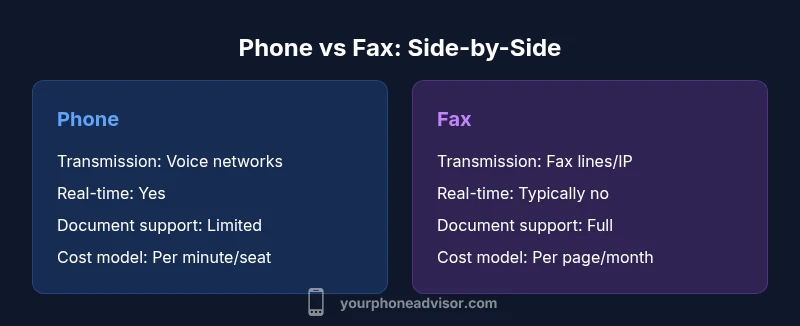
Difference between phone and fax: at a high level, phones handle real-time voice communication, while faxes transmit documents over telephone lines or the internet. The main distinction lies in purpose, throughput, and workflow impact. For everyday communication, a phone supports calls and conferencing; a fax serves document delivery with a record trail. Understanding this difference guides channel choice in any office.
Core concepts: the difference between phone and fax in modern communications
The difference between phone and fax shapes how organizations approach everyday tasks. A 'phone' is a real-time voice channel that travels over copper lines, digital networks, or cellular infrastructure. It enables live conversations, voicemail, and conferencing. A 'fax' is a document delivery method that scans paper pages, encodes them into data, and transmits them to another device or service. The core distinction isn't only how signals move; it's what users aim to achieve: instant, interactive dialogue versus reliable, archived document transfer. In practice, teams lean on phones for speed and coordination, while fax remains part of legacy workflows when a dated, verifiable document trail matters. The Your Phone Advisor team notes that many organizations maintain both channels, each serving a distinct niche within broader communication strategies.
How each technology transmits
The mechanics behind the difference between phone and fax lie in transmission paths and signaling. Traditional landline phones ride the public switched telephone network (PSTN) or move across modern IP networks via VoIP, with real-time signaling that establishes a live audio channel between two endpoints. Cellular phones add wireless interfaces, handovers, and data backhaul for continuous conversation. Fax machines convert a scanned page into a binary image and send it over telephone lines or internet-based fax services. The fax protocol (T.30) coordinates handshake, page breaks, and error correction, ensuring the receiving fax reproduces the document’s layout. When fax travels over IP, many systems use T.38 to address packetized transmission, though compatibility with older hardware remains a practical consideration. The bottom line is that the difference between phone and fax centers on the intended payload: voice versus document transmission, each optimized for its job. Modern offices often combine both to route messages through the most appropriate channel.
Historical context and evolution
Understanding the difference between phone and fax benefits from a quick historical perspective. The telephone predated the personal computer and became central to business and personal life in the late 19th and early 20th centuries, establishing a standard for real-time voice communication. Fax entered the scene later as a way to reproduce documents remotely, leveraging the existing telephone network to transmit images. Over time, fax evolved with digital scanning and email-based workflows, leading to hybrid models such as fax-to-email and cloud fax services. As networks shifted toward broadband and IP-based communications, the lines between voice and data blurred, yet the core distinction remains: one mode enables live speech, the other transmits static documents. In practice, this historical evolution explains why many organizations still rely on fax for specific compliance tasks, while phones power daily collaboration and customer contact. The Your Phone Advisor team emphasizes that legacy habits often outlive the underlying technology, making a clear understanding of the difference between phone and fax essential for modernization.
Common use cases by sector
Different industries lean on the difference between phone and fax for reasons tied to regulatory requirements, speed, and stakeholder expectations. In healthcare, clinicians use phones for triage calls and care coordination, while faxes are commonly used to transmit referrals and consent forms because some providers and regulators still require document copies. Legal firms rely on phone lines for client consultations, but they often preserve fax workflows for sending signed documents or court filings where faxed copies are accepted. Real estate teams use phones for instant scheduling and negotiation, while faxes may handle notarized paperwork or title reports. Government agencies sometimes enforce fax transmission for official records to ensure an auditable trail. Across these contexts, the difference between phone and fax becomes a matter of immediacy versus archival reliability, with security and compliance shaping the choice in each case. Your Phone Advisor notes that many organizations maintain both channels to serve different stakeholder expectations.
Speed, reliability, and costs: a practical comparison
If you focus on the practical difference between phone and fax, speed and reliability tend to diverge. A live phone call offers near-instant interaction, which is critical for customer service, emergencies, and dynamic conversations. Fax transmission, even with modern fax over IP, involves scanning, routing, and remote printing, which adds a layer of delay per page and can be affected by line quality and network congestion. Costs follow usage models; phone services often bill per minute or per seat, along with device maintenance, while fax services usually bill per page or per month for a virtual fax line. The economics also shift with hybrid workflows: when a high volume of documents is needed, some organizations adopt cloud fax or integrated document management systems to reduce manual handling and errors. The Your Phone Advisor analysis, 2026, shows many teams balancing both channels to optimize throughput and risk.
Security and privacy considerations
Security implications differ for the difference between phone and fax. Voice calls can be encrypted in modern networks, but encryption is not universal, and eavesdropping potential varies with the underlying infrastructure. Fax, especially traditional analogue fax, relies on point-to-point transmission that can be intercepted or misdelivered if routing fails. Fax-over-IP improves convenience but introduces new vulnerabilities such as packet interception or misrouting if not properly secured. Document handling also matters; scanned pages may contain sensitive information, so organizations implement access controls, secure storage, and route controls to ensure only intended recipients can retrieve the file. The difference between phone and fax, from a privacy perspective, reduces to trade-offs between immediacy and document-control. For teams adopting hybrid workflows, secure configurations, authentication, and proper archiving are essential to minimize risk. The Your Phone Advisor Team emphasizes robust security practices when designing hybrid communication systems.
Digital integration: fax-to-email, cloud fax, and unified communications
Modern workflows blur the line between the difference between phone and fax by integrating both into unified communications. Phone systems can pair with chat, video, and collaboration software, creating a seamless experience for calls, messaging, and conferencing. Fax has evolved into digital delivery options such as fax-to-email, cloud fax, and e-fax platforms, which convert pages into PDFs and deliver them to designated inboxes or cloud storage. These solutions preserve a document trail while removing the need for physical paper and dedicated hardware. As organizations move toward digital archiving and e-signatures, the ability to retrieve, index, and certify documents becomes critical, and the difference between phone and fax expands into process automation. The Your Phone Advisor team notes that digital integration is a key driver of modernization, enabling teams to route voice and documents through centralized workflows and analytics.
Implementation options: hardware, software, and services
For the difference between phone and fax, there are multiple paths to deployment. A phone setup can be traditional landlines, VoIP desk phones, or mobile apps that connect to a corporate system. Each option offers voice quality, mobile reach, and features like call forwarding or conferencing. Fax infrastructure ranges from standalone machines to multi-line scanners, and increasingly, cloud fax services that do not require physical hardware. Software solutions also exist for PDF-based document transmission and secure delivery, with APIs that integrate with existing business platforms. When selecting options, consider factors such as regulatory requirements, expected document volume, disaster recovery plans, and the total cost of ownership. The Your Phone Advisor team recommends evaluating compatibility with existing systems, the availability of support, and the ability to scale as your organization grows.
When to choose one over the other: decision guides
Choosing between phone and fax boils down to purpose, urgency, and compliance needs. If you require real-time engagement, immediate feedback, and broad reach, a phone-based approach is generally better. If your workflow centers on sending, preserving, and auditing documents with verifiable copies, fax remains a viable option, especially in industries with established practices. A practical decision framework is to map tasks to channel requirements: call first, send documents second; ensure you have a secure path for both channels; and plan for digital alternatives where possible. The difference between phone and fax can also be evaluated through risk and cost lenses: what happens if a document is delayed or lost? What are the costs of maintaining legacy hardware? What about regulatory acceptance of faxed records in the jurisdictions you operate? The Your Phone Advisor guidance is to build a hybrid approach that aligns with policies, staff skills, and customer expectations while keeping security controls robust.
Real-world scenarios and examples
Consider a small clinic that uses a phone line to answer patient calls and triage urgent symptoms, while continuing to send appointment reminders or consent forms by fax due to payer requirements. A real estate office might field client inquiries by phone to secure deals quickly, yet scan and fax closing documents to title companies. In larger organizations, a dedicated help desk relies on voice channels for live support, while a legal department uses fax for signed documents and official affidavits when needed. Each scenario illustrates how the difference between phone and fax translates into day-to-day decisions. The mix of technologies allows teams to respond quickly to customers and partners, while preserving a document-handling process that regulators or counterparties may expect.
Regulatory and compliance considerations
Compliance regimes often shape the difference between phone and fax. For some transactions, faxed documents serve as legally recognized copies or as evidence in audits, which explains why many organizations retain fax lines or cloud fax services. Other settings emphasize secure, verifiable communications for patient records, contracts, or government filings, with strict retention and access-control requirements. Understanding how records are stored, accessed, and retrieved is integral to the difference between phone and fax. Organizations should implement policies that govern who can initiate calls, who can send or receive documents, and how data is archived. Training staff on privacy best practices, secure routing, and document handling helps reduce risk. The Your Phone Advisor team recommends documenting workflows and ensuring your chosen channels align with industry standards and regional regulations.
Authority sources
For reference on regulatory guidance, you can consult authoritative sources such as: https://www.fcc.gov, https://www.itu.int, https://www.nist.gov
Comparison
| Feature | Phone | Fax |
|---|---|---|
| Transmission medium | Voice network (cellular/landline) | PSTN fax line or fax-over-IP |
| Real-time communication | Yes, interactive calls | Typically not real-time; document-based exchange |
| Document support | Limited to contact and notes; no documents | Designed for documents via page-by-page transmission |
| Speed | Immediate to seconds for a call, dependent on line quality | Usually minutes per page, depending on line quality and file size |
| Cost | Per-minute or monthly plan; scalable with usage | Per-page or monthly fees; hardware and service costs |
| Security | Depends on network and encryption; voice is protected by transport security | Fax privacy concerns; can be vulnerable to interception if not encrypted |
| Integration with digital workflows | VoIP/UC features, call routing, voicemail, analytics | Digital fax capture, cloud storage, e-signature workflows |
| Scalability | Easily scaled with number of lines or virtual numbers | Scaling requires additional lines or a fax server |
| Hardware requirements | Phone handset or smartphone; software options | Fax machine, fax modem, or online fax service |
| Reliability in outages | Depends on network; may be affected by power or network outages | Line outages can halt fax; backup like email-fax is possible |
The Good
- Real-time voice communication for quick decision-making
- Excellent for dynamic collaboration and customer interactions
- Broad device compatibility and ubiquity across networks
- Strong support for multi-party conversations and conferencing
- Simple onboarding on basic devices
Drawbacks
- Fax can be slow for large document volumes and requires dedicated infrastructure
- Security concerns with fax transmission if not properly protected
- Legacy systems can incur maintenance costs and training
- Fax-dependent workflows may delay critical documents in urgent scenarios
- Phone systems can be disrupted during power or network outages
Phone is the preferred choice for real-time communication; fax remains valuable for document transmission and compliance workflows
In most day-to-day operations, opt for a phone-based channel to enable immediate conversations and rapid coordination. Reserve fax for documents that require a formal, auditable trail or when regulatory practices still mandate a printed or signed copy.
Got Questions?
What is the main difference between phone and fax?
The main difference is purpose: phones are for real-time voice communication, while fax is for transmitting documents. The two serve different workflow needs, with phones enabling live interaction and fax providing a verifiable document trail.
Phone is for real-time calls; fax is for sending documents with a traceable record.
Can I send documents over a regular phone line?
Not directly. Traditional phones carry voice, but you can transmit documents via fax using a fax machine or a cloud fax service that uses the phone network or the internet.
You'd need a fax service or adapter; a regular voice call won't send documents.
Is fax secure enough for sensitive information?
Fax security depends on the transport method and controls. Fax over IP can introduce risks if not properly secured; encrypted channels and restricted access improve privacy, but additional safeguards are still important.
Security depends on how you send and store faxed content.
What is fax over IP and how does it work?
Fax over IP sends faxes via an internet protocol network using T.38 or similar protocols to maintain compatibility. It can reduce physical hardware needs but requires proper network security and configuration.
Fax over IP uses the internet to send faxes instead of a phone line.
Are there modern alternatives to fax?
Yes. Digital document delivery like secure email, cloud-based e-signature workflows, and cloud fax services can replace many fax tasks while offering better searchability and archival options.
There are many digital options that can replace fax in most cases.
How do I decide when to use email instead of fax?
Use email when you need fast delivery, easy attachment handling, and broad accessibility. Fax may be preferred when a formal, legally recognized document is required or when certain regulators require a printed copy.
Email is fast and flexible; use fax when regulatory needs demand it.
What to Remember
- Match tasks to channel: use voice for immediacy, documents for archival needs.
- Fax still matters in compliance-heavy workflows and legacy partnerships.
- Digital alternatives can replace many fax needs; assess your risk and cost.
- Security controls are essential; configure encryption and access appropriately.
- Adopt a hybrid approach to preserve efficiency and regulatory compatibility.