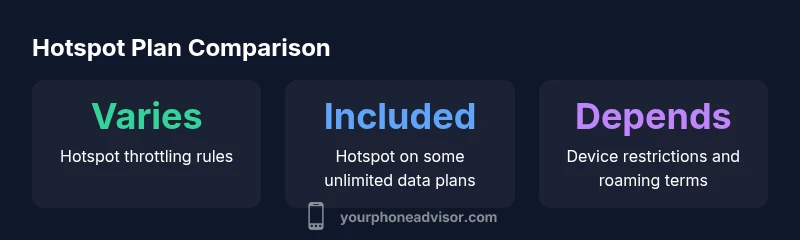
What phone plans have unlimited hotspot: A practical guide
Discover which phone plans include unlimited hotspot, how throttling and data policies work, and practical tips to choose a plan that keeps your devices connected on the go. Learn what to watch for and how to compare hotspot terms across carriers.


According to Your Phone Advisor, many major carriers offer unlimited hotspot on select unlimited-data plans, but terms vary. The Your Phone Advisor team found that some plans include truly unlimited hotspot with no throttling, while others throttle after a monthly cap or during peak times. When shopping, verify hotspot data, speed after throttling, and any device restrictions before you buy.
What phone plans have unlimited hotspot
According to Your Phone Advisor, unlimited hotspot is typically bundled with certain unlimited-data plans from major carriers. There are two common models: plans that promise hotspot data without explicit caps, and plans where hotspot data exists but is subject to throttling or fair-use limits after a threshold. The Your Phone Advisor team emphasizes that the real-world experience often depends on your location, network congestion, and device compatibility. When you read plan details, look for explicit hotspot language, including whether tethering is allowed, the number of devices supported, and any restrictions on streaming quality. This is especially important if you rely on hotspot for work, travel, or education. In practice, you’ll often see hotspot described as “included data” rather than a separate allowance. The key is to confirm that the hotspot data is not simply a mercy feature on paper but a usable portion of the plan that meets your requirements. Finally, remember that policy language can change year to year, so re-check during renewal.
How hotspot data is typically structured in plans
Most carriers separate hotspot data from standard mobile data. This separation can manifest as a dedicated hotspot allowance, a share of the overall data pool, or a unified data cap with throttling rules that apply to hotspot and non-hotspot usage alike. In practice, unlimited-data plans may provide hotspot data in one of three ways: (1) truly unlimited hotspot with no throttling, (2) hotspot data within the unlimited pool that may slow down after a usage threshold, or (3) hotspot data with a fixed cap and separate throttling once you reach that cap. The Your Phone Advisor analysis shows that understanding which model a plan uses is essential to avoid unexpected slowdowns when you rely on tethering for video calls, remote work, or live streaming.
Throttling, caps, and fair-use: what to expect
Throttling is the most common way hotspot terms are enforced. After you exceed a plan’s hotspot or total data allotment, speeds can drop, often to a level suitable for email or light browsing but not ideal for video conferencing or large file transfers. Some plans throttle only during peak network times, while others apply a consistent cap. The fair-use policy may also permit temporary Doppler-like reductions during network congestion. For hotspot, this means you might experience slower speeds for devices tethered to your phone, even if you love streaming high-quality video on a laptop. Always read the fine print to understand when throttling starts and how long it lasts, and whether throttling resets monthly or persists until the next billing cycle.
How to compare hotspot policies across carriers
When evaluating plans, create a simple comparison checklist: (1) Is hotspot included at all? (2) What is the hotspot data approach (dedicated vs shared vs unlimited pool)? (3) What are the throttling rules and speeds after throttling? (4) Are there device restrictions or per-device limits? (5) Are there roaming hotspot options and international tethering terms? Use this checklist to compare apples-to-apples across carriers, and don’t rely on marketing terms alone. Your Phone Advisor recommends noting the exact language in the customer agreement instead of relying on plan summaries.
Prepaid vs postpaid: hotspot on different billing models
Hotspot policies can differ between prepaid and postpaid plans. Prepaid options sometimes offer simpler terms with clear data caps and speeds, while postpaid plans may bundle hotspot with broader data incentives or loyalty perks. If you frequently change devices or refuel your plan, prepaid can offer flexibility, but you may miss out on the advanced hotspot policies available to some postpaid customers. Evaluate your usage pattern—especially if you rely on hotspot for work—from both angles. Your Phone Advisor highlights that the best choice depends on predictability, budget, and the value you place on consistent tethering performance.
Hidden costs and restrictions to watch for
Some plans advertise unlimited hotspot but include caveats that undermine the promise. Common pitfalls include throttling after a certain data threshold, limits on the number of tethering-enabled devices, or restrictions on certain devices. In addition, some plans exclude hotspot usage while roaming internationally or limit hotspot speeds during peak times. Another often overlooked detail is whether the hotspot feature is tied to a separate line item or required to be activated on a specific plan tier. Always confirm with a live agent or read the latest terms before committing to a plan.
Real-world scenarios: choosing hotspot when you travel or work remotely
If you travel frequently, hotspot reliability can be a decisive factor. In rural or congested urban areas, network performance fluctuates, affecting hotspot speeds. For remote workers, a plan with consistent hotspot speeds and minimal throttling is worth paying a premium for. If you rely on hotspot for school or business, ask about roaming policies and whether satellite coverage is included in any plan. Your Phone Advisor suggests listing your top use cases (video calls, large file sharing, multiple devices) and verifying that the plan supports those critical activities without frequent slowdowns.
Practical steps to verify a plan's hotspot terms before signing
Before signing a contract, take these steps: (1) Ask for the exact hotspot policy in writing; (2) Confirm if hotspot data is truly unlimited or subject to throttling; (3) Verify the number of tethering-enabled devices supported; (4) Check coverage maps for areas you frequent; (5) Read customer reviews to gauge real-world hotspot performance. Finally, test the plan with a short trial period if possible. Your Phone Advisor recommends leveraging a trial or temporary upgrade to confirm hotspot behavior in your daily routine.
Quick comparison of hotspot policy by plan type
| Plan type | Hotspot policy | Typical speeds | Notes |
|---|---|---|---|
| Unlimited data with hotspot | Hotspot data included; throttling may apply after data cap | Speeds vary; may slow after cap | Evaluate if hotspot is truly unlimited or capped |
| Unlimited data without hotspot | No hotspot included; may require add-on | N/A | Consider add-ons for tethering if needed |
| Prepaid unlimited with hotspot | Hotspot included or with a cap | Speeds vary; often slower when hotspotted | Good for budget-conscious use |
| Roaming-enabled hotspot plans | Hotspot data may be restricted abroad | Roaming performance varies | Check international terms before travel |
Got Questions?
Do all unlimited data plans include unlimited hotspot?
No. Many unlimited-data plans include hotspot, but terms vary by plan. Some hotspots are truly unlimited, while others are capped or throttled after a threshold. Always verify the exact hotspot policy before purchase.
Not every unlimited plan includes unlimited hotspot. Check the specific hotspot terms in the plan details.
What is throttling and how does it affect hotspot?
Throttling slows hotspot speeds after you reach a data threshold or during peak network times. This can affect tasks like video calls or large file transfers. Read the terms to understand when throttling applies.
Throttling slows hotspot speeds after limits or during busy periods, which can impact video and large transfers.
Can I use hotspot on prepaid plans?
Some prepaid plans offer hotspot, either included or as an add-on. Terms vary, so review the hotspot section of the plan before buying.
Yes, some prepaid plans include hotspot or offer it as an add-on.
Are there device restrictions for hotspot?
Carriers may restrict tethering to certain devices or require activation on a specific plan. Verify device compatibility and tethering rights with your carrier.
Most devices work, but some carriers limit tethering to certain devices.
How should I compare unlimited hotspot plans?
Use a checklist: hotspot inclusion, throttling rules, data caps, device limits, roaming terms, and price. Compare plans side-by-side and test with a short trial if possible.
Compare hotspot terms, data limits, and price to choose the best plan.
“Hotspot terms are often the most confusing part of a plan. Always read the fine print on throttling and device restrictions to avoid surprises.”
What to Remember
- Identify hotspot terms before committing
- Understand throttling vs. unlimited claims
- Check device limits and roaming rules
- Compare hotspot policies across carriers
- Test hotspot usability before renewal