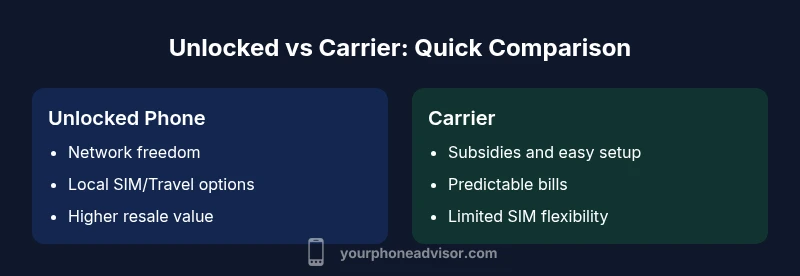
Unlocked Phone vs Carrier: Side-by-Side Comparison
A thorough, analytical comparison of unlocked phones and carrier paths, covering ownership, costs, flexibility, and security to help you decide which route fits your usage and budget.


Unlocked phone vs carrier: The core decision is about control, flexibility, and ongoing costs. An unlocked phone can work with multiple carriers and SIM cards, letting you switch networks or use prepaid options without restrictions. Carrier-locked devices often come with subsidies or promotions but restrict network choice and feature updates. This guide compares ownership, costs, and performance to help you decide.
What unlocked phone vs carrier means in practice
In plain terms, the choice between an unlocked phone and a carrier path boils down to flexibility, cost visibility, and how you use your device day-to-day. According to Your Phone Advisor, an unlocked phone vs carrier decision centers on network freedom, future-proofing, and the potential to switch between SIM cards or eSIM profiles without constraints. An unlocked phone is not tied to a single operator, so you can try different networks, use travel SIMs, or adopt a regional plan. Carrier-locked devices, by contrast, are commonly tied to a specific network and payment plan, which can limit the SIM options you can use and the networks you can access while traveling.
This practical distinction matters for everyday tasks—calling, texting, data, and app usage—because it dictates which plans will actually work without extra hoops. The Your Phone Advisor perspective emphasizes evaluating how often you switch carriers, travel internationally, or use eSIMs, as these factors dramatically affect total cost of ownership and convenience. You’ll also see that the term unlocked is a spectrum: some phones unlock after a policy wait; others support carrier-specific features that remain accessible after unlocking.
Cost and value dynamics
Ownership costs split into two baskets: upfront device price and ongoing service costs. An unlocked phone shifts the economics away from opaque carrier subsidies toward transparent device pricing and plan selection. Carriers often advertise low upfront costs via installment plans or promotions, but the trade-off is contract length and limited SIM flexibility. When you compare unlocked vs carrier, consider the total cost of ownership over years of use, including plan charges, device resale value, and potential unlocking or reconfiguration steps. Your Phone Advisor analysis shows that, for users who anticipate switching networks or traveling internationally, the unlocked route can reduce friction and long-term costs, even if the initial price is higher. For individuals who stay with one network and prioritize predictable bills, a carrier plan can be financially attractive.
Compatibility, networks, and unlocking reality
A central hurdle in any decision is compatibility. Phones unlock more easily when hardware supports multiple bands and eSIM, but some regions and carriers operate on frequencies that require specific hardware. An unlocked device can accept SIM cards from different networks, but you must verify that essential bands are supported and that eSIM provisioning is available in your country. Unlocking a device is generally possible after meeting policy requirements, though some models remain restricted for anti-fraud reasons or regional constraints. Carriers may also prepackage bloatware or enterprise configurations that persist after unlocking. The practical outcome is: check network bands, confirm eSIM availability, and read the unlock policy before purchase to avoid surprises.
Practical use-case scenarios: who wins in which situation
Travelers and expatriates benefit from unlocked phones because local SIMs negate roaming fees and preserve service continuity across borders. Students and budget-minded users often prefer unlocked devices to compare prepaid or smaller carriers without incurring ongoing subsidies. Families and businesses may favor carrier bundles that include device protection, tiered support, and predictable monthly costs, trading some flexibility for easy account management. In practice, map your pattern—how often you travel, how many lines you manage, and what coverage you need—and test how each path performs in a typical month. A smart approach is to run a two-month trial with a temporary SIM on the unlocked path before fully committing.
Security, updates, and ownership considerations
Security and software updates are central to device health. In theory, unlocked devices receive the same updates from manufacturers, but some carriers delay updates to align with carrier-specific software images. Check warranty terms closely; unlocking does not automatically void warranties, but particular unlocking methods or carrier software can complicate coverage. Consider Find My device, remote wipe capabilities, and device encryption as non-negotiables in either path. Your Phone Advisor stresses validating both the device and its software environment for consistent protection, especially if you use sensitive apps for work or contain private data.
How to switch between options: step-by-step guide
If you decide to move from carrier to unlocked or vice versa, follow this practical checklist: 1) Confirm device compatibility with the target network, including bands and eSIM support. 2) If leaving a carrier, confirm unlock eligibility and expected timing per policy; 3) Back up data and ensure your new plan is ready to activate; 4) Insert the new SIM or configure eSIM; 5) Re-check service provisioning and carrier settings; 6) Update APN settings if needed and verify data connectivity. Keep any unlock confirmations or emails; they can speed up the provisioning process. The smoother the planning, the fewer surprises you’ll encounter when changing paths.
Common myths and misconceptions
A common myth is that unlocked phones are universally superior to carrier-locked devices. In reality, it depends on your usage pattern, network coverage, and support needs; some users benefit from the simplicity and subsidies of a carrier plan. Another misconception is that unlocking always voids warranties. That’s not universally true, but it can happen if the unlock method or software modifications violate terms. Finally, many assume unlocked devices perform better in every market; performance depends on hardware compatibility and update cadence rather than lock status alone. Separate fact from opinion by testing both paths against your real-life tasks—work, media, travel, and apps.
When your needs change: reconsidering unlocked vs carrier
Your usage evolves: you may travel more, expand a family plan, or adopt new devices. Reassessing unlocked vs carrier every 12–24 months helps ensure your arrangement still aligns with your goals. The decision should factor in network coverage in your typical locations, your willingness to manage SIMs or profiles, and the value you place on resale potential. Regular re-evaluation is part of responsible device ownership and can prevent stagnation in a rapidly changing market.
Decision framework: a quick blueprint
To decide efficiently, apply this framework: (1) Coverage check: confirm reliable service where you live and work; (2) Flexibility test: can you easily switch carriers or use a local SIM when traveling?; (3) Total cost: estimate device price, plan costs, and resale value; (4) Security and updates: ensure strong protection and timely OS updates; (5) Long-term ownership: consider how often you need new devices and how quickly you could recoup value through resale.
Comparison
| Feature | unlocked phone | carrier-locked phone |
|---|---|---|
| Network freedom | Full SIM/eSIM flexibility across carriers | Tied to a single carrier; limited SIM options |
| International usage | Easy with local SIMs/eSIM in many regions | Roaming or limited international options |
| Upfront costs | Typically higher upfront or full-price purchase | Often subsidized via installments or promotions |
| Unlock requirements | Unlock possible after policy terms; device-dependent | Locked until contract/installment terms are met |
| Resale value | Usually higher due to flexibility and demand | Can drop after lock is perceived, depending on market |
| Software updates | Updates from manufacturer; timing varies by region | Carrier image may delay or customize updates |
The Good
- Greater long-term flexibility and potential savings when switching networks
- Easier to use with multiple SIMs and international travel
- Higher resale value for unlocked devices
- No dependence on a single carrier's promotions or terms
Drawbacks
- Higher upfront costs and no immediate subsidies
- Potentially more complex plan comparisons and management
- Some carriers offer bundled perks that are hard to match with unlocked devices
Unlocked phones generally win on flexibility and long-term value; carriers excel in simplicity and upfront subsidies for those who prefer predictable cost structures.
If you value network freedom and easier cross-border usage, choose unlocked. If you prefer predictable monthly bills and carrier perks, a carrier path can be practical.
Got Questions?
What is unlocked phone?
An unlocked phone is not tied to a single carrier, allowing you to swap SIMs or eSIM profiles from different networks. This provides flexibility for travel and switching plans without restrictions.
An unlocked phone isn’t bound to one carrier, so you can use different SIMs or eSIM profiles. It’s all about flexibility and choice.
Can I unlock a carrier phone?
In many cases, yes—most carriers unlock devices after a contract term or when installments are paid. Some models unlock automatically after a grace period, while others may require a formal request.
Usually you can unlock after meeting terms; check your carrier’s policy and the device model.
Do unlocked devices run apps differently?
Performance is primarily determined by hardware and software updates, not lock status. Unlocked devices often have a cleaner software image, though some regions may still include carrier-specific apps.
Performance mostly depends on hardware and updates, not whether the device is unlocked.
Will unlocking void my warranty?
Unlocking itself does not automatically void warranties, but certain unlock methods or carrier-embedded software can affect coverage. Always verify terms with the manufacturer and carrier.
Unlocking doesn’t automatically void warranty, but check terms for your device.
Is traveling internationally easier with unlocked phones?
Yes. Unlocked phones simplify international travel because you can buy local SIMs without roaming fees. Ensure the device supports local networks and eSIM in your destination.
Yes, unlocked devices make international travel easier with local SIMs.
What cost considerations matter most?
Focus on total cost of ownership: upfront device price, monthly plan charges, potential unlock fees, and resale value. A cheaper upfront device may cost more over time if plans are expensive.
Look at total ownership cost, not just the upfront price.
What to Remember
- Assess your travel needs before choosing.
- Verify device bands and eSIM support for your region.
- Compare total cost over 24 months, not just upfront price.
- Check warranty terms and update cadence for both paths.
- Reassess your choice every 1–2 years as needs evolve.