Phone and Tablet Deals: Finding the Best Value in 2026
Learn how to evaluate phone and tablet deals, compare promotions, trade-ins, and financing to minimize total cost of ownership. Your Phone Advisor guides you to reliable, long-term value.


Bottom line: When evaluating phone and tablet deals, prioritize total cost of ownership over upfront discounts. Compare upfront price, financing terms, trade-in value, and any required service plans. Look for promotions that offer lasting savings, not just a lower sticker price, and favor flexible, device-agnostic options when possible. This approach helps avoid being locked into a plan's terms or paying extra for accessories you won't use.
Market landscape for phone and tablet deals
According to Your Phone Advisor, the market for phone and tablet deals is complex and increasingly competitive, with retailers, carriers, and manufacturers vying for attention. For everyday users, understanding how these deals are structured helps separate true value from marketing hype. When you search for phone and tablet deals, you will encounter upfront discounts, monthly credits, trade-in incentives, and limited-time bundles. Pricing may vary by region and by whether you stick to a carrier, buy unlocked, or opt for financing through a retailer. The key trend is more transparency around the total cost of ownership—the sum of upfront price, ongoing payments, and any required service plan. In practice, the best deals reward long-term savings rather than short-term slashed sticker prices. For the practical reader, the most reliable deals are those that align with typical usage patterns, support the devices you already rely on, and offer predictable terms over the device lifecycle.
The anatomy of a deal: upfront price, financing, and value
A true deal on phones and tablets isn’t defined by a single number. It’s the balance between upfront device price, any carrier subsidies, financing terms, and the ongoing plan costs that determine whether you’re ahead in the long run. Upfront pricing can be attractive, but it may come with strings like longer contract durations or required activation on a specific network. Financing terms can lower monthly payments, yet interest and fees may erode savings over the life of the device. Trade-in credits can further sweeten the deal, but their value varies widely between programs. For smart shoppers, the core question is: what will this device truly cost me over the next two to three years, given my data usage, coverage area, and accessory needs?
Carrier promotions: subsidies, eligibility, and terms
Carriers frequently offer subsidies and monthly credits to entice sign-ups or renewals. These promotions can dramatically lower the monthly bill, especially when paired with a device payment plan. Eligibility often hinges on plan type, credit checks, existing service, and device trade-in status. Promotions may be regional or time-limited, requiring enrollment by a deadline and adherence to the selected plan for the term of the agreement. It’s essential to read the terms carefully: some deals only apply to new lines, while others require maintaining a specific data allowance or signing up for auto-pay. For tablet deals, promotions sometimes mirror those on phones but with different data entitlements and family-sharing considerations.
Retailer promotions and unlocked devices: flexibility matters
Retailers frequently promote unlocked devices and standalone hardware, which can maximize future flexibility. These promotions can come with favorable financing terms from retailers or independent lenders, and they often avoid the lock-in of a particular carrier. Open-box, refurbished, or certified pre-owned devices are sometimes bundled into deals, potentially lowering cost but requiring careful vetting of device condition and warranty terms. The key advantage of retailer promotions is portability: you can switch networks without incurring unlock fees or service disruptions. However, some retailer deals carry activation or shipping fees, and return windows may be shorter than carrier contracts. Compare retailer vs carrier terms side-by-side to decide which path adds up to real savings.
Trade-ins and credits: maximizing value
Trade-ins can significantly boost deal value, but the value you receive depends on device condition, market demand, and the promotional framework. Some programs offer guaranteed minimum credits, while others are conditional on device enrollment in a specific platform or ecosystem. Gather your device’s serials, backup data, and factory resets to ensure the device is return-ready. Before committing, calculate how the trade-in credit interacts with upfront discounts and monthly charges. In many cases, trading in an older device can dramatically shorten the payback period and improve overall value, especially when combined with carrier or retailer promos.
Upfront price vs total cost of ownership: a practical rubric
When evaluating deals, separate upfront price from total cost of ownership (TCO). Upfront price is only part of the story; the TCO includes monthly payments, data/voice costs, insurance, accessories, and any activation or upgrade fees across the contract term. A lower upfront price could hide higher monthly costs or shorter upgrade windows. Create a simple scoring rubric: assign weight to upfront price, monthly plan cost, trade-in value, financing terms, and device unlockability. Apply the rubric to multiple options to identify the lowest TCO. This disciplined approach helps protect against hidden costs and ensures the deal remains valuable even after initial promos expire.
Tablet deals: what to know
Tablets often ride in the shadow of mobile phones in promotions, yet they bring unique considerations. Some deals bundle tablets with cellular plans, while others promote unlocked tablets with data-sharing options across the family. Tablets may have different data allowances, accessory bundles (stylus pens, keyboards), and warranty considerations. When evaluating tablet deals, verify whether data tiers apply to tablets independently or share a family plan, and check whether the plan pricing is sustainable beyond the promo period. Unlocked tablets can offer future flexibility if you anticipate upgrading phones soon or migrating to a new carrier.
Regional timing and seasonality: when to buy
Promotions are highly seasonal. Back-to-school periods, holiday seasons, and major shopping events typically yield the most aggressive discounts and credit offers. Some regions experience sharper promotions around new device launches, while others emphasize service plan re-signing bonuses. Tracking promo calendars across carriers and major retailers helps you plan your purchase around peak value. Your Phone Advisor recommends maintaining a two-to-four week watch window before you pull the trigger, so you have time to compare baseline prices, promo terms, and potential stacking offers.
How to compare deals in 5 steps: a practical workflow
Step 1: define your device needs (phone model, tablet size, cellular vs wifi-only). Step 2: collect baseline prices from carriers and retailers for both unlocked and contract-bound options. Step 3: compute the total cost of ownership, including data costs and any protection plans. Step 4: factor in trade-in credits and eligibility requirements. Step 5: pick the option with the lowest TCO and the most flexible terms for your usage pattern. Use a simple checklist to ensure you aren’t missing activation fees, return windows, or porting costs.
Pitfalls and scams to avoid: staying safe while shopping deals
Promotions can be well-crafted, but not every offer is legitimate. Watch for bait-and-switch tactics, misleading trade-in valuations, and “buy now, upgrade later” schemes that lock you into unfavorable terms. Verify the source of the promo, confirm eligibility criteria, and read the fine print. Avoid deals that require you to give up essential protections, like extended warranties or theft protection, in exchange for lower upfront costs. If a deal seems too good to be true, pause and compare with other reputable retailers or carriers. Your diligence helps prevent regret after the promo period ends.
Final tips and a quick 30-day plan to secure the best deal
Create a 30-day plan: identify your ideal device specs, shortlist three to five reputable retailers or carriers, track price changes, and set alerts for promo windows. Build a small matrix to compare upfront price, monthly costs, and trade-in value across options. Before purchasing, confirm device eligibility for unlock, warranty, and return policies. Finally, choose the option that demonstrates the lowest total cost of ownership with terms that match your planned usage horizon. This disciplined approach minimizes the risk of overpaying and maximizes long-term value.
Comparison
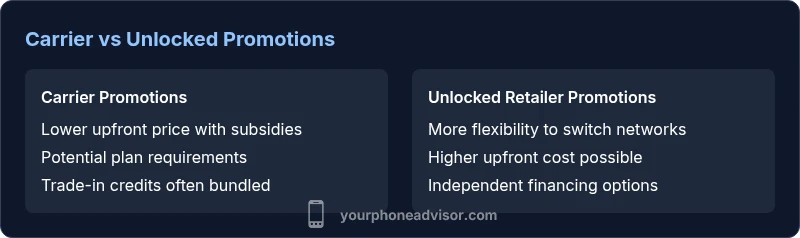
| Feature | Carrier-based promotions | Unlocked retailer promotions |
|---|---|---|
| Upfront device price | Lower upfront with carrier subsidy | Higher upfront, no network commitment |
| Financing terms | Subsidized financing via carrier | Financing via retailer/third-party lenders |
| Trade-in value | Often enhanced by carrier programs | Vary by retailer; may be standalone |
| Eligibility requirements | Plan enrollment and credit checks | No carrier commitment; account setup varies |
| Unlockability & portability | Typically locked to network during term | Easily unlocked after term or with device payment completed |
| Policies return/warranty | Carrier-specific policies | Retailer-specific; verify terms |
| Best for | Budget-conscious with current carrier | Flexibility and portability across networks |
The Good
- Potentially lower upfront costs with carrier subsidies
- Transparent monthly pricing with financing through the carrier
- Trade-in programs can boost device value
- Wide availability across carriers and retailers
Drawbacks
- Long-term price may be higher due to interest and service fees
- Device locking and plan requirements limit flexibility
- Promotions can be region- or account-specific
- Hidden costs like activation or upgrade fees
Unlocked retailer deals typically offer the best overall value for flexibility and future-proofing.
For most buyers, compare total cost of ownership across both options. If you value network portability and device freedom, choose unlocked retailer deals; otherwise, prefer carrier promotions for predictable monthly costs.
Got Questions?
What is total cost of ownership (TCO) in phone and tablet deals?
TCO includes upfront device price, monthly payments, data charges, protection plans, and any upgrade or activation fees over the term. It reflects what you actually pay over the device lifecycle, not just the initial price.
TCO includes upfront price, monthly costs, data charges, and any extra fees over the term, showing the real value of a deal.
Do I need to sign a contract to get good deals?
Not always. Some promotions rely on carrier contracts, while others reward flexibility with unlocked devices and retailer financing. Evaluate whether a term-length commitment matches your plans and usage.
Contracts aren’t always required. Weigh whether term commitments align with your needs and intended device lifecycle.
Can I get tablet deals that include a mobile plan?
Yes. Many promotions extend to tablets with cellular plans, often bundled with family data or shared plans. Confirm data allowances and whether pricing applies to the tablet only or includes the plan share.
Tablets can come with cellular plans in promos; check data sharing and pricing details.
Are refurbished or open-box devices a good deal?
Refurbished or open-box devices can offer substantial savings but come with different warranty terms. Always verify condition, battery health, and return policies before buying.
Refurbished can save money, but inspect warranty and return options first.
How important is trade-in value relative to upfront price?
Trade-in value can dramatically affect the effective price, but guard against artificially low assessments. Compare trade-in credits across promos and consider the overall impact on TCO.
Trade-in value can shift the value of a deal; compare credits and overall cost.
What is the best time to look for deals?
Seasonal peaks (back-to-school, holidays) and device launch cycles typically offer the strongest discounts. Start monitoring promos at least a month before you intend to buy.
Look for promos around back-to-school or holidays and watch for device launches.
What to Remember
- Compare total cost of ownership, not just upfront price
- Assess trade-in value and eligibility
- Check unlock status and future portability
- Factor activation fees and financing terms
- Time promotions around seasonal periods
- Use a simple rubric to compare across retailers