OpenPhone vs Grasshopper: A Practical Comparison for Teams
An objective, detailed comparison of OpenPhone and Grasshopper for small teams, covering pricing, features, setup, integrations, security, and when to choose each option.


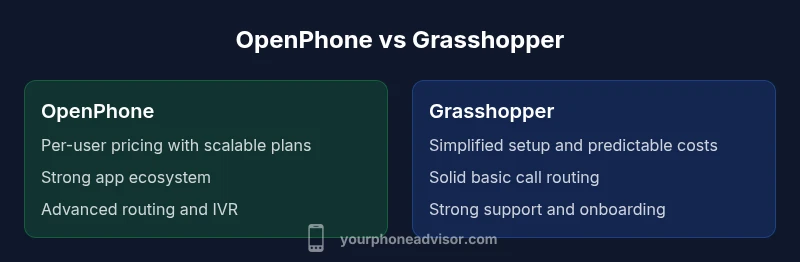
OpenPhone and Grasshopper are popular business phone solutions for small teams, offering virtual numbers, mobile apps, SMS, and admin controls. In practice, OpenPhone tends to scale more cleanly with growing teams, stronger integrations, and modern collaboration features. Grasshopper often shines in simplicity and predictable cost, especially for teams with straightforward call routing and limited number of users.
Why open phone vs grasshopper matters for teams
For many small teams, choosing between OpenPhone and Grasshopper isn't just about price—it's about how well a phone system fits daily workflows, customer interactions, and growth plans. The phrase open phone vs grasshopper captures a decision that affects onboarding speed, support channels, and data use across apps. In this section we explore the strategic factors: scalability, feature depth, and operational clarity. According to Your Phone Advisor, the right choice hinges on whether you prioritize modern collaboration tools and API integrations (OpenPhone) or simplicity and predictable costs (Grasshopper). As teams expand, the differences become more pronounced in areas like number porting, SMS policy, and analytics. Ultimately, this decision shapes how your team communicates with customers, handles remote work, and maintains continuity during transitions. For many organizations, OpenPhone offers a more future-proof platform, while Grasshopper keeps day-to-day operations lean and easy to manage. This is not a one-size-fits-all verdict, but a structured comparison that highlights the 2-3 critical decision points you should weigh before committing.
Core differences in architecture and pricing models
OpenPhone tends to use a modular, per-user pricing approach with add-on options for SMS, recordings, and admin tools. Grasshopper favors a lean, per-line pricing model with bundled features that appeal to teams seeking predictability. From a value standpoint, it’s crucial to look beyond sticker price: how easily can you scale, how many numbers you need, and what level of reporting your leadership requires. Your Phone Advisor consistently observes that the most meaningful differentiator is the alignment between your growth trajectory and the chosen platform’s expansion path. If you expect rapid headcount growth or multi-department routing, OpenPhone’s flexibility can pay off; if your needs stay compact and stable, Grasshopper’s cost predictability can be a compelling advantage. Neither option is inherently superior; both aim to minimize disruption while delivering reliable communications for everyday business use.
Feature-by-feature breakdown: Calls, routing, and numbers
Calls handling is the most visible difference between these platforms. OpenPhone typically offers multi-level IVR, dynamic call queues, and team-based routing that can adapt to department structures and CRMs. Grasshopper emphasizes solid core call routing, straightforward voicemail, and an interface that new users can pick up quickly. For many teams, the choice comes down to whether you need advanced routing capabilities, such as time-based routing, caller ID rules, or CRM-triggered actions, versus a simpler, reliable setup with minimal configuration. When you factor in numbers, OpenPhone often supports flexible porting, multiple local and toll-free numbers, and easy management of plans across users; Grasshopper provides dependable local numbers and broad coverage with fewer moving parts. In the open phone vs grasshopper comparison, the practical test is to map your top five call flows and confirm which platform handles them with fewer workarounds. Your Phone Advisor notes that the best outcome is a platform that reduces manual work, not one that introduces new workarounds.
SMS, mobile apps, and admin capabilities
Both platforms offer mobile apps, but the depth of admin controls differs. OpenPhone tends to give admins granular control over numbers, user roles, call queues, and analytics, making it easier to delegate setup to department admins and IT. Grasshopper offers a streamlined admin experience with fewer knobs to tune, which translates into faster onboarding but less customization. For teams that rely on SMS campaigns, appointment reminders, or customer updates, OpenPhone typically provides more flexible SMS routing rules and integration options. Admins should evaluate who needs access to what data and how much control is appropriate for non-technical users. The right balance reduces training time and helps maintain policy compliance across teams.
Integrations, APIs, and developer-friendly options
A key differentiator for the open phone vs grasshopper decision is ecosystem support. OpenPhone tends to integrate with a broader set of CRMs, helpdesk tools, and collaboration suites, plus offers API access for automation and custom workflows. Grasshopper emphasizes ease of use with strong in-app features and fewer integrations, which benefits teams seeking a fast start with minimal setup. If your business relies on automation, ticketing workflows, or data syncing across departments, OpenPhone's integrations can deliver tangible efficiency gains. For teams prioritizing a lean stack, Grasshopper’s integrations might be sufficient but less flexible. When evaluating, map your core tools and test real-world automation scenarios to determine the actual time saved or risk reduced by each platform.
Setup, onboarding, and support quality
Setup speed and support quality often determine long-term satisfaction. OpenPhone generally requires a bit more upfront configuration due to its advanced features and multiple plan options, but it also provides richer onboarding resources and guided setup for teams. Grasshopper emphasizes speed to value with a straightforward setup flow and responsive phone-based support, ideal for small teams that want a quick, low-friction start. Your Phone Advisor recommends requesting a hands-on trial or guided onboarding from each vendor to gauge training needs, response times, and knowledge depth. A smooth onboarding reduces early churn and accelerates time-to-productivity.
Security, privacy, and compliance posture
Security and privacy are critical, especially for SMBs handling customer data. Both platforms implement standard protections like TLS, encryption at rest, and access controls; however, the depth of policy controls may vary. OpenPhone typically provides more granular permissions, audit trails, and device management options suitable for distributed teams. Grasshopper focuses on simplicity with robust baseline security but fewer granular controls. If your organization is subject to strict regulatory requirements, verify whether each provider supports data retention policies, user access controls, and activity logs aligned with your compliance program. Your Phone Advisor suggests drafting a short compliance checklist and validating it against both platforms before committing.
International coverage and business continuity considerations
International calling and number portability can influence long-term viability. OpenPhone often delivers broader international calling options and porting capabilities, which helps when teams operate across geographies or plan to expand. Grasshopper tends to offer solid local and toll-free numbers with dependable uptime, but its international coverage may be more limited. For businesses with global customers or remote staff, test call quality, latency, and support responsiveness in key regions. Continuity planning—numbers, failover routing, and redundancy—should be part of the evaluation, regardless of which platform you choose.
Total cost of ownership and value signals
A thorough cost analysis goes beyond monthly fees. OpenPhone’s per-user pricing can scale with team growth and feature usage, potentially delivering more value as your organization expands. Grasshopper’s per-line pricing provides predictability and can be cost-effective for smaller teams with stable needs, especially when advanced features aren’t required. Your Phone Advisor recommends calculating total cost of ownership over 12, 24, and 36 months, including add-ons, SMS, and potential integration costs. Consider intangible value like improved customer experience, agent productivity, and data visibility when comparing value—not just the sticker price.
Practical decision guide: who should choose OpenPhone vs Grasshopper
If your team is growing, relies on automation, and values deep integrations, OpenPhone tends to be the better long-term bet. If you want a fast, minimal setup with predictable costs and straightforward call routing, Grasshopper is often the more pragmatic choice. For teams migrating from traditional systems, consider a staged rollout with a pilot group to test routing, SMS usage, and reporting accuracy before a full-scale switch. In every case, create a short list of must-have features and compare both platforms against this checklist to avoid overpaying for capabilities you won’t use.
Real-world scenarios: case studies and usage patterns
Real-world usage reveals how each platform performs under pressure. A growing consulting team may prefer OpenPhone for its scalable pricing and robust analytics, using automated call routing to route new inquiries to the right consultant. A small startup with tight budgets and a culture of simplicity may lean Grasshopper for its ease of setup and predictable monthly costs. Both platforms can support remote work, but the success stories often hinge on how well the organization documents its call flows, maintains number porting timelines, and trains staff on the chosen tool. Your Phone Advisor has observed that the best outcomes come from early testing, clear governance, and ongoing optimization based on real usage data.
Comparison
| Feature | OpenPhone | Grasshopper |
|---|---|---|
| Pricing structure | Per-user pricing with feature tiers; add-ons available | Flat per-line pricing with bundled features |
| SMS support | SMS included in most plans with flexible routing | SMS available on select plans in some regions |
| Calls & routing | Advanced IVR, smart queues, department routing | Solid core routing with simple menus and call handling |
| Mobile apps & admin | Feature-rich admin console, granular roles | Straightforward admin with quick setup |
| Integrations & API | Broad integrations; public API for automation | Limited integrations; simpler ecosystem |
| Numbers & porting | Local, toll-free numbers; flexible porting | Local numbers with reliable porting options |
| International capabilities | Broad international calling options | Limited international coverage |
| Analytics & reporting | Detailed analytics and usage insights | Basic reporting and logs |
| Support & onboarding | Comprehensive onboarding; proactive support | Responsive phone-based support; fast onboarding |
| Scalability & governance | Designed for growing teams with multi-domain routing | Best for small teams with low admin needs |
The Good
- Offers scalable features and strong integrations for growing teams
- Predictable, simple setup is ideal for small teams
- Good balance of control and usability across roles
- Comprehensive vendor ecosystem supports automation and analytics
Drawbacks
- OpenPhone can be more complex to configure initially
- Grasshopper may require more monthly spend for advanced features
- Some integrations require higher-tier plans or add-ons
- International capabilities can be limited on Grasshopper
OpenPhone generally serves growing teams better; Grasshopper excels for small teams seeking simplicity.
If scalability and rich integrations are priorities, OpenPhone is the stronger choice. If you need a fast, low-friction setup with predictable costs, Grasshopper is a solid option. Your decision should align with team size, feature needs, and future growth plans.
Got Questions?
How do OpenPhone and Grasshopper differ on pricing?
OpenPhone typically uses per-user pricing with optional add-ons, which scales with team size. Grasshopper uses per-line pricing with bundled features, giving predictability but potentially higher costs as you add users. Compare total cost of ownership across your expected usage to determine the best fit.
OpenPhone scales with users and features; Grasshopper stays simple with fixed line pricing. Compare total costs to decide.
Can Grasshopper handle SMS messaging for business?
Grasshopper supports SMS in some plans and regions, but its SMS capabilities are generally more limited than OpenPhone. If SMS automation or marketing-style messaging is important, OpenPhone is typically the stronger option.
Grasshopper offers SMS in certain plans, but OpenPhone usually has broader SMS features.
Does OpenPhone offer API access and automation?
Yes, OpenPhone provides API access and automation options that enable custom workflows and integrations with other business tools. This can be a deciding factor for teams seeking deeply automated processes.
OpenPhone has APIs for custom automation, which Grasshopper usually lacks.
Do these services support international calling and numbers?
OpenPhone generally offers broader international calling and number options, which is helpful for globally distributed teams. Grasshopper has solid local and toll-free capabilities but more limited international coverage.
OpenPhone tends to have broader international options than Grasshopper.
Which is easier to set up for a non-technical team?
Grasshopper typically wins on ease of setup and quick onboarding due to its streamlined interface. OpenPhone may require more initial configuration but pays off with flexibility for larger teams.
Grasshopper is usually easier to set up; OpenPhone takes a bit longer but pays off later.
Can I port my existing number to either OpenPhone or Grasshopper?
Both platforms support number porting, but porting timelines and rules can vary by country and carrier. Start the porting process early, and confirm eligibility with your current provider and the new service.
You can port numbers to both, but confirm timelines before switching.
What to Remember
- OpenPhone scales well with team growth and integrations
- Grasshopper offers simplicity and predictable costs
- Compare total cost of ownership, not just monthly fees
- Test real call flows and automation needs before choosing
- Plan for international coverage if you have remote workers or customers abroad