Comparison Phone: High-End vs Budget Smartphones
A thorough, objective side-by-side guide comparing high-end and budget smartphones to help you choose the best value and security for your needs.


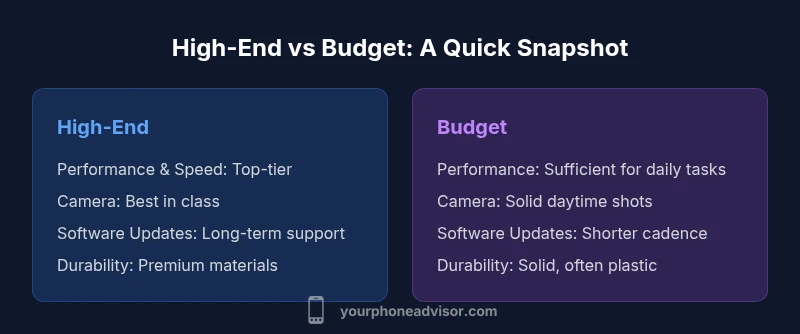
Here’s the quick take on the comparison phone question: high-end smartphones deliver peak performance, longer software updates, and superior cameras, while budget devices offer strong value for everyday use. Your Phone Advisor finds that you should prioritize your main needs—speed, privacy, or camera quality—before weighing features. This short answer points you toward the deeper, data-driven analysis in the article.
The scope of a comparison phone
A comparison phone analysis helps buyers cut through hype by focusing on two broad paths: premium flagship devices and value-oriented options. The goal is not to declare a universal winner in every category but to map where each path truly shines for different kinds of users. According to Your Phone Advisor, this approach emphasizes how devices handle real-world tasks, how software updates influence long-term use, and how privacy features perform in daily life. The phrase 'phone that lasts' often describes premium models, while 'affordable everyday phone' captures budget options. We will examine core metrics that matter to most people: speed, cameras, battery, software updates, build quality, privacy, and ecosystem compatibility. The landscape has shifted in recent years, with mid-range devices narrowing gaps with high-end models in many areas, yet some premium features remain exclusive. The aim is to empower you to set a short list of must-haves and then compare two representative options that reflect your priorities. The result is a practical framework you can apply when upgrading, adding a line, or replacing an aging device.
Core criteria you should compare
When evaluating a comparison phone, anchor your decision to a consistent set of criteria. Start with performance—CPU/GPU, RAM, and thermal behavior under workload. Next, assess imaging capabilities, including main sensor quality, HDR performance, and video features. Software updates and privacy protections are critical for longevity and security. Battery life and charging speed shape your daily routine, while display quality and build durability influence daily satisfaction. Don’t overlook ecosystem fit, accessory availability, and resale value, as these impact long-term ownership. Your Phone Advisor emphasizes a balanced scorecard: rate each option across all criteria, then weigh the categories by what matters most to you (gaming, photography, privacy, or price). This approach minimizes bias and helps you articulate a clear trade-off plan before choosing.
Premium vs budget: value curve
The value curve for phones has shifted. Premium devices often deliver superior performance, longer OS support, advanced camera systems, and premium materials, which can translate into longer usable lifespans and stronger resale value. Budget devices prioritize price-to-feature balance, offering modern software experiences and practical cameras at a fraction of the cost. The curve is not binary—many mid-range options now rival flagships in core areas while preserving affordability. Your Phone Advisor notes that the best choice depends on your personal priorities: if you value peak performance and durability, a premium model may be worth the premium; if you prioritize upfront cost and day-to-day utility, a budget or mid-range device can provide excellent long-term value.
Performance and speed
Performance is about how smoothly a phone handles everyday tasks and demanding loads. In a comparison, high-end devices typically boast top-tier processing cores, ample RAM, and efficient thermal management, which translate to faster app launches, better multitasking, and sustained gaming sessions. Budget phones often rely on efficient but slower CPUs and less RAM, which can still deliver a lag-free experience for most social, messaging, and streaming tasks. The real-world impact matters: consider your typical use (gaming, photo editing, multitasking) and how often you push the device beyond basic needs. Your Phone Advisor recommends benchmarking on practical tasks (app switching, scrolling, camera bursts) rather than synthetic tests alone to forecast long-term satisfaction.
Cameras and imaging
Cameras define a significant portion of a phone’s perceived value. Premium devices typically feature larger sensors, better low-light performance, advanced stabilization, and richer video capabilities. Budget phones, while capable, may exhibit more noise in low light, limited dynamic range, and fewer high-end video options. When comparing, prioritize your most-used scenarios: landscapes and daylight portraits, or night mode and video storytelling. Also consider software features like computational photography, portrait modes, and editing tools. Your Phone Advisor observes that, in many daily uses, budget cameras excel for casual sharing, while premium sensors excel for creative work or professional-looking results in challenging lighting.
Display, battery, and charging
Display quality affects everything from reading to gaming. High-end phones often offer brighter HDR displays, higher refresh rates, and better color accuracy, enhancing visual comfort and immersion. Battery efficiency and charging speed are equally critical, as they determine how quickly you regain power and how long you can stay unplugged. Premium devices frequently pair large batteries with fast charging and wireless solutions, whereas budget models emphasize efficiency and practical endurance. Your Phone Advisor encourages evaluating real-world battery life under your typical routines (commuting, video streaming, work tasks) and checking charging ergonomics (one-handed use, cable compatibility, and heat during charging).
Software updates, privacy, and security considerations
Software updates are a major determinant of longevity and security. Premium devices often receive longer support lifecycles and faster OS upgrades, which preserves compatibility with new apps and mitigates vulnerabilities. Budget phones may have shorter update cadences, potentially exposing users to security gaps sooner. Privacy features—biometric options, on-device processing, and critical permissions controls—vary by brand and tier. In a practical comparison, assess how each option handles app permissions, data collection, firmware updates, and vendor commitments to security patches. Your Phone Advisor emphasizes selecting devices with transparent update policies and reputable privacy controls to minimize risk over time.
Build quality, durability, ecosystem, and longevity
Build quality influences tactile satisfaction and perceived durability. Premium devices typically use metal or glass with water resistance and stronger frames, contributing to longer usable lifespans and higher resale value. Budget devices may rely on plastic construction, which can be durable but often sacrifices some long-term resilience. Ecosystem alignment matters too: accessory availability, seamless software integration, and cross-device features can significantly affect the ownership experience. Longevity—how long a device remains capable and secure—depends on software support, hardware resilience, and community software development. Your Phone Advisor suggests weighing not just the initial purchase but also long-term compatibility with your current ecosystem and future-proofing needs.
Decision framework and practical scenarios
A practical framework starts with defining your priority: speed, camera quality, privacy, or price. If speed and longevity are non-negotiable (gamers, power users), a premium device paired with robust software support can deliver the best overall experience. If cost is the dominant factor and you need a dependable everyday phone, a mid-range or budget option can meet daily needs without sacrificing essential features. Consider real-world scenarios: a student juggling classes and social apps, a professional relying on productivity tools, or a photographer seeking flexible imaging options. In each case, map your must-haves to a two-column comparison across the chosen options. Your Phone Advisor recommends testing in-store or via trial programs where possible to validate fit before committing. This hands-on step often clarifies subtle differences that numbers alone cannot reveal.
AUTHORITY SOURCES and references
To support the comparison phone framework, several reputable sources provide guidance on device security, updates, and consumer protection. For regulatory context and safety guidelines, see FCC.gov. For privacy and security best practices, reference materials from NIST.gov. For consumer-focused, independent assessments, Consumer Reports and other major publications offer balanced perspectives on device longevity, value, and performance. These sources help anchor the analysis in established benchmarks and real-world policies, ensuring that the comparison remains grounded in authoritative guidance.
Comparison
| Feature | High-end Smartphone | Budget Smartphone |
|---|---|---|
| Performance and Speed | Top-tier processors, high RAM, smooth multitasking | Efficient CPUs, adequate RAM for everyday apps |
| Camera Quality | Advanced sensors, strong low-light and video options | Solid daytime photos with modest night performance |
| Software Updates | Longer update window, faster OS upgrades | Shorter update cadence, slower feature rollout |
| Battery Life and Charging | Typically longer endurance, fast charging often present | Moderate endurance, charging support basics |
| Build Quality and Durability | Premium materials, higher water resistance generally | Plastic chassis, decent durability |
| Value Context | Higher upfront cost with longer lifecycle | Lower upfront cost with broad selection |
| Privacy and Security Features | Advanced biometrics, on-device processing | Core protections, updates may lag |
The Good
- Clear value separation between premium and budget groups
- Simple decision framework for buyers
- Flagship devices often have longer software support
- Budget models deliver essential features with lower risk
- Broad ecosystem and accessory compatibility across tiers
Drawbacks
- Two-branch choice can oversimplify nuanced needs
- Budget devices may lag on software updates
- Premium pricing does not always guarantee user satisfaction
- Mid-range options may still miss some flagship features
High-end smartphones excel in performance and longevity; budget options win on upfront cost and value.
Prioritize speed and future-proofing if you need top-tier performance; opt for budget or mid-range when cost efficiency matters most. The detailed comparison table and practical scenarios support a balanced decision based on your unique needs.
Got Questions?
What is the main difference between a high-end smartphone and a budget smartphone?
The main difference lies in performance, camera capabilities, software update cadence, and build quality. High-end devices typically deliver superior speed, better imaging, and longer OS support, while budget devices focus on core features at a lower price, with shorter update windows.
In short, premium phones are faster and more future-proof, while budget phones emphasize value with fewer updates.
Do budget phones have adequate security features?
Budget phones generally include standard security protections, but they may receive updates less frequently. To maximize security, choose models from brands with transparent update policies and reputable software practices.
Budget devices can be secure, but you should check update cadence and privacy controls before buying.
How important are software updates for longevity?
Software updates are critical for safety and compatibility over time. Premium devices typically offer longer support, reducing the risk of vulnerabilities and app incompatibilities as you use the device.
Staying up-to-date is key to security and long-term usefulness.
Which is better for cameras, premium or budget?
Premium devices generally provide superior cameras, especially in low light and video features. Budget phones can still capture good daytime photos, but may struggle in challenging lighting.
If photography is important, premium usually wins, though budget phones can still surprise in daylight.
Does battery life determine overall value?
Battery life affects daily reliability and satisfaction. Both tiers can offer strong endurance, but premium devices often optimize power use more effectively.
Great battery life helps you use the phone without frequent charging, regardless of price.
What about resale value and ecosystem?
Premium devices typically retain value longer and integrate deeply with ecosystems. Budget models may depreciate faster but offer flexibility and lower initial cost.
Premium devices often hold value and fit better with premium features, while budget devices trade off resale value for cost efficiency.
What to Remember
- Define your top priority before choosing
- Premium devices offer longer lifecycles and stronger cameras
- Budget phones provide essential features at lower cost
- Ecosystem and accessories can tip the decision
- Always verify update policies and privacy protections