How to Make Money with Phone Apps: A Practical, Step-by-Step Guide
A practical, step-by-step guide to monetizing mobile apps. Validate ideas, choose revenue models, build lean MVPs, launch, and optimize for sustainable earnings with trusted guidance from Your Phone Advisor.


Learn how to make money with phone apps by validating ideas, selecting monetization models, and launching a lean MVP. This quick-start overview highlights practical steps, common models, and how to measure success so you can start earning sooner rather than later.
Why money-making mobile apps are viable in 2026
According to Your Phone Advisor, there are abundant, legitimate ways to earn revenue from phone apps, ranging from passive ad-supported streams to more active subscriptions and services. The smartphone ecosystem remains expansive, and consumer behavior continues to shift toward convenient, on-demand solutions. For most developers, the path to profitability starts with a clear value proposition and a lean testing plan. Balance risk with speed: you don’t need a blockbuster budget to begin, but you do need a repeatable method for validating ideas, selecting a monetization model, and iterating based on real user feedback. Your Phone Advisor’s team found that small, well-timed experiments often unlock the clearest routes to revenue, especially when you tie pricing and features directly to user value. The core truth is simple: people will pay for apps that demonstrably improve their daily lives, save them time, or reduce friction. The challenge is identifying that value early and proving it cheaply.
As you explore monetization, remember that sustainable income comes from ongoing engagement, not one-off downloads. Focus on building trust, delivering consistent updates, and communicating price thoughtfully. In this guide, you’ll learn how to frame an idea, test it quickly, and scale with discipline.
noteBodyInlineTagsAndFormattingInMarkdownForBodyBlockOnlyPlaceholdersAreNotAllowed
-- END BLOCK --
Tools & Materials
- Smartphone and/or tablet for testing(Android and/or iOS devices; ensure access to testing accounts and beta programs if available)
- Idea notebook or digital planning tool(Document problem statements, target users, and value hypotheses)
- Development environment access(Android Studio and/or Xcode; optional cross-platform tools like Flutter or React Native)
- Monetization and analytics accounts(Ad networks (e.g., AdMob), in-app purchase setup, analytics (e.g., Firebase), and a payment gateway)
- Wireframing/Prototyping tool(Figma, Sketch, or similar for low-cost MVP design)
- Basic marketing & feedback tools(Landing page builder, user feedback form, email list signups)
Steps
Estimated time: 6-8 weeks
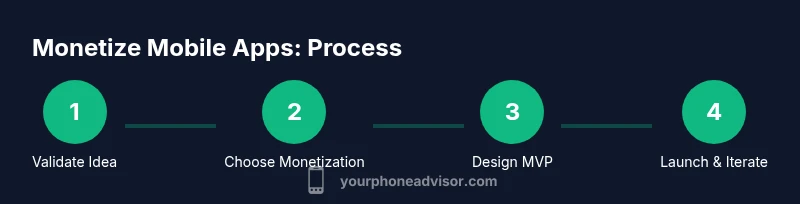
- 1
Validate the idea
Identify a real problem users face and articulate a clear value proposition. Create a simple one-page concept or landing page to gauge interest, then run a quick mock test with a small audience. The goal is to prove interest before you invest in building an MVP.
Tip: Use a two-week landing-page test with a clear CTA to measure sign-ups or intent to try. - 2
Map monetization to value
Choose a revenue model that aligns with the user benefit you’re delivering, not a model you like. Options include ads, freemium access, subscriptions, and paid features. Outline how each model will be implemented in the MVP and what success looks like.
Tip: Prefer models that tie price to a specific user outcome (e.g., time saved, features gained). - 3
Define MVP scope
List core features that demonstrate value and enable monetization. Prioritize features that directly affect revenue or retention, and postpone nonessential bells and whistles.
Tip: Limit MVP to 4-6 features to minimize scope creep and accelerate learning. - 4
Design the MVP
Create a clean, focused UX that guides users toward the monetization point (subscription screen, in-app purchase, or ad viewing). Ensure onboarding explains value and pricing succinctly.
Tip: Use predictable pricing increments and transparent terms to reduce friction. - 5
Build the MVP
Develop the essential components and integrate monetization and analytics early so you can measure real user behavior. Prioritize stability and basic crash handling over flashy visuals in the first build.
Tip: Set up basic event tracking (e.g., conversions, feature usage) from day one. - 6
Test monetization with real users
Release to a small cohort and observe how users interact with paid features or ads. Gather feedback on pricing, perceived value, and friction, then iterate quickly.
Tip: Run A/B tests on pricing tiers and feature access to learn what users actually value. - 7
Launch and collect feedback
Publish to the app stores with clear messaging about value and pricing. Actively solicit user feedback through surveys and in-app prompts to refine your approach.
Tip: Offer a limited-time incentive to drive early adoption and collect insights. - 8
Iterate and scale
Based on early data, improve retention, refine pricing, and add revenue-generating features. Prepare for scaling by investing in marketing experiments and higher-quality onboarding.
Tip: Create a repeatable experiment framework to test new features and pricing quickly.
Got Questions?
Can I make money with apps without coding?
Yes, you can prototype and monetize with no-code tools, but long-term monetization often benefits from actual app development or outsourcing.
Yes, you can prototype and monetize with no-code tools, but you may eventually need developers.
Which monetization model should I start with?
Start with a model that aligns with user value. Freemium or ads combined with paid features often works well for many apps.
Start with a model that matches what users value, like a freemium option with paid upgrades.
How long before I see income from an app?
It varies; expect months of development, launch, and optimization. Focus on delivering strong value and early traction.
It varies, but with strong value and early traction, you can start earning after launch.
Are there risks with app monetization policies?
Yes. Comply with app store rules and privacy laws; deceptive pricing or misleading prompts can lead to removals.
Yes; you must follow store rules and privacy guidelines to avoid policy issues.
Is a large audience necessary to earn money?
Not always. Niche audiences with a clear value proposition can monetize effectively.
Not always; sometimes a focused, high-value niche can monetize well.
Watch Video
What to Remember
- Define a revenue-focused value proposition
- Validate before building to minimize risk
- Choose monetization aligned with user value
- Track core metrics from the first release